
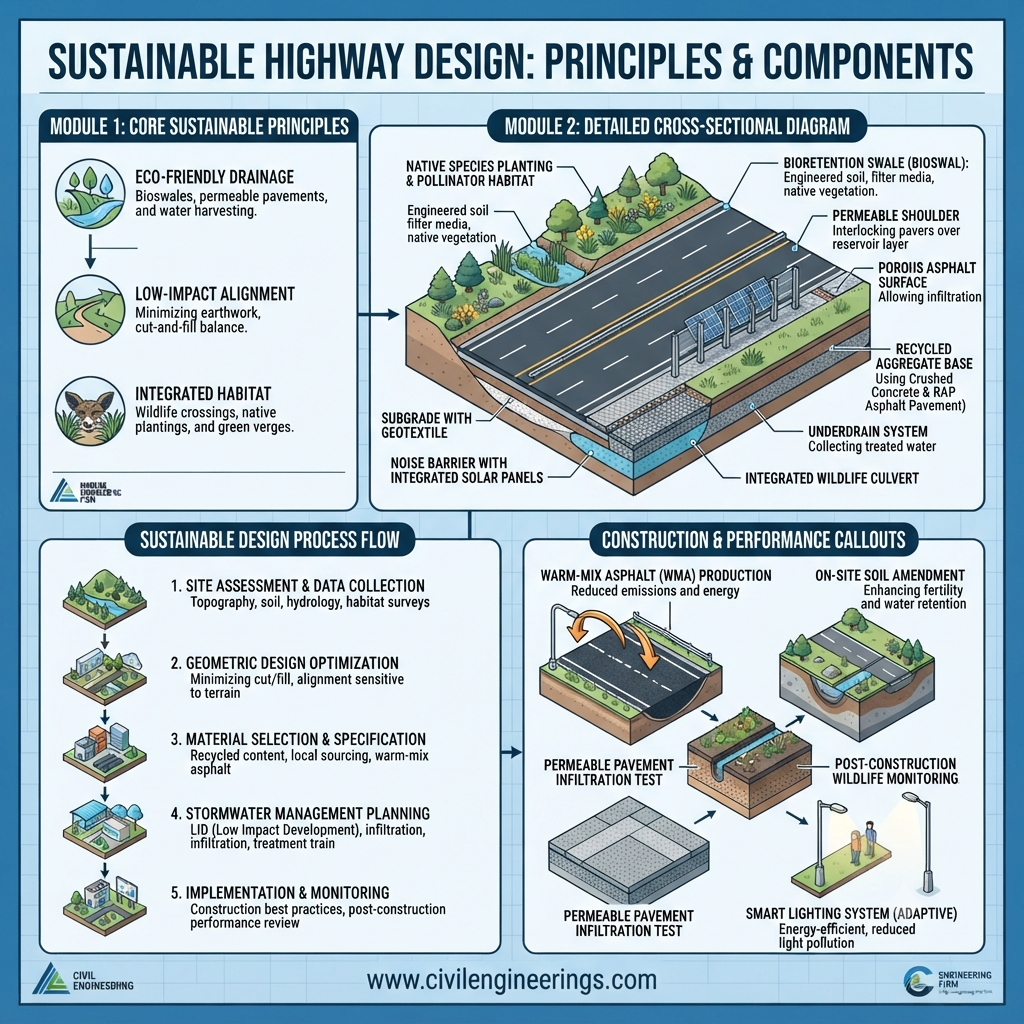
Introduction
Roads are among the most important assets of any nation. They connect cities, support economic growth, improve accessibility, and strengthen trade networks. However, conventional highway construction often consumes enormous amounts of natural resources, generates greenhouse gas emissions, and affects ecosystems. As climate change, environmental regulations, and infrastructure demands continue to grow, engineers must rethink how highways are planned, designed, built, and maintained.
Sustainable Highway Design has emerged as a modern engineering approach that balances transportation efficiency with environmental protection, economic viability, and social responsibility. Instead of focusing only on construction costs, sustainable design considers the entire lifecycle of a highway—from route planning and material selection to maintenance, rehabilitation, and eventual reconstruction.
This comprehensive guide explains the principles, objectives, design process, engineering considerations, sustainable materials, drainage systems, climate resilience, environmental protection measures, and international best practices related to sustainable highways. Whether you are a civil engineering student, highway engineer, contractor, consultant, researcher, or government professional, this article provides practical knowledge that can improve project performance while reducing environmental impact.
What is Sustainable Highway Design?
Sustainable Highway Design is the process of planning, designing, constructing, operating, and maintaining highways while minimizing environmental impacts and maximizing long-term economic and social benefits.
Unlike traditional highway engineering, sustainable design evaluates the entire infrastructure lifecycle rather than focusing solely on initial construction costs.
It integrates:
- Environmental sustainability
- Economic efficiency
- Social responsibility
- Resource conservation
- Climate resilience
- Long-term performance
The goal is to provide safe, durable, and efficient transportation infrastructure without compromising future generations’ ability to meet their own needs.
Why Sustainable Highway Design Matters
Transportation infrastructure contributes significantly to carbon emissions, energy consumption, land disturbance, and resource depletion.
Sustainable highway engineering addresses these concerns by:
- Reducing greenhouse gas emissions
- Conserving natural resources
- Protecting biodiversity
- Lowering maintenance costs
- Improving resilience against extreme weather
- Enhancing road user safety
- Supporting sustainable urban development
Many governments now prioritize sustainable infrastructure because it offers long-term financial and environmental benefits.
Core Principles of Sustainable Highway Design
Successful sustainable highway projects follow several engineering principles.
1. Lifecycle Thinking
Engineers evaluate the complete lifespan of the highway rather than only construction expenses.
This includes:
- Planning
- Design
- Construction
- Maintenance
- Rehabilitation
- End-of-life recycling
2. Resource Efficiency
Efficient use of materials reduces waste and lowers project costs.
Examples include:
- Optimized earthwork
- Recycled aggregates
- Warm mix asphalt
- Fly ash concrete
- Industrial by-products
3. Environmental Protection
Highway projects should minimize damage to:
- Forests
- Wetlands
- Rivers
- Wildlife habitats
- Agricultural land
Environmental Impact Assessments (EIAs) play an important role during project planning.
4. Social Sustainability
Highways should improve quality of life by providing:
- Safe transportation
- Better accessibility
- Reduced traffic congestion
- Noise mitigation
- Pedestrian and cyclist facilities
5. Economic Sustainability
Lower lifecycle costs are often more valuable than lower initial construction costs.
Durable pavements and preventive maintenance reduce future expenditures.
Objectives of Sustainable Highway Design
Major objectives include:
- Minimize environmental degradation
- Improve pavement durability
- Reduce carbon footprint
- Increase energy efficiency
- Promote recycling
- Protect natural ecosystems
- Improve public safety
- Enhance climate resilience
- Optimize maintenance strategies
- Maximize return on infrastructure investment
Planning Phase Considerations
Sustainability begins long before construction starts.
Important planning activities include:
Route Selection
Choose alignments that:
- Avoid environmentally sensitive areas
- Minimize earthwork
- Reduce property acquisition
- Preserve natural drainage
Traffic Forecasting
Accurate traffic prediction prevents under-designed or over-designed highways.
Traffic studies include:
- Average Daily Traffic (ADT)
- Design Hour Volume (DHV)
- Vehicle classification
- Future growth projections
Environmental Assessment
Environmental studies evaluate:
- Air quality
- Noise levels
- Water resources
- Flora and fauna
- Cultural heritage
- Soil conditions
Sustainable Geometric Highway Design
Efficient geometric design improves both safety and sustainability.
Important considerations include:
Horizontal Alignment
Proper curvature reduces:
- Fuel consumption
- Tire wear
- Vehicle emissions
Vertical Alignment
Balanced gradients help heavy vehicles consume less fuel while maintaining operational safety.
Cross Section Design
Typical components include:
- Traffic lanes
- Shoulders
- Median
- Drainage channels
- Side slopes
- Utility corridors
Optimized cross sections reduce construction material requirements.
Environmentally Friendly Pavement Design
Pavement selection significantly affects sustainability.
Flexible Pavement
Advantages include:
- Easier maintenance
- Higher recyclability
- Lower construction time
Rigid Pavement
Benefits include:
- Longer service life
- Lower maintenance frequency
- Better heavy-load performance
Permeable Pavements
Permeable surfaces:
- Reduce runoff
- Improve groundwater recharge
- Minimize urban flooding
Sustainable Construction Materials
Material selection has a major influence on environmental performance.
Recycled Asphalt Pavement (RAP)
RAP reduces:
- Virgin aggregate consumption
- Asphalt binder usage
- Construction waste
Recycled Concrete Aggregate (RCA)
Crushed concrete can replace natural aggregates in many pavement layers.
Fly Ash
Fly ash improves:
- Concrete durability
- Workability
- Sulfate resistance
It also lowers cement consumption.
Ground Granulated Blast Furnace Slag (GGBS)
GGBS enhances:
- Long-term strength
- Chemical resistance
- Durability
Warm Mix Asphalt
Compared to conventional hot mix asphalt, warm mix asphalt:
- Requires lower production temperatures
- Reduces fuel consumption
- Produces fewer emissions
- Improves worker safety
Water Management and Drainage
Water remains one of the greatest threats to pavement performance.
A sustainable drainage system should include:
- Side drains
- Culverts
- Catch basins
- Bio-swales
- Retention ponds
- Infiltration trenches
Proper drainage extends pavement life while protecting nearby water bodies.
Climate-Resilient Highway Design
Changing climate conditions require stronger infrastructure planning.
Engineers now design highways to withstand:
- Extreme rainfall
- Flooding
- Heat waves
- Freeze-thaw cycles
- Landslides
- Coastal erosion
Climate adaptation measures include:
- Higher embankments
- Improved drainage capacity
- Heat-resistant asphalt
- Erosion control systems
- Slope stabilization
- Flood-resistant bridges
Environmental Protection Measures
Sustainable highways incorporate several environmental mitigation strategies.
These include:
Wildlife Crossings
Overpasses and underpasses allow animals to cross highways safely.
Noise Barriers
Noise walls reduce traffic noise near residential communities.
Erosion Control
Engineers use:
- Geotextiles
- Riprap
- Vegetation
- Retaining structures
- Mulching
to stabilize exposed soil.
Green Landscaping
Native vegetation:
- Controls erosion
- Improves aesthetics
- Supports biodiversity
- Reduces maintenance requirements
Smart Technologies in Sustainable Highways
Modern highways increasingly integrate intelligent transportation systems.
Examples include:
- Smart traffic sensors
- AI-based traffic monitoring
- Adaptive signal control
- Solar-powered lighting
- Weather monitoring stations
- Intelligent pavement monitoring
- Connected vehicle infrastructure
These technologies improve efficiency while reducing fuel consumption and emissions.
Lifecycle Cost Analysis (LCCA)
Lifecycle Cost Analysis evaluates all project costs over the highway’s operational life.
Typical cost components include:
- Initial construction
- Routine maintenance
- Rehabilitation
- User delay costs
- Energy consumption
- Disposal or recycling
LCCA helps engineers select the most cost-effective sustainable solution rather than the cheapest initial option.
Practical Recommendations for
Highway Engineers
- Perform detailed lifecycle assessments during design.
- Prioritize durable and recyclable materials.
- Integrate climate adaptation measures into every project.
- Monitor pavement performance using digital technologies.
Contractors
- Minimize construction waste through recycling.
- Reduce fuel use by optimizing equipment operations.
- Follow environmental management plans on site.
- Protect nearby ecosystems during construction.
Civil Engineering Students
- Study sustainability rating systems.
- Learn pavement recycling techniques.
- Understand environmental regulations.
- Gain practical experience with modern design software and BIM tools.
Best Practices from IRC, AASHTO, and ICE
Leading engineering organizations promote sustainable highway development through established principles and guidance.
IRC (Indian Roads Congress) emphasizes environmentally responsible road planning, efficient pavement design, proper drainage, road safety, and maintenance practices suited to local conditions.
AASHTO (American Association of State Highway and Transportation Officials) supports lifecycle cost analysis, resilient infrastructure, context-sensitive design, and sustainable material selection to improve long-term highway performance.
ICE (Institution of Civil Engineers) encourages carbon reduction, circular economy principles, whole-life asset management, and infrastructure resilience as part of sustainable transportation development.
While project requirements differ by country, these organizations share a common objective: delivering highways that remain safe, economical, durable, and environmentally responsible throughout their service life.
Advantages of Sustainable Highway Design
- Lower lifecycle costs
- Reduced greenhouse gas emissions
- Longer pavement life
- Improved environmental protection
- Better resilience against climate change
- Efficient use of natural resources
- Enhanced road safety
- Reduced maintenance frequency
- Improved public acceptance
- Higher infrastructure value
Challenges of Sustainable Highway Design
- Higher initial investment
- Limited availability of recycled materials
- Complex environmental approval processes
- Need for skilled professionals
- Changing climate uncertainties
- Limited awareness in developing regions
- Higher planning requirements
- Difficulty in balancing environmental and economic objectives
Frequently Asked Questions (FAQs)
1. What is Sustainable Highway Design?
It is the practice of designing highways that balance environmental, economic, and social considerations while ensuring long-term infrastructure performance.
2. Why is sustainability important in highway engineering?
Sustainability reduces environmental impacts, lowers lifecycle costs, conserves resources, and improves infrastructure resilience.
3. Which materials are commonly used in sustainable highways?
Recycled asphalt pavement, recycled concrete aggregate, fly ash, GGBS, warm mix asphalt, and other recycled construction materials.
4. What is Lifecycle Cost Analysis?
Lifecycle Cost Analysis compares all costs associated with a highway during its entire service life rather than only initial construction expenses.
5. How does proper drainage improve sustainability?
Effective drainage prevents pavement damage, reduces maintenance needs, protects surrounding ecosystems, and extends road life.
6. What role does climate resilience play in highway design?
Climate-resilient design helps highways withstand flooding, heat, erosion, landslides, and other extreme weather events.
7. How do intelligent transportation systems support sustainable highways?
They improve traffic flow, reduce congestion, lower fuel consumption, enhance safety, and minimize vehicle emissions.
8. Which professionals benefit from learning sustainable highway design?
Civil engineers, transportation engineers, contractors, consultants, researchers, government agencies, and infrastructure planners all benefit from sustainable design knowledge.
9. Can sustainable highways reduce maintenance costs?
Yes. Durable materials, efficient drainage, and proactive maintenance strategies significantly reduce long-term repair expenses.
10. Are sustainable highways more expensive?
Initial costs may be slightly higher, but lower maintenance expenses, longer service life, and improved environmental performance often make them more economical over time.
Conclusion
Sustainable Highway Design is transforming the future of transportation infrastructure by combining sound engineering practices with environmental stewardship and economic efficiency. Modern highways must do more than carry traffic—they should conserve resources, withstand changing climate conditions, protect ecosystems, and deliver long-term value to society. Achieving these outcomes requires thoughtful planning, resilient geometric design, durable pavements, responsible material selection, efficient drainage, and intelligent asset management throughout the infrastructure lifecycle.
For engineers, contractors, consultants, and students, sustainability is no longer an optional consideration; it is an essential part of professional highway engineering. By applying lifecycle thinking, adopting recycled and low-carbon materials, embracing digital technologies, and following recognized guidance from organizations such as IRC, AASHTO, and ICE, transportation professionals can create safer, more durable, and environmentally responsible road networks. Investing in Sustainable Highway Design today will help build infrastructure that supports economic development, improves mobility, and preserves natural resources for future generations.

Kamran Malik is a passionate civil engineering writer and researcher who specializes in construction, transportation, structural engineering, and infrastructure topics. Through his articles on CivilEngineerings.com, he simplifies complex engineering concepts and shares practical insights, industry trends, and educational resources for students, professionals, and engineering enthusiasts.