
Introduction
Every successful road, highway, airport runway, or pavement begins with one critical question: Can the ground safely support the expected traffic load? If the answer is uncertain, even the best-designed pavement may develop cracks, rutting, settlement, or premature failure. That is why engineers perform soil strength tests before starting construction, and one of the most trusted methods is the California Bearing Ratio (CBR) test.
Understanding What is California Bearing Ratio CBR is essential for civil engineering students, highway engineers, contractors, consultants, and infrastructure professionals involved in pavement design and road construction. This simple yet highly effective laboratory and field test evaluates the load-bearing capacity of subgrade soil and helps engineers determine the appropriate pavement thickness for long-lasting performance.
In this comprehensive guide, you will learn the definition of California Bearing Ratio, its history, engineering principles, testing procedure, calculation method, influencing factors, practical applications, advantages, limitations, and recommendations based on widely accepted practices followed by organizations such as IRC, AASHTO, and ICE. Whether you are preparing for engineering exams or working on a real construction project, this article will strengthen your understanding of one of highway engineering’s most important soil tests.
What is California Bearing Ratio (CBR)?
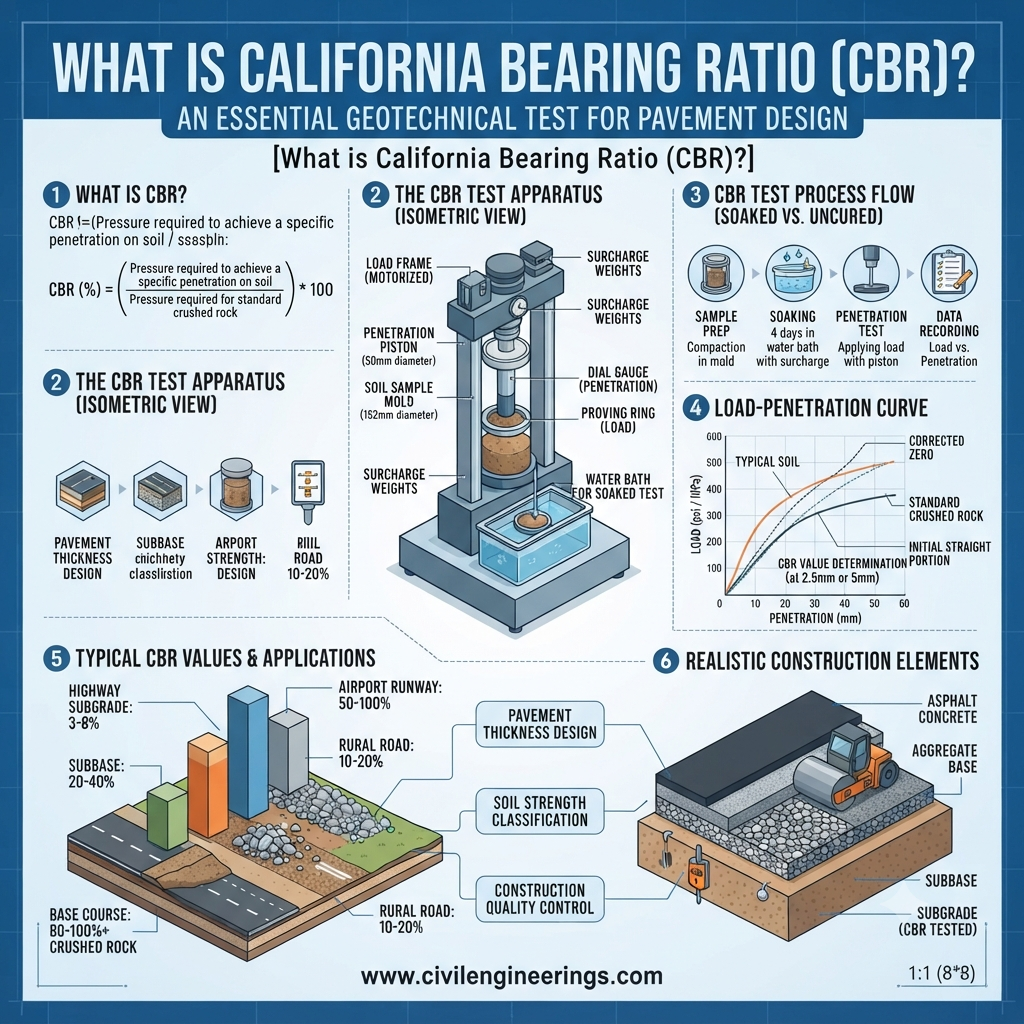
The California Bearing Ratio (CBR) is a standardized penetration test used to evaluate the strength of subgrade soil, sub-base, and base materials for pavement design. It measures the resistance of soil against the penetration of a standard plunger under controlled loading conditions.
The CBR value is expressed as a percentage and compares the measured penetration resistance of a soil sample with the resistance of high-quality crushed stone, which serves as the standard reference material.
The basic equation is:
CBR (%) = (Measured Load ÷ Standard Load) × 100
A higher CBR percentage indicates stronger soil with greater load-carrying capacity, while a lower value suggests weaker soil that requires pavement improvement or stabilization before construction.
Because pavement thickness depends heavily on soil strength, CBR has become one of the most widely used parameters in highway engineering, pavement engineering, and transportation infrastructure projects.
Key Characteristics of California Bearing Ratio
- Determines subgrade strength.
- Helps design flexible pavements.
- Used for highways, roads, airports, and industrial yards.
- Suitable for both laboratory and field testing.
- Forms an important input for pavement thickness design.
History of the California Bearing Ratio Test
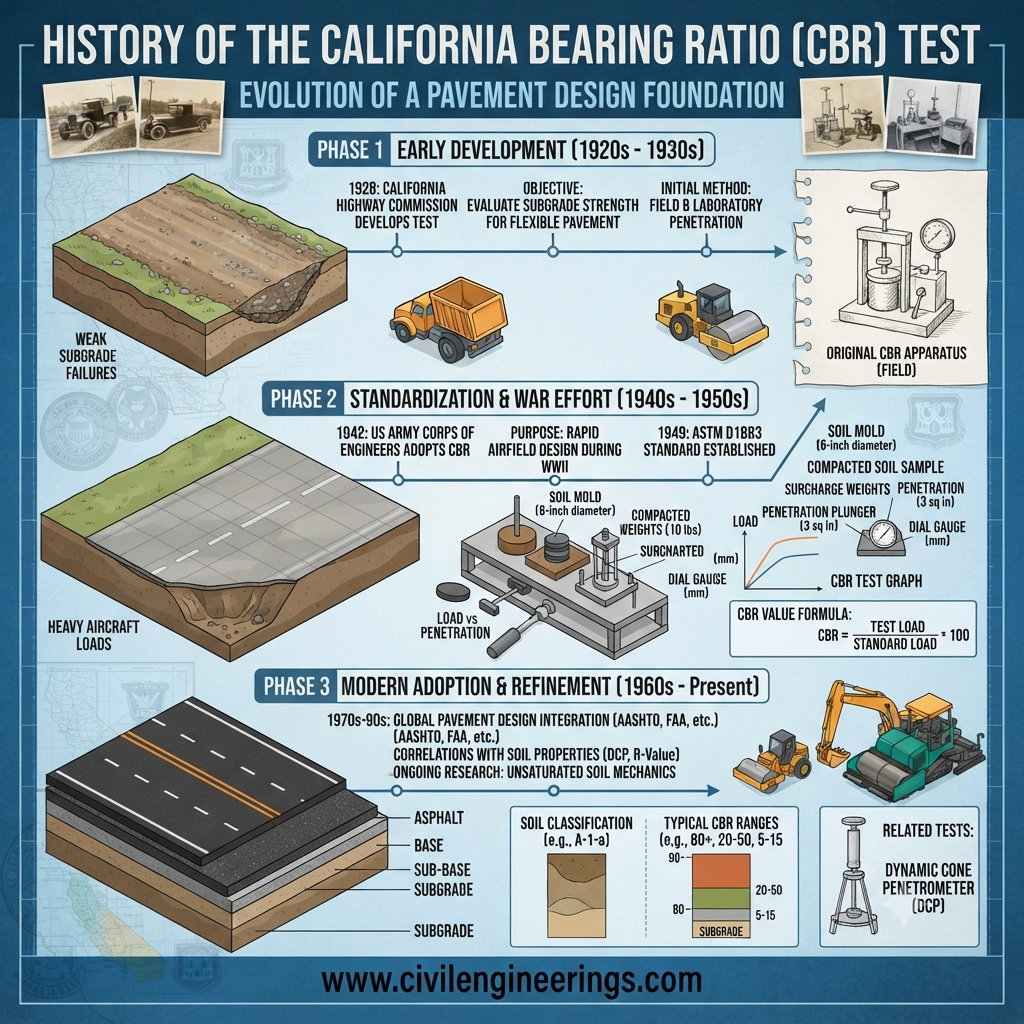
The California Bearing Ratio test was developed during the late 1920s by the California Division of Highways to improve road pavement design. Engineers needed a practical method for evaluating soil strength under wheel loads without performing expensive full-scale pavement tests.
The procedure proved reliable, economical, and easy to repeat. As a result, transportation agencies around the world adopted the method for pavement design.
Today, the CBR test is recognized by several engineering organizations, including:
- Indian Roads Congress (IRC)
- American Association of State Highway and Transportation Officials (AASHTO)
- ASTM International
- Institution of Civil Engineers (ICE)
Although modern pavement design now incorporates advanced mechanistic methods, CBR remains one of the most widely accepted indicators of subgrade performance, particularly for flexible pavement projects.
Why is the CBR Test Important?
The foundation of every pavement lies beneath the visible road surface. Even premium asphalt or concrete cannot perform well if the supporting soil lacks adequate strength.
The California Bearing Ratio test provides engineers with reliable information about how much load the soil can safely withstand before significant deformation occurs.
Major Reasons for Conducting a CBR Test
1. Determines Subgrade Strength
The test quantifies the bearing capacity of natural soil, allowing engineers to classify weak and strong foundation materials.
2. Helps Design Pavement Thickness
A soil with a high CBR value can support traffic using a thinner pavement structure. Weak soils require thicker pavement layers or stabilization techniques to distribute loads effectively.
3. Reduces Construction Costs
Accurate CBR testing prevents unnecessary overdesign while minimizing the risk of costly pavement failures caused by inadequate subgrade strength.
4. Improves Road Performance
Well-designed pavements resist rutting, cracking, settlement, and surface deformation over their service life.
5. Supports Material Selection
CBR values help engineers evaluate whether locally available soils are suitable for embankments, subgrades, or sub-base layers.
6. Ensures Compliance with Standards
Many road authorities require CBR testing before approving pavement designs for highways, rural roads, industrial developments, and airport pavements.
Engineering Principle Behind the CBR Test
The California Bearing Ratio test is based on a simple engineering concept.
When a wheel load moves over a pavement, the pressure transfers through several pavement layers until it reaches the underlying soil. If the soil cannot resist this stress, excessive deformation occurs, eventually damaging the pavement.
The CBR test simulates this condition by pressing a standard cylindrical plunger into a compacted soil specimen at a constant rate.
The measured resistance is then compared with the resistance offered by a standard crushed rock material.
The stronger the soil resists penetration, the higher its California Bearing Ratio.
Engineering Concept
Traffic Load
↓
Pavement Surface
↓
Base Course
↓
Sub-base
↓
Subgrade Soil
↓
Measured Soil Resistance (CBR)
This simple principle allows engineers to estimate pavement support capacity without constructing an actual road section.
Components Required for the CBR Test
Accurate testing requires standardized equipment to ensure repeatable and reliable results.
Common equipment includes:
- CBR mould
- Spacer disc
- Cutting collar
- Filter paper
- Loading machine
- Penetration piston (50 mm diameter)
- Dial gauges
- Loading weights
- Compaction hammer
- Soaking tank
- Moisture content equipment
- Balance
- Oven for moisture determination
Each component plays an important role in producing consistent test results that comply with established engineering standards.
Types of California Bearing Ratio Tests
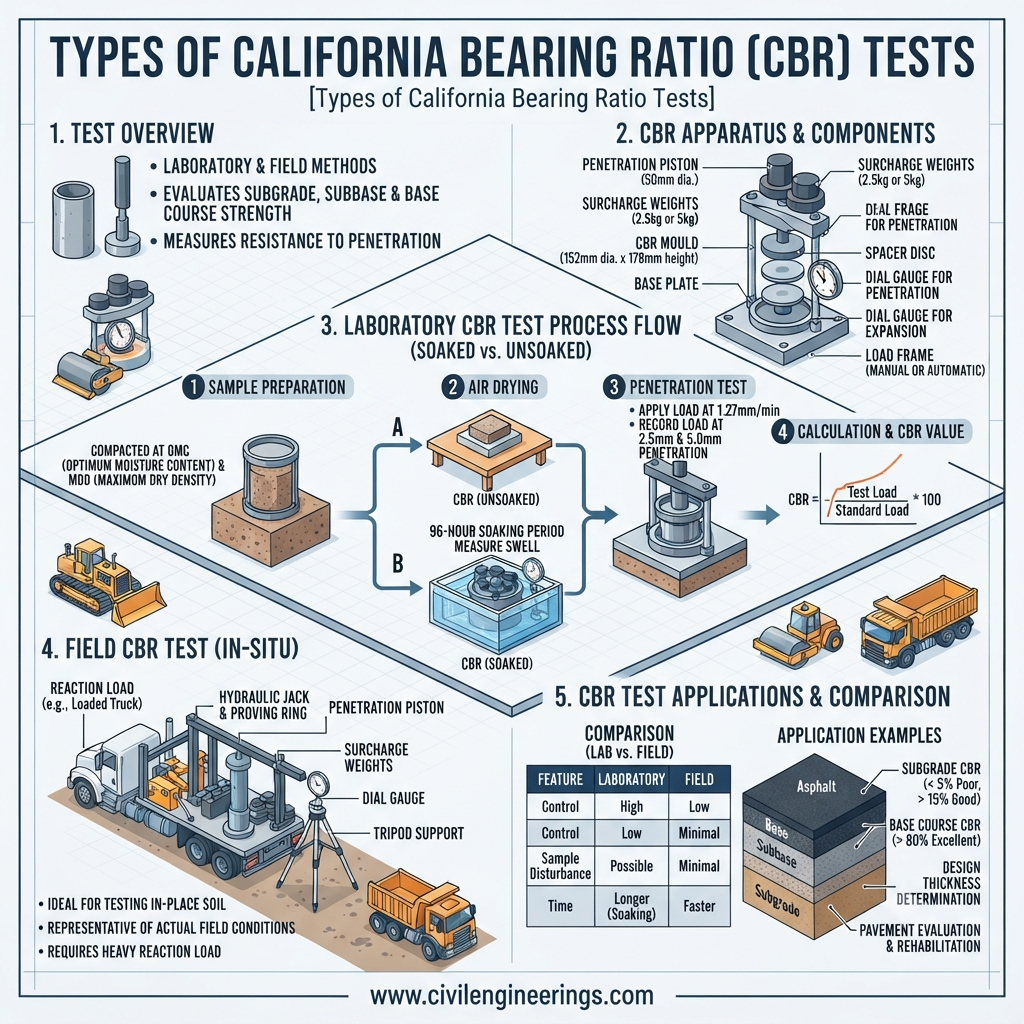
Different project conditions require different testing methods. Engineers generally choose between laboratory and field testing depending on project requirements.
Laboratory CBR Test
The laboratory CBR test is performed on compacted soil samples under carefully controlled conditions.
The soil is compacted to the specified density and moisture content before testing.
The specimen may be tested in either:
- Unsoaked condition
- Soaked condition (typically 96 hours)
Soaked CBR values are commonly used for pavement design because they represent the weakest expected field condition after heavy rainfall or groundwater infiltration.
Advantages
- Highly controlled environment
- Better repeatability
- Suitable for pavement design
- Accurate comparison of soil types
Field CBR Test
The field CBR test is conducted directly on prepared subgrade layers at the construction site.
Instead of testing a laboratory specimen, the penetration piston is pressed into the compacted field soil.
This method provides a realistic assessment of in-situ soil strength.
Advantages
- Represents actual site conditions
- Useful during construction quality control
- Detects poor compaction
- Confirms laboratory assumptions
Field CBR testing is especially valuable for large highway, airport, and industrial pavement projects where quality assurance is essential.
Step-by-Step California Bearing Ratio Test Procedure
The accuracy of a California Bearing Ratio test depends on proper sample preparation, controlled testing conditions, and careful observation throughout the procedure.
Sample Preparation
The soil sample is first collected from the project site and prepared by removing oversized particles, organic matter, and debris. Engineers then determine the optimum moisture content and maximum dry density through a compaction test. The soil is compacted inside the standard CBR mould in layers using the specified compaction energy. Proper compaction is essential because density has a direct influence on the final CBR value.
Soaking Process
For pavement design, the compacted specimen is generally submerged in water for approximately 96 hours. Surcharge weights are placed on the specimen to simulate the pressure exerted by pavement layers. Soaking represents the worst-case field condition when the subgrade becomes saturated after prolonged rainfall or poor drainage. Swell measurements are also recorded during this stage because excessive expansion may indicate problematic soils.
Penetration Test
After soaking, the mould is positioned under the loading machine. A standard plunger with a diameter of 50 mm penetrates the soil at a constant rate of 1.25 mm per minute. The load required to achieve standard penetration depths is recorded continuously. Particular attention is given to penetration values of 2.5 mm and 5.0 mm, as these are used for determining the CBR percentage.
Recording Test Results
The recorded load values are corrected, plotted on a load-penetration curve, and compared with the standard crushed stone values. If the calculated CBR at 5.0 mm exceeds the value at 2.5 mm, engineers usually repeat the test to verify the results. Accurate data recording ensures reliable pavement design and helps engineers make informed decisions regarding subgrade improvement or stabilization.
How to Calculate California Bearing Ratio (CBR)
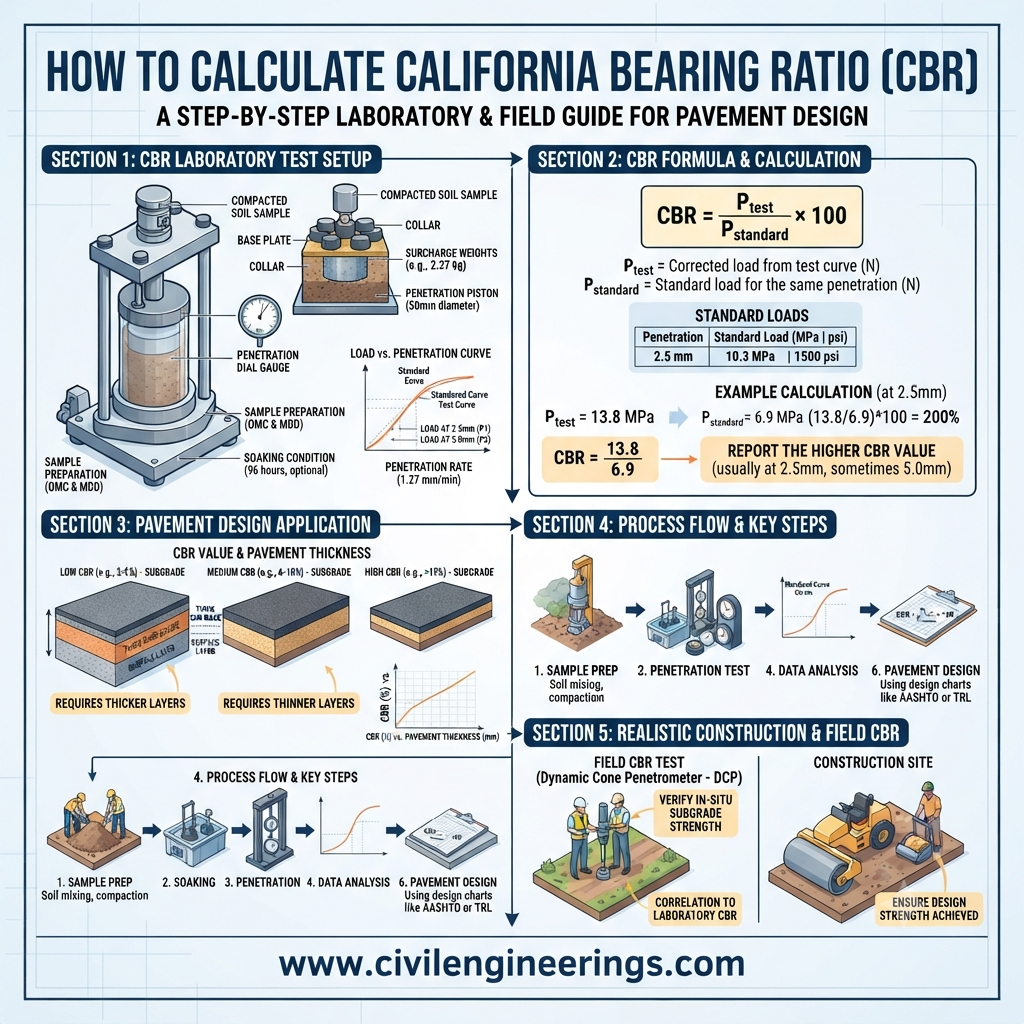
The California Bearing Ratio is determined by comparing the load required to penetrate a soil specimen with the load required to penetrate a standard crushed stone material. The result is expressed as a percentage.
CBR Formula
CBR (%) = (Test Load ÷ Standard Load) × 100
Where:
- Test Load = Load measured during the CBR test
- Standard Load = Standard load for crushed stone
Standard Loads
| Penetration | Standard Load |
|---|---|
| 2.5 mm | 1,370 kg (13.24 kN) |
| 5.0 mm | 2,055 kg (19.96 kN) |
Example Calculation
Suppose the measured load at 2.5 mm penetration is 820 kg.
CBR = (820 ÷ 1370) × 100 = 59.85%
Therefore, the California Bearing Ratio is approximately 60%.
In practice, engineers calculate the CBR at both 2.5 mm and 5.0 mm penetrations. The 2.5 mm value is generally adopted for pavement design because it better represents the soil’s bearing resistance. However, if the CBR at 5.0 mm is consistently higher, engineering standards recommend repeating the test. If the trend persists, the 5.0 mm value may be used.
Typical CBR Values for Different Soils
The CBR value varies significantly depending on soil type, moisture content, density, and compaction.
| Soil Type | Typical CBR (%) |
|---|---|
| Soft Clay | 2–5 |
| Silty Clay | 3–8 |
| Clayey Sand | 5–15 |
| Fine Sand | 10–20 |
| Gravelly Sand | 20–50 |
| Crushed Stone | 80–100 |
| Well-Graded Crushed Aggregate | 100+ |
These values are approximate. Actual project values should always be determined through laboratory or field testing.
Factors Affecting California Bearing Ratio
Several variables influence the CBR value obtained during testing. Understanding these factors helps engineers interpret results correctly and improve pavement performance.
1. Moisture Content
Water has a major influence on soil strength. As moisture content increases, many soils lose shear strength, causing the CBR value to decrease. This is why soaked CBR tests are widely used in pavement design.
2. Soil Type
Granular soils generally exhibit higher CBR values than cohesive soils. Gravel and well-graded crushed aggregates provide excellent bearing capacity, whereas clay soils often produce lower values due to their plastic nature.
3. Degree of Compaction
Higher compaction increases soil density, reduces voids, and improves load-bearing capacity. Proper field compaction is therefore essential for achieving the desired pavement performance.
4. Density of Soil
Dense soils resist penetration more effectively than loose soils. Even small changes in dry density can significantly affect the CBR result.
5. Particle Size Distribution
Well-graded materials containing a suitable combination of coarse and fine particles generally provide better interlocking and higher CBR values than poorly graded soils.
6. Plasticity Index
Highly plastic clays usually have lower bearing capacity because they deform more easily under load. Soils with lower plasticity tend to perform better as pavement subgrades.
7. Drainage Conditions
Poor drainage allows water to accumulate within the pavement structure, reducing soil strength over time. Effective drainage systems help maintain higher CBR values throughout the pavement’s service life.
Practical Applications of California Bearing Ratio
The California Bearing Ratio test plays a vital role in almost every transportation infrastructure project.
Highway Construction
CBR is widely used to determine pavement thickness for national highways, expressways, urban roads, and rural roads.
Airport Pavements
Airport engineers evaluate subgrade strength before designing runways, taxiways, and aprons that must withstand heavy aircraft loads.
Industrial Pavements
Factories, warehouses, ports, and logistics parks rely on CBR testing to ensure pavements can support heavy trucks and material-handling equipment.
Railway Infrastructure
Although railway design primarily depends on other geotechnical parameters, CBR testing can assist in evaluating formation layers and access roads.
Embankment Construction
Engineers assess borrow materials using CBR values before incorporating them into highway embankments and earthworks.
Quality Control During Construction
Field CBR testing verifies that the constructed subgrade meets design specifications before placing sub-base and base course materials.
Interpretation of CBR Results
Interpreting CBR values correctly is as important as performing the test itself.
- Below 3% – Very weak soil requiring stabilization or replacement.
- 3–5% – Poor subgrade suitable only after improvement.
- 5–10% – Fair bearing capacity for lightly loaded pavements.
- 10–20% – Good subgrade for many road projects.
- 20–50% – Strong subgrade with good pavement support.
- Above 50% – Excellent material suitable for heavy-duty pavements and base layers.
These ranges provide general guidance. Final pavement design should always consider traffic loading, environmental conditions, drainage, and applicable design standards.
Practical Recommendations for
Highway Engineers
- Conduct soaked CBR tests for flexible pavement design.
- Correlate CBR results with traffic loading and design life.
- Consider drainage improvements where low CBR values are expected.
Site Engineers
- Verify field compaction before conducting CBR testing.
- Ensure representative soil sampling.
- Record moisture content during testing.
Contractors
- Maintain optimum moisture during compaction.
- Prevent contamination of subgrade materials.
- Follow approved quality control procedures throughout construction.
Civil Engineering Students
- Understand both laboratory and field testing procedures.
- Practice CBR calculations using real engineering data.
- Study how CBR values influence pavement thickness design under IRC and AASHTO methods.
Advantages of the California Bearing Ratio Test
The popularity of the CBR test comes from its simplicity and practical value.
- Simple and easy to perform.
- Cost-effective compared with many advanced geotechnical tests.
- Provides reliable input for flexible pavement design.
- Suitable for laboratory and field applications.
- Recognized by major highway agencies worldwide.
- Supports pavement optimization and cost control.
- Helps identify weak subgrade soils before construction.
- Reduces the risk of premature pavement failure.
Limitations of the California Bearing Ratio Test
Although valuable, the CBR test has certain limitations.
- Represents penetration resistance rather than the complete stress-strain behavior of soil.
- Test results are highly sensitive to moisture content and compaction.
- Does not fully represent dynamic traffic loading.
- Less suitable for highly organic or unusual soils.
- Modern mechanistic-empirical pavement design methods often require additional geotechnical parameters.
- Laboratory conditions may not perfectly replicate field performance.
Therefore, engineers should interpret CBR results alongside other geotechnical investigations rather than relying on a single test.
General Discussion of IRC, AASHTO, and ICE Guidance
Leading engineering organizations continue to recognize the importance of the California Bearing Ratio test in pavement engineering.
- IRC (Indian Roads Congress) uses CBR values extensively for the design of flexible pavements and provides guidance on testing procedures, pavement thickness selection, and subgrade evaluation.
- AASHTO (American Association of State Highway and Transportation Officials) incorporates CBR as one of several methods for evaluating subgrade strength, particularly in preliminary investigations and pavement design.
- ICE (Institution of Civil Engineers) promotes sound geotechnical investigation practices, emphasizing that CBR testing should form part of a broader site assessment that includes soil classification, drainage evaluation, and engineering judgment.
While modern pavement design increasingly uses mechanistic-empirical approaches, the California Bearing Ratio remains a trusted and practical indicator of subgrade quality across many projects worldwide.
Frequently Asked Questions (FAQs)
1. What is the California Bearing Ratio (CBR)?
The California Bearing Ratio is a penetration test used to determine the load-bearing capacity of subgrade soil for pavement design.
2. Why is the CBR test important?
It helps engineers design economical and durable pavements by evaluating the strength of the supporting soil.
3. What is a good CBR value for road construction?
Generally, a CBR value above 10% is considered suitable for many road projects, although required values depend on traffic loading and design standards.
4. What is the difference between soaked and unsoaked CBR?
A soaked CBR test measures soil strength after saturation, while an unsoaked test evaluates soil in its natural moisture condition.
5. Which penetration value is normally used for CBR calculations?
The 2.5 mm penetration value is typically adopted unless the 5.0 mm value is consistently higher after repeat testing.
6. Which soils generally have the highest CBR values?
Well-graded gravel and crushed stone usually exhibit the highest CBR values because of their excellent strength and particle interlocking.
7. Can CBR be measured in the field?
Yes. Field CBR tests are commonly performed during construction to assess the in-place strength of compacted subgrade soils.
8. How does moisture affect CBR?
Increasing moisture generally reduces soil strength, resulting in lower CBR values, especially for clayey soils.
9. Is the CBR test used only for highways?
No. It is also used for airports, industrial pavements, container yards, access roads, and other transportation infrastructure projects.
10. What standards are commonly associated with CBR testing?
CBR testing is commonly performed in accordance with guidance published by organizations such as IRC, AASHTO, ASTM, and ICE, depending on project requirements and regional specifications.
Conclusion
Understanding What is California Bearing Ratio CBR is fundamental for anyone involved in highway engineering, pavement design, or geotechnical investigations. The CBR test offers a practical, economical, and reliable method for evaluating subgrade strength, enabling engineers to design safe, durable, and cost-effective pavement structures. By measuring the soil’s resistance to penetration, the test provides valuable information for determining pavement thickness, selecting suitable construction materials, and identifying weak ground conditions before construction begins.
Although modern pavement engineering incorporates advanced analytical methods, the California Bearing Ratio continues to be an indispensable tool because of its simplicity, proven reliability, and widespread acceptance by organizations such as IRC, AASHTO, and ICE. Engineers should always interpret CBR values alongside soil classification, drainage conditions, traffic loading, and other geotechnical data to achieve the best design outcomes. A thorough understanding of What is California Bearing Ratio CBR helps students build strong technical knowledge while enabling professionals to deliver resilient infrastructure that performs efficiently throughout its intended service life.

Kamran Malik is a passionate civil engineering writer and researcher who specializes in construction, transportation, structural engineering, and infrastructure topics. Through his articles on CivilEngineerings.com, he simplifies complex engineering concepts and shares practical insights, industry trends, and educational resources for students, professionals, and engineering enthusiasts.