
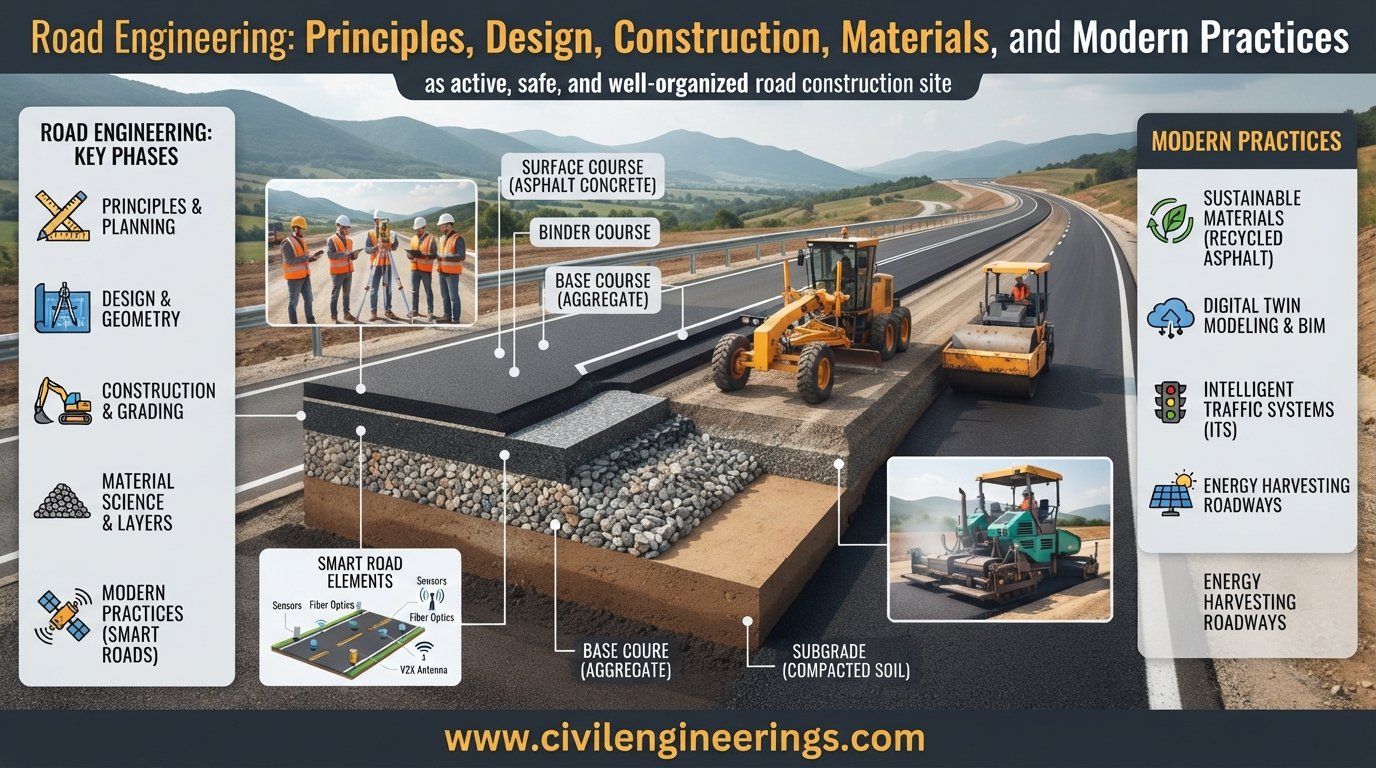
Roads are more than paved surfaces connecting two locations. They are engineered transportation systems that influence economic activity, travel time, road safety, logistics, urban growth, and access to essential services. A well-designed highway can support heavy traffic for decades, while a poorly planned road may develop drainage problems, pavement failures, congestion, and safety hazards within a relatively short period.
Road Engineering brings together transportation planning, surveying, geotechnical engineering, pavement engineering, traffic engineering, drainage, materials technology, construction management, and maintenance. The discipline begins long before construction equipment reaches the site and continues throughout the road’s service life.
For civil engineering students, highway engineers, contractors, consultants, and infrastructure professionals, understanding the complete road engineering process is essential. This guide explains the fundamental principles, planning stages, surveys, geometric design, pavement systems, drainage, construction practices, quality control, safety, sustainability, maintenance, and modern technologies used in road projects.
What Is Road Engineering?
Road engineering is a specialized branch of civil and transportation engineering concerned with the planning, investigation, design, construction, operation, maintenance, rehabilitation, and management of roads and highways.
The objective is not simply to create a route between two points. Engineers must develop a transportation facility that is:
- Safe for different road users
- Structurally adequate
- Economically feasible
- Comfortable to drive on
- Suitable for expected traffic
- Resistant to environmental effects
- Efficient to construct and maintain
- Compatible with surrounding land use
- Sustainable over its life cycle
The discipline covers everything from route selection and traffic forecasting to pavement thickness, drainage structures, road markings, slope protection, and maintenance planning.
The Institution of Civil Engineers emphasizes that effective highway design depends on understanding material properties, design loading, existing ground conditions, environmental interaction, geometric design, site investigation, pavement engineering, and drainage.
Road Engineering vs Highway Engineering
The terms are often used interchangeably, but their practical scope can differ.
Road engineering generally covers roads ranging from local streets to major transportation corridors. Highway engineering often focuses on larger, higher-capacity routes such as highways, expressways, motorways, and strategic corridors.
Both involve closely related activities:
- Highway planning
- Traffic analysis
- Geometric design
- Pavement design
- Earthwork
- Drainage design
- Road construction
- Traffic control
- Safety engineering
- Maintenance and rehabilitation
The appropriate terminology depends on the country, agency, project type, and professional context.
Importance of Road Engineering
A road is a long-term public asset. Its performance depends heavily on decisions made during planning and design.
Good road engineering provides several benefits.
1. Improved Transportation Efficiency
A properly designed road reduces unnecessary delays, sharp geometric restrictions, congestion, and vehicle operating costs.
An efficient road network also improves connections between:
- Cities
- Industrial areas
- Ports
- Airports
- Agricultural regions
- Markets
- Residential communities
- Educational and healthcare facilities
2. Better Road Safety
Safety should be incorporated from the earliest planning stage rather than treated as an additional feature after construction.
Road engineers consider:
- Design speed
- Sight distance
- Horizontal curves
- Vertical curves
- Intersection layout
- Superelevation
- Lane width
- Shoulder width
- Pedestrian facilities
- Roadside hazards
- Signs and markings
- Lighting
- Barriers
FHWA guidance similarly emphasizes integrating safety into planning, design, construction, operation, and maintenance rather than addressing crashes only after a problem occurs.
3. Longer Pavement Life
Correct pavement design distributes wheel loads through the pavement structure before stresses reach the subgrade.
The basic concept can be represented as:
Traffic Load → Surface → Base → Subbase → Subgrade
Each layer contributes to structural capacity, drainage, durability, or load distribution.
4. Economic Development
Reliable roads reduce transportation costs and improve access to markets. This makes road infrastructure an important component of regional and national economic development.
Major Components of Road Engineering
Road engineering is multidisciplinary. A successful project requires coordination between several engineering areas.


Transportation Planning
Transportation planning determines why a road is needed and what level of service it should provide.
Engineers study:
- Existing traffic
- Future traffic demand
- Land development
- Population growth
- Freight movement
- Public transportation
- Network connectivity
- Alternative routes
Traffic forecasting is particularly important because pavement and geometric design depend on expected future demand.
Surveying and Mapping
Accurate survey information forms the foundation of road design.
Typical surveys include:
- Topographic survey
- Cadastral survey
- Alignment survey
- Utility survey
- Traffic survey
- Hydrological survey
- Geotechnical investigation
- Environmental survey
Errors in the initial survey can propagate into earthwork quantities, drainage design, land acquisition, and construction costs.
Geotechnical Engineering
The natural ground must support the pavement and embankment system.
Engineers investigate:
- Soil classification
- Bearing capacity
- Moisture content
- Compaction characteristics
- CBR
- Shear strength
- Settlement
- Groundwater
- Expansive soils
- Weak subgrades
A pavement may be correctly designed on paper but still fail prematurely if unsuitable subgrade conditions are overlooked.
Road Planning and Route Selection
Route selection is one of the most influential decisions in a highway project.
The best route is rarely the shortest straight line. Engineers must balance construction cost, travel efficiency, safety, environmental impacts, land acquisition, drainage, geology, and future development.
Preliminary Route Investigation
At the preliminary stage, engineers examine:
- Existing maps
- Satellite imagery
- Terrain
- Rivers and streams
- Settlements
- Existing roads
- Geological conditions
- Protected areas
- Utility corridors
- Property boundaries
Several possible corridors may then be compared.
Economic and Technical Evaluation
A route can be evaluated using factors such as:
- Initial construction cost
- Land acquisition cost
- Earthwork quantity
- Bridge and culvert requirements
- Travel distance
- Travel time
- Maintenance requirements
- Environmental impacts
- Future expansion potential
A simplified benefit-cost ratio is:
BCR = Present Value of Benefits / Present Value of Costs
A ratio greater than 1 generally indicates that quantified benefits exceed quantified costs, although actual project decisions require broader economic, social, environmental, and policy evaluation.
ICE describes planning, design, tendering, construction, maintenance, and operation as major phases in the road development process, with concept, preliminary, and detailed design forming important stages within design.
Road Surveying and Site Investigation
Once a potential corridor has been identified, detailed field investigations begin.
Topographic Survey
Topographic data establishes:
- Ground elevations
- Contours
- Existing roads
- Buildings
- Drainage channels
- Trees
- Utility structures
- Property boundaries
- Natural features
Modern projects may use GNSS, total stations, drones, LiDAR, and digital terrain models.
Traffic Survey
Traffic data helps determine the required road capacity and pavement loading.
Common traffic studies include:
- Classified traffic counts
- Origin-destination surveys
- Speed studies
- Axle load surveys
- Turning movement counts
- Parking studies
- Pedestrian counts
Geotechnical Investigation
Boreholes, trial pits, laboratory testing, and field tests help establish the engineering properties of the soil.
The California Bearing Ratio (CBR) is commonly used in pavement-related investigations as an indicator of subgrade strength in applicable design procedures.
A simplified CBR relationship is:
CBR (%) = Test Load / Standard Load × 100
The exact calculation and test procedure should follow the governing specification.
Geometric Design of Roads
Geometric design determines the three-dimensional arrangement of the road.
It includes:
- Horizontal alignment
- Vertical alignment
- Cross-section
- Sight distance
- Superelevation
- Gradients
- Intersections
- Interchanges
- Lane widths
- Shoulders
- Medians
Design Speed
Design speed influences many geometric elements.
Higher design speeds generally require greater attention to:
- Curve radius
- Sight distance
- Superelevation
- Stopping distance
- Clear zones
- Intersection spacing
Horizontal Alignment
Horizontal alignment consists mainly of tangents and curves.
For a simple circular curve:
R = radius of curve
The relationship between speed, radius, and lateral acceleration is fundamental to safe curve design.
A commonly used conceptual relationship is:
e + f = V² / 127R
Where:
- e = superelevation rate
- f = side friction factor
- V = speed in km/h
- R = curve radius in metres
Actual design limits, coefficients, and application must follow the relevant road authority’s standard.
Vertical Alignment
Vertical alignment consists of grades and vertical curves.
Engineers consider:
- Maximum gradient
- Minimum gradient
- Crest curves
- Sag curves
- Drainage
- Heavy vehicle performance
- Sight distance
A poorly coordinated vertical profile can increase safety risks and construction quantities.
Pavement Design in Road Engineering
Pavement engineering is one of the central components of road engineering. A pavement is a constructed structural system placed over natural ground to allow traffic to pass while controlling stresses transferred to the subgrade. ICE describes pavement engineering as involving soils, hydraulics, materials, and their response to loading.


Flexible Pavement
Flexible pavement commonly uses bituminous surfacing over granular or stabilized layers.
A typical structure may include:
- Wearing or surface course
- Binder course
- Base course
- Subbase
- Compacted subgrade
The thickness depends on traffic loading, climate, material properties, drainage, reliability requirements, and the selected design method.
Rigid Pavement
Rigid pavement generally uses a concrete slab as its principal structural element.
Important design considerations include:
- Concrete strength
- Slab thickness
- Joint spacing
- Load transfer
- Temperature effects
- Subbase support
- Drainage
- Reinforcement where applicable
Pavement Design Inputs
A pavement design normally requires information about:
- Design traffic
- Axle loading
- Subgrade strength
- Material properties
- Climate
- Drainage
- Reliability
- Serviceability or performance criteria
- Construction quality
A simplified traffic conversion concept is:
ESAL = Σ (N × LEF)
Where:
- N = number of axle-load applications
- LEF = load equivalency factor
Modern pavement design methods can use more sophisticated mechanistic-empirical approaches rather than relying solely on equivalent axle concepts.
Road Drainage Design
Water is one of the most important factors affecting pavement performance.
Poor drainage can weaken the subgrade, saturate pavement layers, cause erosion, damage shoulders, and accelerate cracking and pothole formation.
Typical drainage facilities include:
- Side drains
- Catch drains
- Kerb and gutter systems
- Culverts
- Cross-drainage structures
- Subsurface drains
- Median drains
- Outfalls
Basic Rational Method
For small catchments, the Rational Method is commonly expressed as:
Q = CIA
Where:
- Q = peak runoff
- C = runoff coefficient
- I = rainfall intensity
- A = drainage area
Units must remain consistent with the selected equation form.
Drainage design should also consider inlet capacity, hydraulic grade, outlet conditions, erosion protection, debris, sedimentation, and maintenance access.
Road Construction Process
Road construction converts engineering drawings and specifications into a physical transportation facility.


Site Clearance and Preparation
The contractor first clears vegetation, debris, unsuitable materials, and obstructions according to the contract requirements.
Temporary drainage and traffic arrangements may also be established.
Earthwork
Earthwork generally includes:
- Excavation
- Embankment construction
- Borrow material placement
- Cut-to-fill operations
- Grading
- Moisture conditioning
- Compaction
Engineers should monitor both the quantity and quality of earthwork.
Subgrade Preparation
The subgrade must achieve the specified:
- Level
- Crossfall
- Moisture condition
- Density
- Strength
- Surface regularity
A poorly compacted subgrade can create differential settlement and pavement distress.
Subbase and Base Construction
Aggregates are placed in controlled layers.
Typical field controls include:
- Layer thickness
- Gradation
- Moisture
- Density
- Surface tolerance
- Material quality
Asphalt Construction
For flexible pavement, the process may include:
- Surface preparation
- Prime coat where specified
- Asphalt mixing
- Transportation
- Paving
- Initial rolling
- Intermediate rolling
- Finish rolling
- Joint treatment
- Surface inspection
Temperature control is particularly important for hot-mix asphalt because material workability and compaction depend strongly on temperature.
Quality Control and Quality Assurance
A road can only perform as well as the quality built into it.
Contractors should establish inspection and testing procedures covering materials, workmanship, equipment, and finished work.
Common Road Construction Tests
Depending on the specification, testing may include:
- Sieve analysis
- Atterberg limits
- Proctor compaction
- Field density
- CBR
- Aggregate crushing value
- Los Angeles abrasion
- Soundness
- Bitumen penetration
- Softening point
- Ductility
- Marshall or other asphalt mixture testing
- Concrete slump
- Concrete compressive strength
Testing frequency and acceptance criteria must come from the project specification rather than generic values.
Field Quality Checks
Engineers should also inspect:
- Layer thickness
- Crossfall
- Finished levels
- Alignment
- Compaction
- Drainage outlets
- Asphalt joints
- Surface defects
- Road markings
- Signs and safety hardware
Quality assurance should not become a paperwork exercise. The objective is to verify that the completed asset will deliver the required performance.
Road Safety Engineering
Road safety should influence every design decision.
Important safety elements include:
- Adequate sight distance
- Consistent alignment
- Proper intersection geometry
- Safe pedestrian crossings
- Roadside clear zones
- Guardrails where justified
- Delineators
- Signs
- Pavement markings
- Lighting
- Speed management
- Work-zone traffic control
Engineers should also undertake safety audits or reviews at appropriate project stages where required.
A technically correct road is not necessarily a safe road. Human factors, driver expectations, vulnerable road users, roadside environment, and operational conditions all matter.
Road Maintenance and Rehabilitation
Road engineering continues after opening.
A pavement management strategy helps authorities decide when and where to intervene.
Common Pavement Distresses
Flexible pavements may experience:
- Fatigue cracking
- Transverse cracking
- Rutting
- Potholes
- Ravelling
- Bleeding
- Edge failures
- Settlement
Rigid pavements can experience:
- Slab cracking
- Joint deterioration
- Faulting
- Spalling
- Pumping
- Loss of support
Preventive Maintenance
Preventive treatments are often more economical than waiting for major structural failure.
Possible treatments include:
- Crack sealing
- Surface treatments
- Patching
- Milling and overlay
- Drainage improvements
- Shoulder repair
- Full-depth rehabilitation
The correct treatment depends on the cause, severity, structural condition, traffic, climate, and remaining service life.
Road Engineering Standards: IRC, AASHTO and ICE
Road projects should always follow the standards and specifications designated by the relevant road authority and contract.
IRC
The Indian Roads Congress (IRC) develops and maintains codes, standards, and guidelines covering road and transportation engineering. Its technical structure includes committees dealing with transport planning, traffic engineering, flexible and rigid pavements, drainage, road safety, urban roads, maintenance, and other highway subjects.
IRC documents are particularly relevant to projects following Indian standards or specifications influenced by IRC practice.
AASHTO
Develops transportation standards, specifications, and guidelines covering highways, bridges, traffic engineering, and related transportation systems.
AASHTO guidance is widely referenced in pavement design, geometric design, materials, structural evaluation, and transportation engineering.
ICE
The Institution of Civil Engineers (ICE) provides professional guidance and technical resources covering highway development, pavement engineering, design, construction, and infrastructure management. Its road-development guidance highlights the importance of site investigation, geometric design, drainage, pavement design, and detailed engineering.
Important: IRC, AASHTO, ICE, DMRB, national highway specifications, and local authority standards are not automatically interchangeable. Engineers should identify the governing standard before beginning calculations or preparing drawings.
Sustainable Road Engineering
Modern road engineering increasingly considers the complete environmental and economic life cycle of infrastructure.
Sustainable practices may include:
- Recycled asphalt pavement
- Recycled aggregates where permitted
- Warm-mix asphalt
- Energy-efficient construction equipment
- Optimized earthwork
- Improved drainage
- Longer-life pavement designs
- Low-carbon materials
- Solar-powered roadside systems
- Vegetated drainage solutions
- Reduced construction waste
Sustainability should not mean selecting a material simply because it is marketed as “green.” Engineers should evaluate performance, durability, availability, carbon impact, maintenance requirements, and whole-life cost.
Smart Technology in Modern Road Engineering
Technology is changing how engineers survey, design, construct, and maintain highways.
Useful technologies include:
- Drone surveying
- GNSS and RTK positioning
- LiDAR
- Building Information Modelling
- Digital terrain models
- 3D machine control
- Intelligent compaction
- Pavement condition sensors
- Automated traffic counting
- AI-based defect detection
- Geographic Information Systems
- Digital asset management
Smart highways can combine sensors, cameras, communication systems, traffic monitoring, and data analytics to improve operational decision-making.
However, technology should support engineering judgment rather than replace it. A sophisticated model built on inaccurate survey or traffic data can still produce a poor engineering decision.
Practical Recommendations for Students, Engineers and Contractors
For Civil Engineering Students
Focus on understanding the relationship between theory and field practice.
Learn:
- Surveying
- Soil mechanics
- Highway geometric design
- Traffic engineering
- Pavement design
- Hydrology
- Quantity estimation
- Construction materials
- AutoCAD and Civil 3D
- GIS
- Basic data analysis
Do not memorize formulas without understanding where they come from and when they apply.
For Highway and Site Engineers
Maintain a disciplined workflow:
- Verify drawings before construction.
- Confirm benchmarks and control points.
- Review the specification.
- Check materials before placement.
- Monitor layer thickness.
- Record field density results.
- Inspect drainage continuously.
- Control construction tolerances.
- Document nonconformities.
- Never ignore recurring defects.
Field observations should feed back into design and construction decisions.
For Contractors
Successful road construction depends on planning as much as equipment.
Prepare:
- Method statements
- Inspection and test plans
- Material source approvals
- Equipment schedules
- Traffic management plans
- Quality-control procedures
- Environmental controls
- Survey-control systems
- Daily production targets
Avoid placing the next pavement layer until the previous layer has been properly inspected and accepted.
Common Road Engineering Mistakes to Avoid
Several recurring mistakes can reduce road performance.
Ignoring Drainage
Even excellent pavement materials can deteriorate rapidly when water remains within the pavement structure.
Designing Only for Current Traffic
Road demand can change significantly during the pavement’s service life. Future traffic must be considered.
Poor Compaction
Insufficient density can increase deformation, permeability, settlement, and premature distress.
Inadequate Site Investigation
Unknown weak soil, groundwater, expansive soil, or unstable slopes can create expensive construction problems.
Treating Maintenance as an Afterthought
Preventive maintenance is generally easier to plan than emergency rehabilitation after structural failure.
Using Standards Without Understanding Them
A formula copied from another project may not apply to the current road class, traffic conditions, climate, materials, or governing standard.
Frequently Asked Questions About Road Engineering
What is the main purpose of road engineering?
The main purpose is to plan, design, construct, operate, maintain, and rehabilitate roads so they provide safe, efficient, durable, economical, and suitable transportation facilities.
What are the main branches of road engineering?
Major areas include transportation planning, surveying, geometric design, traffic engineering, pavement engineering, geotechnical engineering, drainage, construction management, road safety, and maintenance.
Why is drainage important in road engineering?
Drainage prevents water from accumulating around or inside the pavement structure. Excess moisture can weaken soil and pavement layers, accelerate erosion, and contribute to premature pavement distress.
What is the difference between flexible and rigid pavement?
Flexible pavement generally uses bituminous layers that distribute traffic loads through several layers. Rigid pavement primarily relies on a concrete slab to carry and distribute loads.
What tests are commonly performed during road construction?
Depending on the project, tests may include aggregate gradation, compaction, field density, CBR, abrasion, bitumen properties, asphalt mixture testing, concrete slump, and compressive strength.
Which standards are used for highway design?
The governing standard depends on the project location and road authority. IRC, AASHTO, ICE resources, DMRB, national specifications, and local highway authority manuals may be relevant.
How is road pavement thickness determined?
Pavement thickness depends on factors such as design traffic, axle loading, subgrade strength, material properties, environmental conditions, drainage, reliability, and the selected pavement design methodology.
What software is useful for road engineering?
Common tools include AutoCAD Civil 3D, OpenRoads, GIS platforms, pavement design software, hydraulic modelling software, survey-processing applications, and project management systems. The appropriate software depends on project requirements.
What causes premature road failure?
Common causes include inadequate drainage, weak subgrade, insufficient pavement thickness, poor material quality, inadequate compaction, overloaded traffic, construction defects, poor detailing, and delayed maintenance.
Is road engineering only about highway construction?
No. Road engineering covers the complete life cycle of transportation infrastructure, including planning, route selection, surveys, design, construction, traffic operation, safety, maintenance, rehabilitation, and asset management.
Conclusion
Road Engineering is a multidisciplinary field that combines science, engineering judgment, field experience, construction management, and long-term asset planning. A successful road begins with a sound understanding of traffic demand, terrain, soil, drainage, environment, land requirements, and future development. Those inputs then guide route selection, geometric design, pavement structure, drainage, safety measures, construction methodology, and quality control.
For engineers and contractors, the most important lesson is that road performance depends on the entire system rather than a single pavement layer. Good materials cannot compensate for poor drainage. A strong pavement cannot correct an unsafe alignment. Accurate design cannot deliver reliable performance without proper construction control.
Students should therefore learn to connect calculations with field conditions, while practicing engineers should continually verify assumptions against actual site performance. By combining appropriate standards such as IRC, AASHTO, and ICE guidance with sound engineering judgment, quality construction, effective maintenance, and modern technology, transportation professionals can create roads that remain safer, stronger, more economical, and more sustainable throughout their intended service life.

Kamran Malik is a passionate civil engineering writer and researcher who specializes in construction, transportation, structural engineering, and infrastructure topics. Through his articles on CivilEngineerings.com, he simplifies complex engineering concepts and shares practical insights, industry trends, and educational resources for students, professionals, and engineering enthusiasts.