
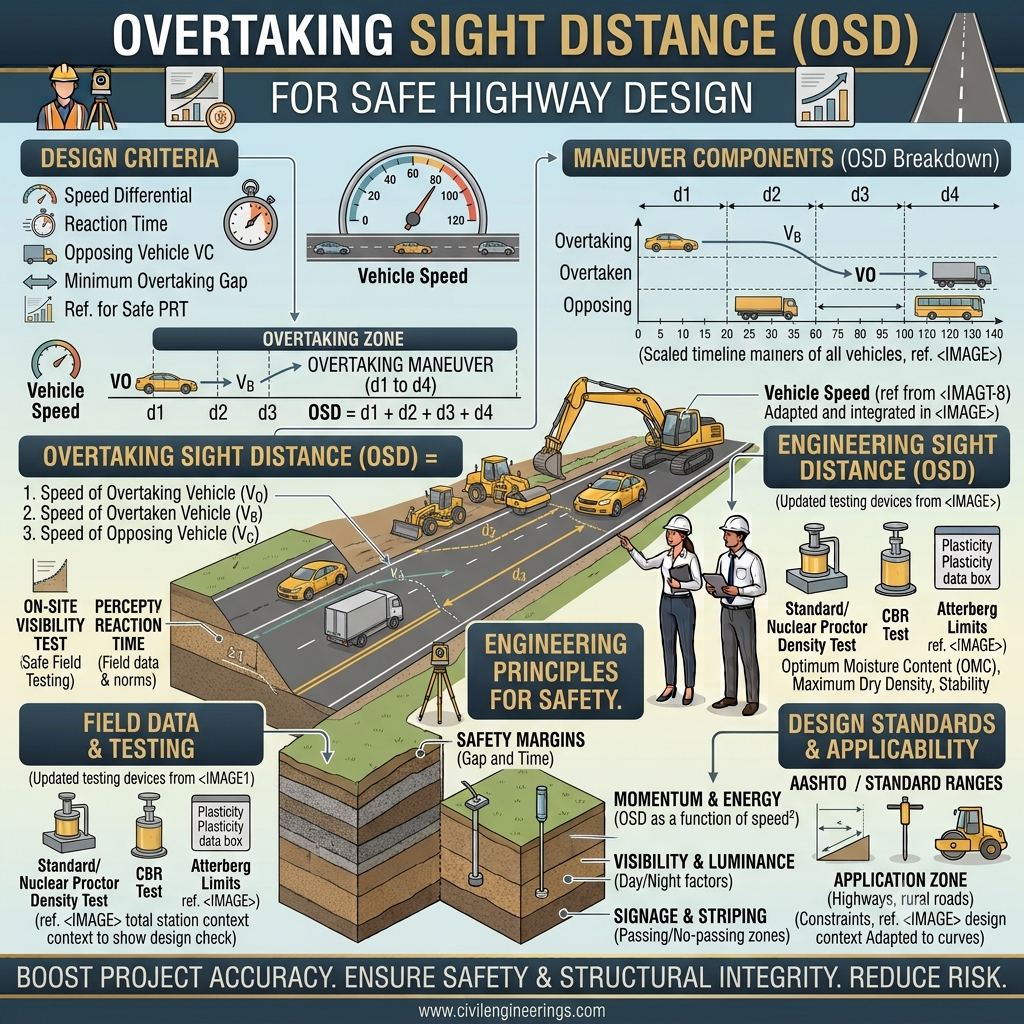
Overtaking is one of the most demanding driving maneuvers on a two-lane, two-way highway. A driver must judge the speed of a slower vehicle, assess the distance to an approaching vehicle, accelerate into the opposing lane, pass safely, and return to the original lane before a collision risk develops. Even a small error in speed estimation or distance judgment can lead to a serious head-on crash. This is why Overtaking Sight Distance (OSD) is a fundamental concept in highway geometric design.
For civil engineers, highway designers, consultants, and construction professionals, understanding OSD is essential when planning horizontal and vertical alignments, selecting passing zones, and evaluating the safety of rural roads. Adequate overtaking visibility improves traffic operations, reduces unsafe passing attempts, and helps drivers make informed decisions.
This comprehensive guide explains the meaning and importance of Overtaking Sight Distance, its governing principles, standard formulas, component distances, step-by-step calculations, factors affecting design, and practical applications. It also discusses Indian Roads Congress (IRC) guidance, AASHTO principles, UK highway-design practice, common design errors, and field inspection methods. Whether you are studying highway engineering or reviewing a road project, these concepts will help you understand how engineers provide safer opportunities for overtaking.
What Is Overtaking Sight Distance?
Overtaking Sight Distance (OSD) is the minimum length of road ahead that a driver needs to see clearly to overtake a slower vehicle safely without colliding with an oncoming vehicle.
It is particularly important on two-lane, two-way roads where vehicles travelling in opposite directions share the same carriageway and drivers must temporarily enter the opposing traffic lane to pass a slower vehicle.
OSD must provide enough visible distance for the driver to assess the situation, initiate the maneuver, accelerate, pass the slower vehicle, and return to the correct lane with an adequate safety margin.
Why Is Overtaking Sight Distance Important?
Adequate overtaking visibility helps highway engineers:
- Reduce the risk of head-on collisions.
- Identify suitable overtaking zones on rural highways.
- Design safer summit curves and horizontal alignments.
- Improve traffic flow on single-carriageway roads.
- Establish appropriate overtaking restrictions and road markings.
- Evaluate whether existing roads provide sufficient passing opportunities.
A road may have adequate stopping sight distance but still lack sufficient overtaking sight distance. A driver might see a vehicle ahead clearly enough to stop but not have enough visibility to complete a passing maneuver safely.
Where Is OSD Required?
OSD is especially relevant to:
- Two-lane, two-way rural highways.
- Undivided roads carrying traffic in both directions.
- Roads with long stretches of slow-moving heavy vehicles.
- Hilly and rolling terrain.
- Roads with summit vertical curves.
- Locations where overtaking opportunities are limited.
On divided highways, drivers generally overtake within lanes moving in the same direction. Therefore, conventional opposing-traffic OSD is not normally the controlling sight-distance criterion; adequate stopping sight distance remains essential.
Components of Overtaking Sight Distance
The total OSD depends on the distances covered during different stages of the overtaking maneuver. A conventional highway-engineering model divides it into three principal components.

1. Distance during perception and initial maneuver (\(d_1\))
The overtaking driver follows the slower vehicle, assesses the available gap, and begins moving into the opposing lane. The model accounts for the distance travelled during this initial phase.

2. Distance during actual overtaking (\(d_2\))
The overtaking vehicle accelerates, passes the slower vehicle, and returns to its original lane. This component depends on vehicle speeds, acceleration, and the time required to complete the maneuver.

3. Distance travelled by the opposing vehicle (\(d_3\))
An approaching vehicle continues moving toward the overtaking vehicle while the maneuver takes place. The design must provide enough distance to accommodate this opposing movement.
The total overtaking sight distance is expressed as:
\[ \boxed{OSD=d_1+d_2+d_3} \]
Where:
- \(OSD\) = overtaking sight distance, in metres
- \(d_1\) = distance covered during the initial overtaking stage
- \(d_2\) = distance covered during the actual passing maneuver
- \(d_3\) = distance covered by the opposing vehicle
This component-based model is useful for understanding the underlying mechanics. However, the precise assumptions and equations differ between design standards. Engineers should use the method specified by the governing standard rather than combining components from different methods.
Overtaking Sight Distance Formula
There is no single universal OSD formula that applies to every highway-design standard. The calculation depends on the assumed vehicle speeds, acceleration, reaction time, initial spacing, and safety clearance.
Conventional Three-Distance Method
A common conceptual model uses:
\[ OSD=d_1+d_2+d_3 \]
For the initial stage, distance can be represented generally as:
\[ d_1=v\,t_1 \]
For the actual overtaking stage:
\[ d_2=\bar{v}_o\,t_2 \]
For the opposing vehicle:
\[ d_3=v_a\,t_2 \]
Where:
- \(v\) = average speed during the initial stage, in m/s
- \(t_1\) = duration of the initial stage, in seconds
- \(\bar{v}_o\) = average speed of the overtaking vehicle during passing, in m/s
- \(t_2\) = duration of the actual passing stage, in seconds
- \(v_a\) = speed of the approaching vehicle, in m/s
These expressions illustrate how the distances relate to speed and time. They are not, by themselves, a complete design procedure: the assumed initial spacing, relative movement, safety clearances, and maneuver timing must also be defined consistently.
When speeds are provided in kilometres per hour, convert them to metres per second using:
\[ v=\frac{V}{3.6} \]
Here, \(V\) is the speed in km/h.
Factors Affecting the Formula
The design method must account for:
- Speed of the overtaking vehicle.
- Speed of the vehicle being overtaken.
- Speed of the opposing vehicle.
- Acceleration capability.
- Perception and decision time.
- Initial following distance.
- Clearance when returning to the original lane.
- Road gradient and vehicle performance.
A faster design speed generally increases the required sight distance because vehicles travel farther during the maneuver. The relationship is not simply proportional: changing the assumed speed can also change maneuver duration and the required relative distance between vehicles.
Standard Overtaking Sight Distance Values
For highway design in India, IRC guidance provides standard OSD values based on the assumed overtaking maneuver and the movement of an opposing vehicle. The values below are given in IRC:73-2023, Table 5.3, as reproduced in available copies of the standard. The older IRC:73-1980 and IRC:66-1976 tables also contain the familiar values shown here. Always verify the applicable edition and project requirements before using them in a design.
| Design speed (km/h) | Overtaking maneuver time (s) | Opposing vehicle time (s) | Total time (s) | OSD (m) |
|---|---|---|---|---|
| 40 | 9.0 | 6.0 | 15.0 | 165 |
| 50 | 10.0 | 7.0 | 17.0 | 235 |
| 60 | 10.8 | 7.2 | 18.0 | 300 |
| 65 | 11.5 | 7.5 | 19.0 | 340 |
| 80 | 12.5 | 8.5 | 21.0 | 470 |
| 100 | 14.0 | 9.0 | 23.0 | 640 |
These figures illustrate how rapidly the required visibility increases with speed. At 80 km/h, for example, the recommended OSD in this table is 470 m, while at 100 km/h it rises to 640 m.
Important: Do not substitute these figures for a different country’s passing-sight-distance criteria. AASHTO-based and other national standards use their own design assumptions and tables.
Worked Example: Calculating Overtaking Sight Distance
Consider a two-lane rural highway with a design speed of 80 km/h. The design team needs to determine the standard overtaking sight distance for an initial geometric-design assessment.
Step 1: Identify the Design Speed
Given:
\[ V=80\text{ km/h} \]
The road is assumed to be a two-lane, two-way highway, and the design uses the applicable IRC tabulated method.
Step 2: Find the Corresponding OSD
From the IRC table above:
\[ t_1=12.5\text{ s} \]
\[ t_2=8.5\text{ s} \]
\[ OSD=470\text{ m} \]
Here, \(t_1\) and \(t_2\) represent the time components associated with the overtaking maneuver and the opposing vehicle, respectively.
Step 3: Interpret the Result
The road geometry should provide approximately 470 m of unobstructed sight distance for the design case represented by this table.
The engineer must then confirm that the required sight line remains available along the actual road alignment. A long straight-looking road may still fail the check because of a crest curve, vegetation, a cut slope, roadside structures, or a combination of horizontal and vertical curvature.
Step 4: Document the Design Decision
The design report should identify the governing standard and edition, selected design speed, available sight distance, survey assumptions, limiting obstructions, and any proposed corrective treatment.
This example demonstrates how engineers use standard tables. A project-specific design may require a more detailed analysis where actual vehicle behavior, terrain, traffic composition, or other conditions fall outside the standard assumptions.
Factors Affecting Overtaking Sight Distance
OSD is influenced by road geometry, vehicle characteristics, driver behavior, and traffic conditions. Engineers should examine these factors together rather than relying on design speed alone.
1. Design Speed
Higher speeds generally increase the distance travelled during an overtaking maneuver and by an approaching vehicle. As a result, high-speed rural roads usually require longer passing sight distances.
2. Speed Difference Between Vehicles
The speed of the slower vehicle affects how long the overtaking vehicle must remain in the opposing lane.
A small speed difference can extend the maneuver, while a larger difference may allow a quicker pass, provided acceleration and safety clearances remain adequate.
3. Acceleration and Vehicle Type
A passenger car can usually accelerate more quickly than a heavily loaded truck. Steep upgrades, heavy loads, poor vehicle condition, and limited engine performance can lengthen the maneuver.
4. Road Gradient
An upgrade may reduce the overtaking vehicle’s acceleration. A downgrade can also influence vehicle speed and braking behavior. Engineers should follow the grade assumptions and adjustment procedures specified in the governing standard.
5. Horizontal and Vertical Alignment
Sharp horizontal curves, summit curves, and combinations of the two can obstruct the driver’s line of sight.
A road may provide adequate visibility on a straight approach but lose it immediately beyond a crest or around an inside cut slope.
6. Traffic and Weather Conditions
Opposing traffic, rain, fog, glare, poor pavement markings, and reduced pavement friction can make an otherwise possible maneuver unsafe. Design criteria cannot eliminate the need for drivers to judge actual conditions before passing.
Overtaking Sight Distance on Horizontal and Vertical Curves
Providing adequate OSD requires more than checking a distance along a plan drawing. Engineers must verify visibility in both the horizontal and vertical planes.

Horizontal Curves
On a horizontal curve, the line of sight may intersect a cut slope, wall, vegetation, building, or other obstruction on the inside of the curve.
The engineer should calculate the required lateral clearance or setback using the governing geometric-design procedure. Surveyed terrain, roadside features, and future vegetation growth should all be considered.
Summit Vertical Curves
A crest curve can hide an approaching vehicle behind the road profile. This is especially important because overtaking sight distance is generally much longer than stopping sight distance.
Where the required OSD cannot be achieved economically, the designer should evaluate whether another alignment, a passing lane, a suitable restriction, or a different operational treatment offers a safer solution.
IRC:73-2023 discusses the geometric relationship between summit curves and sight distance, including the use of eye and object heights for overtaking or intermediate sight-distance checks.
Intermediate Sight Distance and Stopping Sight Distance
Three sight-distance concepts are important in highway geometric design.
| Type | Purpose | Typical application |
|---|---|---|
| Stopping Sight Distance (SSD) | Allows a driver to perceive a hazard and stop safely | Basic visibility requirement throughout the road |
| Intermediate Sight Distance (ISD) | Provides more visibility than SSD where full OSD is difficult to achieve | Certain two-lane roads with limited passing opportunities |
| Overtaking Sight Distance (OSD) | Provides visibility for a safe passing maneuver involving opposing traffic | Two-lane, two-way roads |
Under the conventional IRC approach, Intermediate Sight Distance is taken as twice the Stopping Sight Distance. It is a compromise where full overtaking sight distance cannot reasonably be provided. It is not equivalent to full OSD and should not be interpreted as permission to overtake whenever that distance is available.
The minimum stopping sight distance remains essential even where overtaking is prohibited.
IRC, AASHTO, and ICE References
Indian Roads Congress (IRC)
For Indian highway projects, relevant references include:
- IRC:73-2023 — Geometric Design Standards for Non-Urban Roads.
- IRC:66-1976 — Recommended Practice for Sight Distance on Rural Highways, subject to applicable amendments and current project requirements.
IRC:73-2023 provides geometric-design criteria and tabulated sight-distance values, while IRC:66-1976 is a historical reference for the development and application of rural highway sight-distance principles.
AASHTO
The AASHTO A Policy on Geometric Design of Highways and Streets, commonly called the Green Book, covers passing sight distance for suitable two-lane highway applications. It uses design criteria intended to accommodate a normal passing maneuver without interference from an opposing vehicle.
ICE and UK Highway Practice
In the United Kingdom, highway geometric design should follow the applicable Design Manual for Roads and Bridges (DMRB) requirements and relevant overseeing-authority standards. The Institution of Civil Engineers provides professional resources on highway engineering, but the DMRB and project-specific requirements determine the applicable design criteria.
The key rule is to use the standard adopted for the project, confirm the correct edition, and document any permitted departure or relaxation through the appropriate approval process.
Practical Applications of Overtaking Sight Distance
OSD calculations help engineers make decisions during several stages of highway development.
- Route selection: Compare alternatives to identify alignments that offer safe passing opportunities.
- Geometric design: Check whether horizontal and vertical curves provide the necessary visibility.
- Road safety assessment: Identify locations where drivers may attempt risky overtaking maneuvers.
- Pavement marking: Support the assessment of passing and no-passing zones under the applicable traffic-control standards.
- Highway improvement: Evaluate whether vegetation clearance, curve modification, or passing lanes could improve operations.
- Maintenance planning: Identify obstructions caused by vegetation, roadside development, or deteriorating markings.
On heavily trafficked two-lane roads, a dedicated passing lane may provide a more practical solution than attempting to achieve full OSD continuously. The choice should consider traffic demand, terrain, crash history, construction costs, and the safety implications of merging movements.
Common Mistakes in Overtaking Sight Distance Design
Using the Wrong Standard
Mixing IRC, AASHTO, and UK design values can produce inconsistent results. Each standard may use different assumptions, measurement criteria, and design procedures.
Checking Only the Plan Alignment
A clear horizontal alignment does not guarantee sufficient visibility over a crest curve. Engineers must check the combined effect of plan and profile.
Ignoring Roadside Obstructions
Trees, walls, signboards, buildings, and cut slopes can reduce actual visibility even when the design drawings appear satisfactory.
Treating Intermediate Sight Distance as Full OSD
ISD provides an intermediate level of visibility, not the same passing opportunity as full OSD. Designers must clearly distinguish the two.
Assuming Every Driver Can Complete the Maneuver
Drivers vary in judgment, acceleration capability, and willingness to accept risk. Design should follow established criteria rather than assume aggressive or unusually skilled driving behavior.
Practical Recommendations for Students, Engineers, and Contractors
Civil engineering students
- Learn the difference between SSD, ISD, and OSD.
- Practice calculations using the correct IRC or AASHTO method.
- Understand the assumptions behind tabulated values.
- Study how crest curves and horizontal obstructions limit visibility.
Highway engineers and consultants
- Verify OSD at the preliminary and detailed design stages.
- Check the surveyed terrain and actual sight lines.
- Review operating speeds, traffic composition, and crash history.
- Consider passing lanes or alternative alignments where full OSD is impractical.
- Record assumptions and obtain approval for any permitted design departure.
Site engineers and contractors
- Check that constructed profiles match approved drawings.
- Remove unauthorized obstructions within the required sight envelope.
- Maintain signs and pavement markings.
- Report unexpected visibility restrictions to the supervising engineer.
- Avoid changing road geometry or roadside features without design review.
Frequently Asked Questions About Overtaking Sight Distance
1. What is Overtaking Sight Distance in highway engineering?
Overtaking Sight Distance is the minimum visible length of road required for a driver to pass a slower vehicle safely on a two-way road without conflicting with an approaching vehicle.
2. What is the formula for Overtaking Sight Distance?
The conventional component-based expression is \(OSD=d_1+d_2+d_3\), where the terms represent the initial maneuver distance, actual overtaking distance, and opposing-vehicle distance. The detailed calculation depends on the governing design standard.
3. What is the OSD at 80 km/h according to IRC?
The commonly published IRC table gives an OSD of 470 m at 80 km/h. Confirm the applicable edition and project requirements before adopting this value.
4. Why is OSD greater than stopping sight distance?
Overtaking requires a vehicle to enter the opposing lane, pass a slower vehicle, and return safely. Stopping sight distance only needs to provide enough distance to perceive a hazard and bring the vehicle to a stop.
5. What is the difference between OSD and ISD?
OSD provides sufficient visibility for the complete passing maneuver under the design assumptions. ISD is an intermediate criterion, conventionally defined in IRC practice as twice SSD, and does not provide the same assurance of a complete overtaking opportunity.
6. How does a summit curve affect OSD?
A summit curve can conceal approaching traffic behind the crest. The engineer must check the vertical sight line and provide adequate curve length or consider another appropriate design solution.
7. Is OSD required on divided highways?
Conventional opposing-traffic OSD is generally not the controlling criterion on divided highways because opposing traffic travels on a separate carriageway. Adequate stopping sight distance and safe lane-changing visibility remain important.
8. What factors influence OSD?
Important factors include design speed, relative vehicle speeds, acceleration, maneuver time, road gradient, horizontal and vertical alignment, and the distance required to avoid conflict with opposing traffic.
9. Can OSD be provided on every section of a rural highway?
Not always. Terrain, land acquisition, environmental constraints, and construction costs may make continuous OSD impractical. Engineers should provide passing opportunities where feasible and evaluate appropriate alternatives where visibility is restricted.
10. Which standards should engineers use for OSD calculations?
Indian projects should follow the applicable IRC standards; projects in the United States commonly use AASHTO-based criteria; and UK projects should follow the applicable DMRB and overseeing-authority requirements.
Conclusion
Overtaking Sight Distance is a fundamental highway geometric-design parameter that directly influences passing opportunities, traffic operations, and the risk of head-on collisions. Its purpose is to provide enough unobstructed visibility for a driver to assess the road ahead, pass a slower vehicle, and return safely to the original lane before encountering opposing traffic.
For civil engineering students and practicing highway professionals, understanding the relationship between vehicle speed, maneuver time, acceleration, opposing traffic, and road geometry is essential. The component-based OSD formula provides a useful conceptual framework, while the relevant design standard supplies the assumptions and values needed for project calculations.
Engineers should pay particular attention to summit curves, horizontal curves, roadside obstructions, and locations where long stretches of road provide few safe passing opportunities. Where full OSD is impractical, intermediate sight distance, passing lanes, improved alignment, and suitable traffic-control measures may offer alternatives, depending on the circumstances.
Always apply the governing IRC, AASHTO, or DMRB requirements consistently, verify sight distance against actual site conditions, and document design decisions carefully. A well-designed highway should not merely accommodate overtaking; it should make safe driving decisions easier and dangerous maneuvers less likely.

Kamran Malik is a passionate civil engineering writer and researcher who specializes in construction, transportation, structural engineering, and infrastructure topics. Through his articles on CivilEngineerings.com, he simplifies complex engineering concepts and shares practical insights, industry trends, and educational resources for students, professionals, and engineering enthusiasts.