
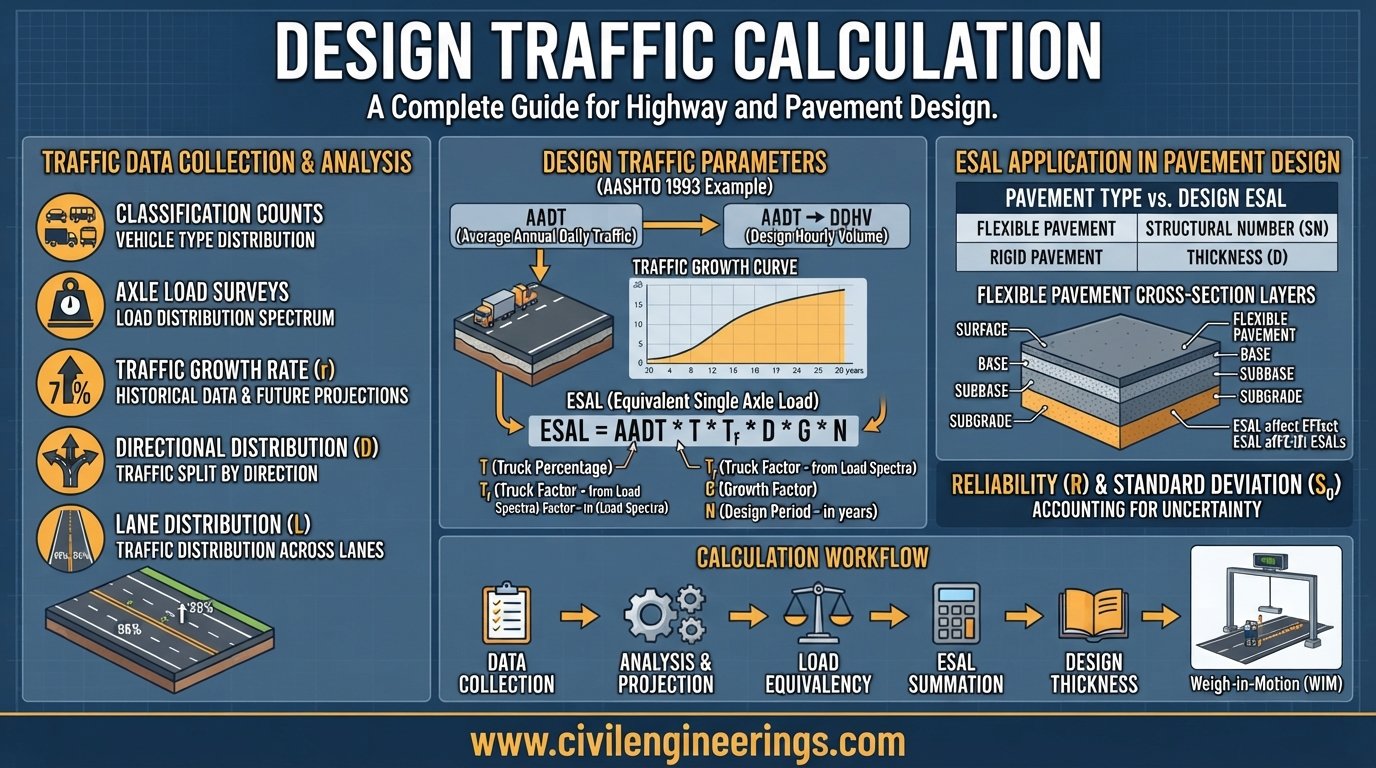
Designing a road without accurately estimating future traffic is like designing a bridge without knowing the load it must carry. A pavement may look adequate on opening day, yet fail prematurely when heavy commercial vehicles, axle loads, and traffic growth exceed the assumptions used during design.
Design Traffic Calculation converts present and projected traffic into a design loading that engineers can use to determine pavement thickness, structural capacity, lane requirements, and long-term performance. It considers factors such as existing commercial traffic, annual traffic growth, design life, directional distribution, lane distribution, vehicle damage factors, and equivalent standard axle loads.
This guide explains the complete design traffic calculation process, including traffic data collection, growth projection, commercial vehicle estimation, lane distribution, vehicle damage factor, cumulative standard axles, ESAL concepts, worked examples, common mistakes, and practical engineering recommendations. It also discusses how IRC, AASHTO, and ICE-related highway practices approach traffic and pavement design.
Whether you are a civil engineering student preparing for an examination or a highway engineer developing a pavement design report, the following methodology provides a practical framework for understanding and checking design traffic calculations.
What Is Design Traffic Calculation?
Design traffic calculation is the engineering process of estimating the cumulative traffic loading that a pavement is expected to experience during its selected design period.
Unlike a simple traffic count, design traffic calculation is concerned with future pavement loading. Engineers must determine not only how many vehicles currently use a road, but also how many will use it in the future and how severely different vehicle types will load the pavement.
For flexible pavement design, traffic is commonly expressed as the cumulative number of equivalent standard axle repetitions. Depending on the adopted design method, this may be expressed as:
- Million Standard Axles (MSA)
- Equivalent Standard Axle Loads (ESALs)
- Equivalent Single Axle Loads
- Cumulative axle-load repetitions
- Other mechanistic traffic-loading parameters
IRC pavement practice uses standard axle concepts extensively, while AASHTO pavement procedures use equivalent axle loading and, in modern approaches, more detailed axle-load and vehicle information. IRC publications describe pavement design in terms of cumulative standard axle loading, including the 80 kN standard axle concept. (Indian Registry for Internet Names)


Why Design Traffic Is Important in Highway Engineering
Traffic loading is one of the principal inputs in pavement structural design. A pavement that carries mostly passenger cars experiences a very different loading environment from one carrying buses, overloaded trucks, container trailers, and multi-axle vehicles.
The importance of design traffic calculation can be understood through several engineering requirements.
Pavement Thickness
Flexible pavement thickness depends strongly on the cumulative loading expected during the design period.
Underestimating traffic can result in:
- premature rutting;
- fatigue cracking;
- deformation;
- potholes;
- structural failures;
- excessive maintenance requirements.
Overestimating traffic can also create problems because the resulting pavement may be unnecessarily thick and expensive.
Economic Design
The objective is not simply to construct the thickest possible pavement.
A competent highway engineer seeks an economical structure that can safely accommodate the anticipated traffic while satisfying the applicable performance criteria.
Accurate traffic forecasting therefore contributes directly to life-cycle cost optimization.
Road Capacity and Lane Planning
Traffic calculation also supports geometric design. Forecast traffic affects decisions involving:
- number of lanes;
- carriageway width;
- intersections;
- climbing lanes;
- service roads;
- median arrangements;
- interchange requirements.
ICE guidance emphasizes that effective highway design requires reliable knowledge of design loadings and consideration of their interaction with ground, environment, and other engineering factors. (Institution of Civil Engineers (ICE))
Pavement Rehabilitation
For an existing highway, traffic data can help engineers estimate the loading already experienced by the pavement and the additional loading expected during the rehabilitation design period.
FHWA guidance specifically identifies project traffic counts as an important input for estimating traffic loads in pavement rehabilitation design. (Federal Highway Administration)
Major Inputs Required for Design Traffic Calculation
A reliable calculation begins with reliable input data. The most important parameters are the following.
Initial Traffic
Initial traffic represents the traffic at the beginning of the pavement design period.
For pavement design, engineers are particularly interested in commercial vehicles, because heavy vehicles produce substantially greater pavement damage than ordinary passenger vehicles.
Traffic may be obtained through:
- classified traffic counts;
- automatic traffic counters;
- automatic traffic counter-cum-classifier systems;
- axle-load surveys;
- historical traffic records;
- toll-plaza data;
- origin-destination surveys;
- traffic forecasting studies.
T Growth Rate
Traffic normally increases over time because of:
- population growth;
- economic development;
- industrial activity;
- vehicle ownership;
- urban expansion;
- agricultural production;
- freight movement;
- tourism;
- new developments.
The annual growth rate is commonly represented by r.
For example, a 6% annual growth rate is represented as:
r = 0.06
The selected growth rate should be supported by historical traffic data and an appropriate forecasting methodology rather than simply choosing a convenient percentage.
Design Period
The design period, represented by n, is the period over which the pavement or facility is evaluated for the selected design criteria.
For example:
n = 15 years
or
n = 20 years
The correct period depends on the road classification, pavement type, governing standard, rehabilitation strategy, and project requirements.
Directional Distribution Factor
Traffic on a two-way road is divided between the two directions.
The directional distribution factor, commonly represented by D, accounts for the proportion of traffic traveling in the design direction.
If 55% of commercial vehicles travel in one direction:
D = 0.55
For a balanced road, the value may be approximately 0.50, but field data should be preferred where available.
Lane Distribution Factor
On a multilane highway, not all traffic in a direction uses the design lane equally.
Heavy vehicles tend to concentrate in particular lanes, especially on divided highways.
Therefore, engineers apply a lane distribution factor to determine the proportion of design traffic carried by the critical lane.
This factor must be selected according to the applicable design standard and actual road configuration.
Vehicle Damage Factor
The Vehicle Damage Factor (VDF) represents the damaging effect of commercial vehicles relative to a standard axle.
A heavily loaded multi-axle truck may cause considerably more pavement damage than a light commercial vehicle.
VDF is influenced by:
- axle configuration;
- axle loads;
- vehicle type;
- loading condition;
- pavement design methodology;
- traffic composition.
An axle-load survey is often preferable when heavy-vehicle loading is significant.
How to Calculate Design Traffic Step by Step
The following procedure provides a practical framework for a typical flexible pavement calculation.
Step 1: Determine Existing Commercial Traffic
Begin with classified traffic data.
Suppose a survey establishes:
Commercial Vehicles = 1,500 vehicles/day
This value should represent the appropriate traffic year and survey location.
If the road has significant seasonal variation, engineers should adjust short-duration counts using appropriate seasonal factors.
Step 2: Estimate Traffic at the Opening of the Road
If the survey year differs from the expected opening year, project the traffic forward.
A commonly used compound-growth relationship is:
Where:
- = commercial vehicles per day at opening;
- = present commercial vehicles per day;
- = annual growth rate;
- = number of years between the survey year and opening year.
For example, if:
- present traffic = 1,500 CVPD;
- growth rate = 6%;
- opening is 2 years later,
then:
This becomes the starting traffic for the design period.
Step 3: Apply the Traffic Growth Factor
For compound annual growth, the cumulative growth factor is:
where:
- = annual growth rate;
- = design period in years.
This factor effectively sums the traffic contribution from each year of the design period.
Step 4: Account for Direction and Lane Distribution
The traffic carried by the critical design lane can be represented by:
Where:
- = commercial vehicles/day in the design lane;
- = opening-year commercial vehicles/day;
- = directional distribution factor;
- = lane distribution factor.
The actual values of D and L must come from the governing standard, project conditions, or traffic study.
Step 5: Apply the Vehicle Damage Factor
Once the design-lane commercial traffic is established, VDF converts commercial vehicle repetitions into standard axle repetitions.
The general relationship is:
Where:
- = cumulative standard axle repetitions;
- = opening-year commercial vehicles/day;
- = cumulative growth factor;
- = directional distribution factor;
- = lane distribution factor;
- = vehicle damage factor.
The exact terminology and factors vary between design standards, so the adopted IRC, AASHTO, agency, or project methodology should always control the final calculation.
Step 6: Convert to Million Standard Axles
If the calculated cumulative traffic is expressed in standard axle repetitions:
Thus, if:
then:
The pavement would therefore be designed for approximately 25 MSA, subject to the applicable design procedure and assumptions.


Worked Example of Design Traffic Calculation
Consider a proposed flexible pavement with the following assumptions:
- Opening-year commercial traffic = 1,800 CVPD
- Annual traffic growth = 6%
- Design period = 15 years
- Directional factor = 0.50
- Design-lane factor = 0.75
- Vehicle Damage Factor = 3.0
Calculate the Growth Factor
Calculate Cumulative Standard Axles
Therefore:
The calculated design traffic is therefore approximately:
25.8 MSA
This example is illustrative. In an actual pavement design, the engineer must determine VDF from appropriate axle-load information or the governing standard rather than assuming a value without justification.
ESAL and Standard Axle Concept
What Is an ESAL?
An Equivalent Single Axle Load (ESAL) expresses the pavement-damaging effect of different axle loads in terms of an equivalent standard axle.
The fundamental idea is simple: one heavy axle does not have the same pavement effect as one light axle.
AASHTO pavement procedures have historically used equivalent axle load concepts, while modern pavement analysis can incorporate more detailed axle-load spectra and mechanistic-empirical procedures. AASHTO’s current pavement engineering guide also covers modern pavement analysis, construction, maintenance, and the AASHTOWare Pavement ME Design framework. (AASHTO Store)
Why Axle Load Matters More Than Vehicle Count
Two roads could each carry 10,000 vehicles per day but experience dramatically different pavement loading.
For example Road:
A
- 9,000 passenger cars
- 1,000 light commercial vehicles
Road B
- 6,000 passenger cars
- 4,000 heavily loaded trucks
Road B will generally impose much greater structural loading.
Consequently, pavement traffic analysis should not rely solely on total AADT.
Traffic Data Collection for Design Traffic
Classified Traffic Count
A classified traffic count identifies vehicles by category and direction.
Typical categories can include:
- motorcycles;
- cars;
- vans;
- light commercial vehicles;
- buses;
- two-axle trucks;
- three-axle trucks;
- multi-axle trucks;
- tractor-trailers.
For pavement design, truck classification is particularly important.
Axle Load Survey
An axle-load survey determines the actual loads carried by different axles.
It can be conducted using:
- weigh-in-motion systems;
- portable axle weighing equipment;
- static weigh stations;
- other approved measurement systems.
This information becomes particularly valuable where heavy freight traffic or overloading is significant.
Automatic Traffic Counter-Cum-Classifiers
Modern projects increasingly use automatic systems to collect continuous traffic data.
Depending on the equipment, these systems can record:
- vehicle count;
- vehicle classification;
- direction;
- speed;
- axle configuration;
- time of passage.
Indian highway project documentation also recognizes technologies such as pneumatic tubes, inductive loops, video detection, and infrared systems for automatic traffic counting and classification. (Infracon)
FHWA recommends longer-duration classification counts where practical and notes that project-specific counts can be required for pavement design and rehabilitation studies. (Federal Highway Administration)
Factors That Can Significantly Change Design Traffic
Traffic Growth Is Not Always Constant
A simple constant growth rate is convenient, but actual traffic may change because of:
- new industrial zones;
- new highways;
- economic recessions;
- changes in freight routes;
- major housing developments;
- new ports or logistics terminals;
- fuel-price changes;
- policy interventions.
A highway engineer should therefore review the plausibility of the assumed growth rate.
Overloading Can Increase Pavement Damage
Heavy commercial vehicles can have a disproportionate effect on pavement deterioration.
If an axle-load survey reveals widespread overloading, using an old or generic VDF may underestimate the actual structural demand.
Traffic Diversion Must Be Considered
A new expressway or bypass may divert traffic from an existing route.
Similarly, a new industrial facility may suddenly increase truck traffic.
Traffic forecasting should therefore consider the broader transportation network rather than treating the project road as an isolated facility.
IRC, AASHTO and ICE Considerations
IRC Approach
Indian Road Congress guidance provides established procedures for flexible pavement design and traffic loading. IRC documents use commercial traffic, axle loading, standard axle concepts, and pavement performance criteria within their respective design methodologies. IRC material also distinguishes pavement design approaches according to traffic levels and pavement conditions. (Indian Registry for Internet Names)
For Indian projects, the engineer should use the latest applicable IRC document specified by the road authority, rather than relying on an old formula from a textbook.
AASHTO Approach
AASHTO pavement methodology has evolved from traditional ESAL-based procedures toward more comprehensive mechanistic-empirical approaches.
The current AASHTO pavement guide covers pavement structural design, materials, construction, maintenance, preservation, and modern pavement analysis tools. (AASHTO Store)
ICE and UK Highway Practice
ICE guidance emphasizes the use of appropriate highway design standards, accurate design loading information, engineering judgment, site investigation, and validated design procedures. In UK practice, highway design also interfaces with the Design Manual for Roads and Bridges and other applicable standards. (Institution of Civil Engineers (ICE))
Therefore, IRC, AASHTO, and ICE references should be viewed as frameworks and professional references, not interchangeable calculation standards.
Common Mistakes in Design Traffic Calculation
Using Total Traffic Instead of Commercial Traffic
One of the most common mistakes is multiplying total AADT by a growth factor without separating heavy vehicles.
Pavement structural loading requires appropriate vehicle and axle information.
Ignoring Lane Distribution
Using total two-way traffic directly for a single design lane can significantly overestimate or underestimate pavement loading.
Selecting an Unsupported Growth Rate
A 5% or 6% growth rate should not become a default assumption merely because it appears in a previous project.
Historical traffic data and development forecasts should support the selected value.
Using an Inappropriate VDF
A VDF derived from a completely different highway can produce misleading results.
Truck composition, axle loading, freight characteristics, and regional overloading patterns can vary considerably.
Ignoring Seasonal Traffic
Agricultural areas, tourist corridors, mining routes, and industrial roads can experience significant seasonal fluctuations.
Short surveys should therefore be adjusted carefully.
Mixing Different Standards
Engineers sometimes combine:
- an IRC traffic formula;
- an AASHTO equivalency factor;
- a local lane distribution factor;
- and an unrelated design-life assumption.
This can produce an internally inconsistent design.
Use one coherent methodology unless a formal comparison is being undertaken.
Practical Recommendations for Engineers and Contractors
For Civil Engineering Students
Students should focus first on understanding the meaning of every variable.
Do not memorize the equation alone. Understand why traffic growth, lane distribution, axle loading, and VDF appear in the calculation.
Practice at least three types of problems:
- constant traffic;
- traffic with compound growth;
- traffic converted to standard axle repetitions.
For Highway Engineers
Before approving a design traffic calculation, check:
- survey duration;
- survey location;
- vehicle classification;
- traffic direction;
- commercial vehicle percentage;
- growth assumptions;
- design period;
- axle-load data;
- VDF;
- lane distribution;
- traffic diversion;
- planned developments.
Maintain a transparent calculation sheet so another engineer can reproduce the result.
For Contractors
Contractors should understand the design traffic assumptions even though they normally do not establish the pavement design.
Traffic assumptions influence:
- pavement layer thickness;
- construction sequencing;
- material quantities;
- construction traffic management;
- temporary diversion design;
- pavement protection during construction.
Heavy construction vehicles can impose substantial temporary loading, particularly on newly constructed or partially completed pavement layers.
Design Traffic Calculation Checklist
Before finalizing a pavement traffic calculation, verify the following:
- Traffic survey data are representative.
- Commercial vehicles are correctly identified.
- Survey year is established.
- Opening-year traffic is calculated correctly.
- Traffic growth rate has engineering justification.
- Design period matches the governing standard.
- Directional distribution is appropriate.
- Critical-lane distribution is considered.
- Vehicle damage factor is supported by data or the governing standard.
- Axle-load information has been reviewed where required.
- Cumulative traffic has been converted correctly to MSA or ESALs.
- Units have been checked.
- Rounding has not materially affected the result.
- The final calculation is consistent with the adopted pavement design method.
Frequently Asked Questions About Design Traffic Calculation
What is Design Traffic Calculation?
Design traffic calculation is the process of estimating cumulative future traffic loading that a pavement is expected to carry during its design period. It normally considers commercial traffic, traffic growth, lane distribution, axle loading, and equivalent standard axle repetitions.
What is the basic formula for design traffic?
A commonly used general relationship for cumulative standard axle loading is:
The exact formula and factors must be checked against the applicable design standard.
What is MSA in pavement design?
MSA means Million Standard Axles. It represents cumulative standard axle repetitions divided by one million.
For example, 30,000,000 standard axle repetitions equal 30 MSA.
Why is commercial traffic important?
Commercial vehicles generally produce much greater pavement loading than passenger cars. Therefore, pavement structural design requires information about heavy vehicles rather than relying solely on total vehicle volume.
What is Vehicle Damage Factor?
Vehicle Damage Factor is a parameter used to convert commercial vehicle traffic into an equivalent standard axle loading. It reflects the damaging effect of the commercial vehicle population relative to the adopted standard axle.
How is traffic growth calculated?
For compound annual growth, future traffic can be estimated using:
where is initial traffic, is annual growth rate, and is the number of years.
Is AADT sufficient for pavement design?
Usually, AADT alone is not sufficient for detailed pavement structural design. Engineers normally need vehicle classification and, where required, axle-load information to estimate structural traffic loading.
What is the difference between ESAL and MSA?
ESAL is an equivalent axle-loading unit, while MSA is a way of expressing a large cumulative number of standard axle repetitions in millions.
For example, 20 million standard axle repetitions can be reported as 20 MSA.
Which standard should be used for design traffic calculation?
The engineer should follow the standard specified by the project authority and applicable jurisdiction. For Indian roads, relevant IRC guidance may apply; AASHTO procedures are common in the United States and other projects; UK projects may follow DMRB and associated standards. These methodologies should not be mixed without a clear engineering basis. (Institution of Civil Engineers (ICE))
Conclusion
Design Traffic Calculation is one of the most important steps in pavement and highway engineering because it establishes the traffic loading that the road must withstand throughout its design period. A reliable calculation begins with representative traffic data and then considers commercial vehicle volume, traffic growth, directional distribution, lane distribution, axle loading, vehicle damage factors, and cumulative standard axle repetitions.
The quality of the final pavement design depends heavily on the quality of these assumptions. An underestimated design traffic value can contribute to premature pavement deterioration, while an excessive value can increase construction costs without providing proportional benefits.
For professional practice, engineers should use current and project-specific traffic surveys wherever possible, validate growth assumptions against development forecasts, investigate axle loading on heavy-freight routes, and apply the complete methodology required by the governing standard. IRC, AASHTO, ICE, and other highway authorities provide valuable frameworks, but the project-specific design standard should always take precedence.
Ultimately, accurate Design Traffic Calculation transforms raw traffic counts into a meaningful structural design input, helping engineers develop safer, more durable, economical, and sustainable road infrastructure.
