
Introduction
Every successful road begins with a thorough understanding of the ground beneath it. Even the best pavement design cannot perform well if engineers ignore the soil’s strength, composition, and behavior. A weak foundation often causes settlement, cracking, rutting, and costly maintenance long before the pavement reaches its expected service life.
Soil Investigation for Road is one of the most critical stages in highway engineering because it provides the information required to design safe, durable, and economical roads. Civil engineers rely on soil investigations to determine the bearing capacity, moisture characteristics, density, and engineering properties of the ground before construction begins.
Whether the project involves a village road, a state highway, or an expressway, proper soil investigation reduces construction risks, improves pavement performance, and extends the life of the roadway. It also helps engineers select suitable construction materials, determine pavement thickness, and avoid unexpected ground failures.
In this comprehensive guide, you will learn the purpose, objectives, methods, engineering principles, and field procedures involved in Soil Investigation for Road, along with practical examples and industry best practices.
What Is Soil Investigation for Road?
Soil Investigation for Road is the systematic process of studying the physical and engineering properties of soil along a proposed road alignment. Engineers collect field data and laboratory results to evaluate whether the existing soil can safely support pavement layers and traffic loads.
The investigation helps determine:
- Soil type
- Bearing capacity
- Moisture content
- Density
- Shear strength
- Compressibility
- Permeability
- Groundwater conditions
This information forms the foundation of pavement design, embankment construction, drainage planning, and slope stability analysis.
Why Soil Investigation Is Essential in Highway Engineering
The soil beneath a road carries every vehicle load transmitted through the pavement layers. If the foundation lacks strength, the entire pavement structure becomes vulnerable to failure.
A detailed soil investigation helps engineers:
- Design economical pavement structures.
- Identify unsuitable soil before construction.
- Select proper ground improvement methods.
- Reduce future maintenance costs.
- Improve road safety and durability.
- Prevent uneven settlement.
- Enhance drainage performance.
- Increase pavement service life.
Practical Example
Imagine two roads constructed with identical pavement thicknesses. One rests on dense gravel, while the other sits on soft clay. The gravel foundation provides excellent support and experiences minimal deformation. The clay foundation compresses under repeated traffic loads, causing cracks and rutting within a few years.
This example demonstrates why soil investigation is essential before designing any road.
Objectives of Soil Investigation
Engineers conduct soil investigations to collect accurate information that supports safe and economical highway design.
Primary Objectives
- Determine soil strength.
- Measure bearing capacity.
- Identify groundwater levels.
- Evaluate moisture conditions.
- Assess slope stability.
- Classify soil according to engineering standards.
- Recommend suitable pavement thickness.
- Identify problematic soils.
- Select appropriate construction methods.
- Estimate earthwork requirements.
These objectives enable engineers to make informed decisions throughout the project lifecycle.
Engineering Principles Behind Soil Investigation
Several engineering principles govern the behavior of soil under traffic loads. Understanding these principles helps engineers design pavements that remain stable throughout their design life.
Load Distribution
Vehicle loads travel through the pavement and spread into the underlying soil. Strong subgrade soil distributes loads efficiently, while weak soil concentrates stresses and increases deformation.
      Vehicle Load
           │
           ▼
======================
 Asphalt Surface
======================
 Base Course
======================
 Sub-base
======================
 Compacted Subgrade
======================
 Natural Soil
Every pavement layer reduces the stress reaching the natural ground. Therefore, the strength of the subgrade directly influences pavement performance.
Bearing Capacity
Bearing capacity represents the maximum load that soil can safely support without excessive settlement or shear failure.
High bearing capacity allows engineers to design thinner and more economical pavements. Low bearing capacity often requires soil stabilization or thicker pavement layers.
Compaction
Compaction increases soil density by reducing air voids.
Proper compaction:
- Improves strength.
- Reduces settlement.
- Increases stability.
- Minimizes water infiltration.
- Enhances pavement performance.
Field compaction remains one of the most important quality control activities during road construction.
Moisture Control
Water significantly affects soil behavior.
Excess moisture reduces soil strength, while insufficient moisture prevents effective compaction. Engineers therefore determine the optimum moisture content before beginning earthwork.
Maintaining proper moisture levels improves long-term pavement performance.
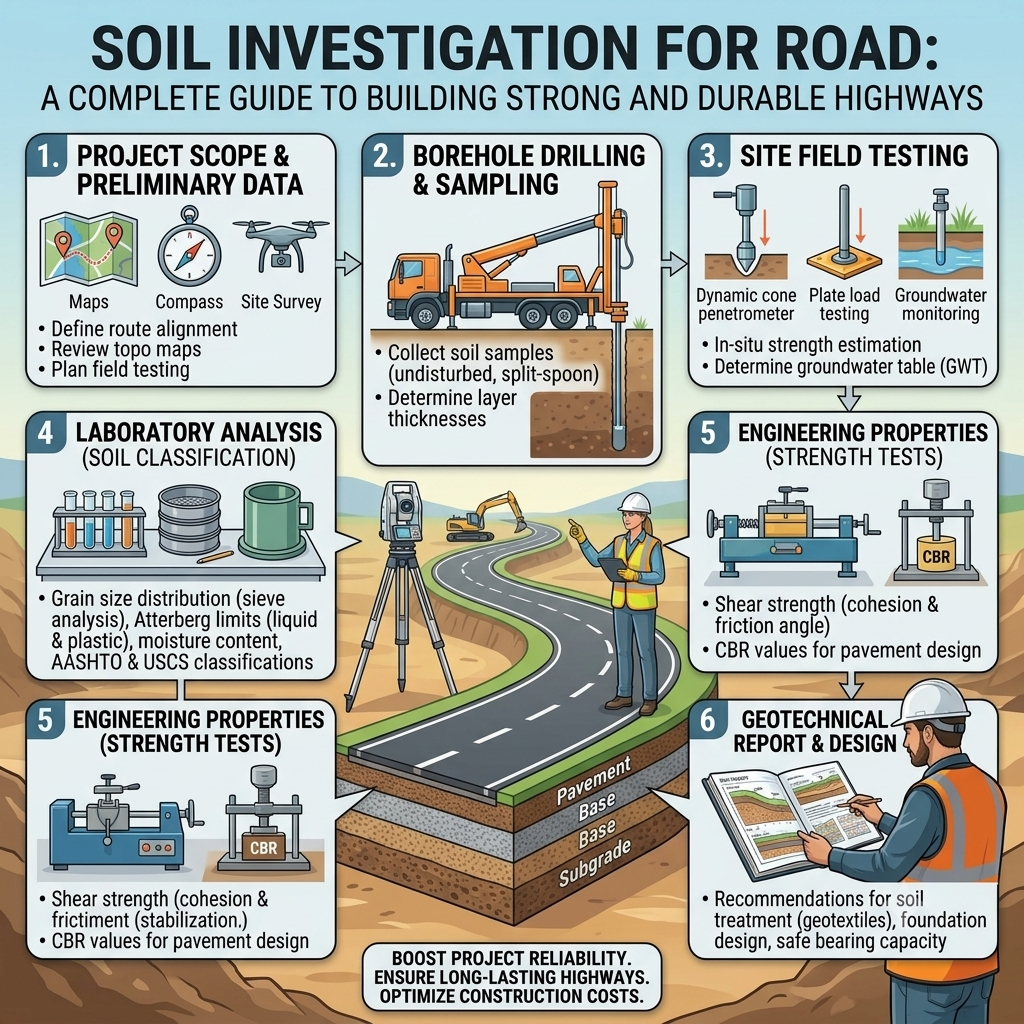
Step-by-Step Soil Investigation Process
Every road project follows a structured investigation procedure to ensure reliable data collection and engineering analysis.
Step 1: Desk Study
The investigation begins with collecting and reviewing available information about the project area.
Information Reviewed
- Geological maps
- Topographic maps
- Satellite imagery
- Existing road data
- Previous investigation reports
- Hydrological records
- Rainfall data
- Land-use information
Purpose
The desk study helps engineers understand existing site conditions before visiting the project location.
It also identifies potential challenges that require detailed investigation during fieldwork.
Step 2: Site Reconnaissance
After completing the desk study, engineers visit the project site to observe existing conditions.
A reconnaissance survey provides valuable firsthand information that cannot always be obtained from maps or reports.
Engineers Observe
- Existing roads
- Surface drainage
- Vegetation
- Soil exposure
- Rock outcrops
- Erosion
- Flood-prone areas
- Nearby structures
- Utility corridors
Benefits
Site reconnaissance helps engineers:
- Verify map information.
- Identify inaccessible areas.
- Locate borehole positions.
- Detect unstable slopes.
- Understand local environmental conditions.
Step 3: Field Investigation Methods
Field investigations provide the actual engineering data required for pavement and foundation design.
Different methods suit different soil conditions and project requirements.
Borehole Drilling
Engineers drill boreholes at selected intervals along the proposed highway alignment.
Boreholes reveal:
- Soil layers
- Groundwater levels
- Rock depth
- Soil consistency
Typical Borehole Layout
Road Centerline
----------------------------------------------------

BH1--------BH2--------BH3--------BH4--------BH5

BH = Borehole Location
The spacing depends on terrain, project size, and soil variability.
Trial Pits
Engineers excavate shallow pits to inspect near-surface soil conditions directly.
Trial pits allow visual examination of:
- Soil texture
- Layer thickness
- Moisture condition
- Root penetration
- Fill material
They also provide disturbed and undisturbed soil samples.
Standard Penetration Test (SPT)
The Standard Penetration Test measures soil resistance by driving a split-spoon sampler into the ground using a standard hammer.
Engineers use SPT values to estimate:
- Soil density
- Relative strength
- Bearing capacity
- Settlement characteristics
The test is widely used because it provides reliable data for many soil types.
Cone Penetration Test (CPT)
The Cone Penetration Test pushes a cone-shaped probe into the soil at a constant rate.
The equipment continuously records soil resistance with depth.
Advantages
- Fast testing
- Continuous soil profile
- Accurate stratification
- Minimal disturbance
- Reliable data for soft soils
Groundwater Investigation
Groundwater influences pavement performance and embankment stability.
Engineers measure:
- Water table depth
- Seasonal groundwater fluctuations
- Drainage conditions
- Soil saturation
High groundwater levels may require subsoil drainage or improved pavement design.
Practical Application
Suppose engineers plan a four-lane highway across an agricultural area. During the field investigation, boreholes reveal alternating layers of clay and loose sand, while groundwater appears only 1.5 meters below the surface.
Based on these findings, the design team may recommend:
- Raising the embankment height.
- Installing subsurface drainage.
- Stabilizing weak clay with lime.
- Increasing pavement thickness.
- Improving compaction specifications.
These decisions reduce future settlement and improve the long-term performance of the highway.
Key Takeaways
A comprehensive Soil Investigation for Road forms the foundation of every successful highway project. By combining desk studies, site reconnaissance, borehole drilling, trial pits, penetration tests, and groundwater investigations, engineers gain the knowledge required to design safe and durable pavements. Understanding soil behavior, bearing capacity, compaction, and moisture conditions allows project teams to minimize risks, optimize construction costs, and extend pavement life. Investing in detailed soil investigations during the planning stage saves significant time and money throughout the construction and maintenance phases.
Step 4: Soil Sampling
After completing the field investigation, engineers collect representative soil samples for laboratory testing. Proper sampling ensures that laboratory results accurately reflect the actual ground conditions along the proposed road alignment.
Engineers generally collect two types of samples:
Disturbed Samples
Disturbed samples lose their natural structure during collection. Engineers use these samples for identification and classification tests.
Common tests include:
- Grain Size Analysis
- Atterberg Limits
- Moisture Content
- Specific Gravity
Undisturbed Samples
Undisturbed samples preserve the soil’s natural structure. Engineers use them to evaluate engineering properties that influence pavement and foundation performance.
Typical tests include:
- Triaxial Compression Test
- Direct Shear Test
- Consolidation Test
- Permeability Test
Best Sampling Practices
- Label every sample correctly.
- Record sampling depth accurately.
- Seal samples immediately to preserve moisture.
- Transport samples carefully to avoid disturbance.
- Store samples under suitable conditions before testing.
Proper sampling improves the reliability of laboratory results and supports accurate pavement design.
Step 5: Laboratory Testing
Laboratory testing provides detailed information about the engineering characteristics of soil. Engineers use these results to determine pavement thickness, select construction methods, and recommend soil improvement techniques.
Moisture Content Test
This test measures the amount of water present in the soil.
Importance
- Determines field moisture conditions.
- Supports compaction control.
- Assists in earthwork planning.
Grain Size Analysis
Engineers perform sieve analysis and hydrometer testing to determine particle size distribution.
Purpose
- Classify soil.
- Evaluate drainage characteristics.
- Assess compaction behavior.
- Select suitable construction materials.
Atterberg Limits
These tests determine the consistency and plasticity of fine-grained soils.
They include:
- Liquid Limit (LL)
- Plastic Limit (PL)
- Plasticity Index (PI)
Engineering Significance
Highly plastic soils often experience excessive swelling and shrinkage. Engineers may stabilize such soils before construction.
Proctor Compaction Test
The Proctor Test identifies the Optimum Moisture Content (OMC) and Maximum Dry Density (MDD).
Why It Matters
Compaction carried out near the OMC achieves maximum soil density and strength, reducing settlement and improving pavement performance.
California Bearing Ratio (CBR) Test
The CBR test is one of the most important tests in Soil Investigation for Road because it measures the load-bearing capacity of the subgrade.
Typical CBR Values
| Soil Type | Approximate CBR |
|---|---|
| Soft Clay | 2–5% |
| Slity Soil | 5–10% |
| Sandy Soil | 10–20% |
| Well-Graded Gravel | 40–80% |
Higher CBR values indicate stronger subgrade soils and often allow thinner pavement structures.
Shear Strength Tests
Engineers determine soil strength using:
- Direct Shear Test
- Triaxial Compression Test
- Unconfined Compression Test (for cohesive soils)
These tests help evaluate slope stability, embankment safety, and foundation performance.
Step 6: Soil Classification
Soil classification organizes different soil types according to their engineering properties. A proper classification system helps engineers predict soil behavior and select suitable construction methods.
Common Soil Types
- Gravel
- Sand
- Silt
- Clay
- Organic Soil
- Peat
Widely Used Classification Systems
- Unified Soil Classification System (USCS)
- AASHTO Soil Classification System
These systems consider grain size, plasticity, and engineering behavior to classify soils for highway applications.
Step 7: Engineering Analysis
After completing field and laboratory investigations, engineers analyze all collected data.
The analysis helps determine:
- Pavement thickness
- Embankment stability
- Ground improvement needs
- Drainage requirements
- Foundation recommendations
- Construction methods
Example
Suppose laboratory results indicate:
- CBR = 4%
- High Plasticity Index
- High Groundwater Level
Engineers may recommend:
- Lime stabilization
- Granular capping layer
- Geotextile reinforcement
- Increased pavement thickness
- Improved drainage system
Such recommendations improve road performance and reduce future maintenance costs.
Step 8: Soil Investigation Report
The final stage involves preparing a comprehensive soil investigation report.
The report serves as the primary reference document for pavement designers, structural engineers, and construction teams.
Typical Report Contents
- Project overview
- Site location
- Geological information
- Field investigation details
- Borehole logs
- Groundwater observations
- Laboratory test results
- Soil classification
- Engineering analysis
- Design recommendations
- Conclusions
A clear and well-organized report supports informed decision-making throughout the project lifecycle.
Common Soil Problems in Road Construction
Several soil conditions can create challenges during highway construction.
Expansive Clay
Expands when wet and shrinks during dry periods, causing pavement cracking and uneven settlement.
Solution
- Lime stabilization
- Moisture control
- Improved drainage
Soft Clay
Possesses low bearing capacity and high compressibility.
Solution
- Soil replacement
- Preloading
- Geosynthetic reinforcement
- Stone columns
Loose Sand
May experience excessive settlement under traffic loads.
Solution
- Mechanical compaction
- Vibro-compaction
- Cement stabilization
Organic Soil
Contains decomposed organic matter with very low strength.
Solution
- Complete removal
- Replacement with engineered fill
Practical Applications of Soil Investigation
Soil investigation supports many aspects of highway engineering, including:
- Pavement design
- Bridge foundation design
- Embankment construction
- Retaining wall design
- Culvert foundations
- Drainage system planning
- Slope stabilization
- Ground improvement projects
Accurate soil data reduces uncertainties and helps engineers optimize construction costs.
Best Practices for Soil Investigation
- Start investigations during the planning phase.
- Use qualified geotechnical professionals.
- Perform adequate boreholes across the project alignment.
- Combine field observations with laboratory testing.
- Monitor groundwater conditions throughout the investigation.
- Follow standardized testing procedures.
- Document all field activities carefully.
- Review investigation results before finalizing pavement design.
- Update recommendations if site conditions change during construction.
Practical Recommendations
Civil Engineers
- Correlate laboratory results with field observations.
- Avoid relying on a single borehole for long highway sections.
- Consider seasonal groundwater fluctuations during design.
- Verify subgrade conditions before construction begins.
Contractors
- Protect exposed soil from excessive moisture.
- Achieve specified field compaction levels.
- Replace unsuitable material promptly.
- Maintain accurate quality control records.
Engineering Students
- Understand the purpose of each laboratory test.
- Learn how CBR values influence pavement thickness.
- Study real geotechnical reports.
- Visit active investigation sites to observe field equipment and sampling techniques.
General Discussion of IRC, AASHTO, and ICE Practices
Recognized highway engineering organizations emphasize that reliable soil data forms the basis of safe and economical pavement design.
General recommendations include:
- Carry out detailed geotechnical investigations before design.
- Base pavement thickness on subgrade strength and projected traffic loading.
- Achieve specified compaction requirements for embankments and pavement layers.
- Monitor groundwater conditions and provide adequate drainage.
- Follow standardized laboratory and field testing procedures.
- Review investigation findings before approving construction.
Applying these principles improves pavement durability, reduces maintenance costs, and enhances long-term highway performance.
Frequently Asked Questions (FAQs)
1. What is soil investigation for road construction?
Soil investigation is the process of studying soil properties through field exploration and laboratory testing to determine whether the ground can safely support a road.
2. Why is soil investigation important before building a road?
It helps engineers evaluate soil strength, bearing capacity, groundwater conditions, and drainage characteristics, allowing them to design safe and durable pavements.
3. Which test is most important for pavement design?
The California Bearing Ratio (CBR) test is widely used because it measures the strength of the subgrade and helps determine pavement thickness.
4. What is the purpose of the Proctor Compaction Test?
The Proctor Test identifies the Optimum Moisture Content (OMC) and Maximum Dry Density (MDD) needed to achieve effective soil compaction.
5. How does groundwater affect road construction?
High groundwater levels reduce soil strength, increase moisture content, and may require improved drainage or ground stabilization.
6. What is the difference between disturbed and undisturbed soil samples?
Disturbed samples are suitable for classification tests, while undisturbed samples preserve natural soil structure for strength and consolidation testing.
7. Which soil is best for road construction?
Well-graded gravel and dense sandy soils generally provide excellent support because they have high bearing capacity and good drainage characteristics.
8. How often should boreholes be drilled during a road investigation?
The spacing depends on terrain, project length, and soil variability. Engineers determine appropriate intervals based on project-specific requirements.
9. Can engineers improve weak soil instead of replacing it?
Yes. Common improvement methods include lime stabilization, cement stabilization, geotextile reinforcement, stone columns, and mechanical compaction.
10. Who prepares the soil investigation report?
Qualified geotechnical engineers prepare the report after analyzing field observations, laboratory results, and engineering recommendations.
Conclusion
A comprehensive Soil Investigation for Road provides the technical foundation for designing safe, durable, and cost-effective highway infrastructure. From desk studies and field reconnaissance to borehole drilling, laboratory testing, soil classification, and engineering analysis, each stage supplies critical information about the ground conditions beneath the proposed roadway. Reliable soil data enables engineers to select appropriate pavement thickness, improve weak subgrades, design effective drainage systems, and reduce the risk of settlement or premature pavement failure. It also helps contractors plan construction activities efficiently and ensures that projects comply with recognized engineering practices. Investing in a detailed Soil Investigation for Road at the beginning of a project saves significant time and money during construction and maintenance. Whether you are a civil engineer, contractor, researcher, or engineering student, mastering soil investigation principles strengthens your ability to build roads that remain safe, stable, and serviceable for decades.
