
Introduction
Every successful road, highway, bridge, or building begins with a clear understanding of the soil beneath it. Soil serves as the foundation for every civil engineering structure, and its characteristics directly influence strength, stability, durability, and construction cost. Engineers cannot design safe infrastructure without first identifying the type of soil present at the project site.
Soil Classification is the scientific process of grouping soils based on their physical and engineering properties. It allows engineers to predict how soil will behave under different loading and environmental conditions. Instead of treating every soil as unique, classification systems organize soils into standardized categories that simplify design, testing, construction, and quality control.
In highway engineering, proper Soil Classification plays a vital role in pavement design, embankment construction, slope stability, drainage planning, and foundation selection. Selecting the wrong soil or misunderstanding its properties can lead to settlement, pavement cracking, excessive maintenance, and costly reconstruction.
This comprehensive guide explains the principles of Soil Classification, the major classification systems used worldwide, practical engineering applications, and best practices for civil engineers, contractors, and engineering students.
What Is Soil Classification?
Soil Classification is the systematic process of identifying and grouping soils according to their grain size, particle distribution, plasticity, mineral composition, and engineering behavior. Engineers use standardized systems to classify soils into categories with similar characteristics, making it easier to predict their performance under construction and loading conditions.
A soil classification system provides a common language for engineers, geologists, contractors, and laboratory technicians. Instead of describing every soil in detail, professionals assign a standard classification symbol or group name that reflects its engineering properties.
For example:
- Well-graded gravel
- Poorly graded sand
- Silty sand
- Lean clay
- Fat clay
- Organic soil
Each classification indicates how the soil is likely to respond to compaction, moisture changes, drainage, and structural loads.
Why Soil Classification Is Important
Every civil engineering project relies on accurate information about subsurface conditions. Different soil types behave differently under the same load. Some soils provide excellent support for foundations, while others require stabilization or replacement before construction.
Proper Soil Classification helps engineers:
- Select suitable foundation systems.
- Design safe and durable pavements.
- Estimate bearing capacity.
- Predict settlement.
- Evaluate drainage characteristics.
- Determine compaction requirements.
- Reduce construction risks.
- Improve long-term infrastructure performance.
In road engineering, soil classification forms the basis of pavement design because the strength of the subgrade directly influences pavement thickness and service life.
Practical Example
Consider two highway projects with identical traffic volumes. One project rests on dense gravel, while the other lies on highly plastic clay. The gravel subgrade can support heavier loads with thinner pavement layers, whereas the clay subgrade may require stabilization and a thicker pavement structure. Proper soil classification allows engineers to make these decisions before construction begins.
Objectives of Soil Classification
The primary goal of Soil Classification is to organize soils into groups that exhibit similar engineering behavior. This standardization simplifies communication, testing, design, and construction.
Key Objectives
- Identify soil type quickly.
- Predict engineering performance.
- Select appropriate construction methods.
- Estimate load-bearing capacity.
- Support pavement and foundation design.
- Improve quality control.
- Reduce construction failures.
- Standardize engineering reports.
Accurate classification saves both time and money by reducing uncertainty during the design and construction phases.
Engineering Properties of Soil
Soil classification depends on several engineering properties that influence its performance in the field.
Grain Size Distribution
Grain size refers to the size of individual soil particles. Engineers determine grain size through sieve analysis and hydrometer testing.
Soils are generally divided into:
- Boulder
- Cobble
- Gravel
- Sand
- Silt
- Clay
Coarse-grained soils usually provide higher strength and better drainage than fine-grained soils.
Engineering Significance
- Controls permeability.
- Influences compaction.
- Affects bearing capacity.
- Determines drainage performance.
Plasticity
Plasticity describes the ability of fine-grained soil to change shape without cracking when moisture is present.
Engineers measure plasticity using Atterberg Limits:
- Liquid Limit (LL)
- Plastic Limit (PL)
- Plasticity Index (PI)
Importance
Plasticity affects:
- Shrinkage
- Swelling
- Compressibility
- Pavement performance
- Foundation stability
Highly plastic clays often present challenges because they expand when wet and shrink during dry conditions.
Permeability
Permeability measures how easily water flows through soil.
Different soils exhibit different drainage characteristics:
- Gravel → Very High
- Sand → High
- Silt → Moderate
- Clay → Very Low
Why Permeability Matters
Good drainage improves pavement performance by preventing water from weakening the subgrade. Low-permeability soils may trap moisture, increasing the risk of settlement and pavement damage.
Compaction Characteristics
Compaction increases soil density by reducing air voids. Proper compaction improves strength, stability, and durability.
Engineers determine optimum compaction using the Proctor Compaction Test.
Benefits of Proper Compaction
- Higher bearing capacity
- Reduced settlement
- Improved shear strength
- Better pavement performance
- Increased service life
Strength and Compressibility
Strength defines the soil’s ability to resist failure under load, while compressibility indicates the amount of settlement that occurs when a load is applied.
Dense granular soils generally exhibit high strength and low compressibility, whereas soft clays often display lower strength and greater settlement potential.
Understanding these properties enables engineers to design safe foundations and pavement structures.
Major Soil Classification Systems
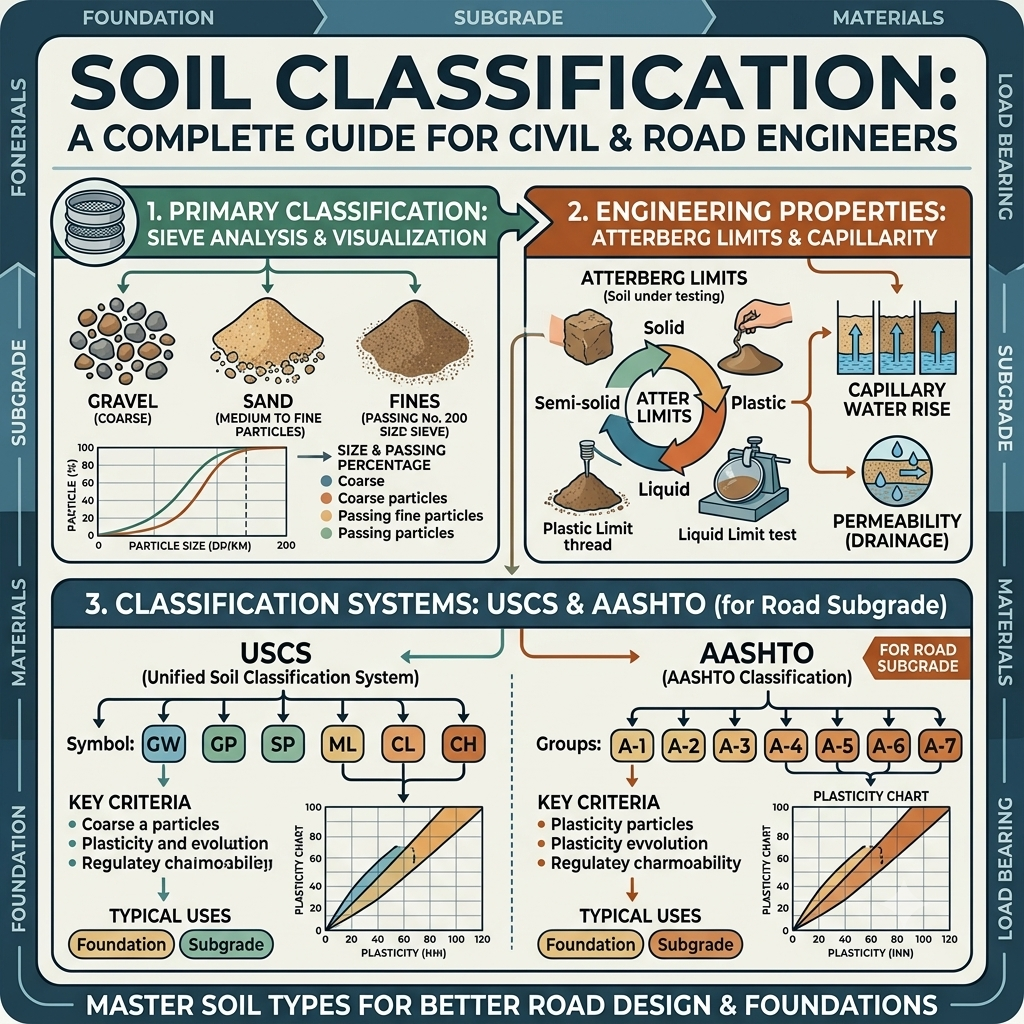
Several standardized systems classify soils based on engineering properties. Among them, the Unified Soil Classification System (USCS) and the AASHTO Soil Classification System remain the most widely used in civil and highway engineering.
Unified Soil Classification System (USCS)
The Unified Soil Classification System (USCS) classifies soils according to grain size distribution and plasticity characteristics.
Major Categories
Coarse-Grained Soils
More than 50% of the material remains on the No. 200 sieve.
Examples include:
- Gravel (G)
- Sand (S)
Subgroups include:
- GW – Well-Graded Gravel
- GP – Poorly Graded Gravel
- SW – Well-Graded Sand
- SP – Poorly Graded Sand
Fine-Grained Soils
More than 50% passes the No. 200 sieve.
Examples include:
- ML – Low Plasticity Silt
- CL – Lean Clay
- CH – Fat Clay
- MH – Elastic Silt
Organic Soils
Organic soils contain decomposed plant material and usually possess low strength. Engineers generally avoid using them beneath roads and foundations unless they are treated or replaced.
Advantages of USCS
- Simple classification symbols.
- Excellent for foundation engineering.
- Widely accepted worldwide.
- Supports geotechnical design.
- Easy interpretation of engineering behavior.
AASHTO Soil Classification System
The AASHTO Soil Classification System was developed specifically for highway and pavement engineering.
Unlike USCS, AASHTO focuses on evaluating soil performance as a pavement subgrade.
Soil Groups
The system divides soils into:
- A-1
- A-2
- A-3
- A-4
- A-5
- A-6
- A-7
General Performance
- A-1 → Excellent subgrade material
- A-2 → Good subgrade
- A-3 → Fine sand
- A-4 → Silty soil
- A-5 → Elastic silt
- A-6 → Clayey soil
- A-7 → Highly plastic clay with poor engineering performance
The system also uses a Group Index (GI) to indicate the expected quality of the soil as a highway subgrade. Lower group index values generally represent better-performing soils.
Why Highway Engineers Prefer AASHTO
- Specifically developed for pavement design.
- Helps estimate subgrade quality.
- Supports pavement thickness calculations.
- Simplifies highway material selection.
Practical Engineering Applications
Proper Soil Classification influences nearly every stage of civil and highway engineering projects.
Common applications include:
- Highway pavement design
- Foundation selection
- Embankment construction
- Retaining wall design
- Slope stability analysis
- Earthwork planning
- Drainage system design
- Soil stabilization projects
- Airport runway construction
- Railway track formation
Accurate soil classification enables engineers to select appropriate construction methods and reduce long-term maintenance costs.
Soil Classification Diagram
                     SOIL CLASSIFICATION
                            │
        ┌───────────────────┴───────────────────┐
        │                                       │
  Coarse-Grained Soils                  Fine-Grained Soils
        │                                       │
   ┌────┴────┐                          ┌────────┴────────┐
   │         │                          │                 │
 Gravel     Sand                      Silt             Clay
 (GW/GP)   (SW/SP)                  (ML/MH)         (CL/CH)
        │                                       │
        └───────────────┬───────────────────────┘
                        │
                 Engineering Evaluation
                        │
        Bearing Capacity • Compaction • Drainage
         Pavement Design • Foundation Design
Key Takeaways
Soil Classification provides the foundation for safe, economical, and durable civil engineering projects. By identifying soil based on grain size, plasticity, permeability, and strength, engineers can predict field performance and make informed design decisions. Standardized systems such as USCS and AASHTO simplify communication, improve quality control, and support pavement and foundation design. Understanding these principles enables engineers to minimize construction risks and optimize infrastructure performance.
Indian Standard (IS) Soil Classification System
The Indian Standard Soil Classification System (ISCS) follows the guidelines of IS 1498 and closely resembles the Unified Soil Classification System (USCS). Engineers across India use this system for foundation design, highway projects, embankments, earth dams, and geotechnical investigations.
The system classifies soils according to:
- Grain size distribution
- Plasticity characteristics
- Compressibility
- Organic content
Major Soil Categories
Coarse-Grained Soils
More than 50% of the soil remains on the 75-micron sieve.
These include:
- Gravel (G)
- Sand (S)
Depending on gradation and fines content, engineers classify them further into:
- Well-graded gravel (GW)
- Poorly graded gravel (GP)
- Well-graded sand (SW)
- Poorly graded sand (SP)
Fine-Grained Soils
More than 50% of the material passes the 75-micron sieve.
Classification depends mainly on Atterberg Limits.
Examples include:
- ML – Low Plasticity Silt
- CL – Lean Clay
- CH – High Plasticity Clay
- MH – Elastic Silt
Organic Soils
Organic soils contain decomposed vegetation and exhibit low strength with high compressibility. Engineers rarely recommend these soils for supporting highways or structural foundations without treatment.
Field Identification of Soil
Laboratory testing provides accurate results, but engineers often perform preliminary field identification before collecting samples.
Quick field identification saves time and helps determine which laboratory tests are necessary.
Visual Examination
Engineers examine:
- Color
- Particle size
- Texture
- Moisture condition
- Organic content
Hand Feel Test
The soil is rubbed between the fingers.
- Sand feels coarse.
- Silt feels smooth.
- Clay feels sticky and plastic.
Ribbon Test
A moist soil sample is rolled into a ribbon.
- Long ribbons usually indicate clay.
- Short ribbons often indicate silt.
- Sandy soils cannot form ribbons.
Dilatancy Test
The engineer shakes a wet soil sample.
Rapid appearance and disappearance of water generally indicate silt, while clay responds slowly.
Dry Strength Test
After drying, engineers crush the sample by hand.
High dry strength usually indicates clay.
Laboratory Tests Used for Soil Classification
Accurate Soil Classification requires laboratory testing performed according to established standards.
Sieve Analysis
Purpose:
Determines the particle size distribution of coarse-grained soils.
Engineering Application:
- Aggregate grading
- Subgrade evaluation
- Pavement material selection
Hydrometer Analysis
Purpose:
Measures particle size distribution for fine-grained soils that pass the No. 200 sieve.
Application:
- Clay analysis
- Silt classification
Atterberg Limits Test
Measures:
- Liquid Limit (LL)
- Plastic Limit (PL)
- Plasticity Index (PI)
Engineering Importance:
Determines soil consistency, plasticity, and classification.
Proctor Compaction Test
Purpose:
Determines:
- Optimum Moisture Content (OMC)
- Maximum Dry Density (MDD)
Application:
- Embankment construction
- Highway subgrade compaction
- Earthworks
California Bearing Ratio (CBR) Test
The CBR test evaluates the load-bearing capacity of subgrade soil.
High CBR values indicate stronger soils suitable for supporting pavement loads.
The test plays a key role in flexible pavement design.
Direct Shear Test
Measures:
- Shear strength
- Cohesion
- Angle of internal friction
Application:
- Retaining walls
- Slope stability
- Foundation design
Soil Classification in Highway Construction
Highway engineers depend on Soil Classification throughout the project lifecycle. The characteristics of the subgrade directly influence pavement thickness, material selection, construction methods, and maintenance requirements.
During Planning
Engineers identify unsuitable soils before selecting the highway alignment.
During Design
Classification data supports:
- Pavement design
- Embankment design
- Drainage planning
- Foundation selection
During Construction
Contractors use soil classification to:
- Select borrow materials
- Achieve required compaction
- Control moisture content
- Stabilize weak soils
During Maintenance
Engineers investigate pavement failures by evaluating changes in subgrade behavior and moisture conditions.
Practical Example
A highway project crosses an area with expansive clay soil. Laboratory testing reveals a high Plasticity Index and low CBR value. Engineers decide to stabilize the soil with lime and increase pavement thickness before construction begins. This decision minimizes future cracking, settlement, and maintenance costs.
Best Practices for Soil Classification
Following proven engineering practices improves the reliability of soil investigations and project outcomes.
- Collect representative soil samples from different depths.
- Perform both field identification and laboratory testing.
- Use standardized classification systems consistently.
- Verify laboratory results through field observations.
- Maintain proper documentation for future reference.
- Consider seasonal groundwater fluctuations.
- Evaluate drainage conditions during site investigations.
- Conduct additional testing in problematic areas.
- Review geotechnical reports before finalizing designs.
- Update classification if site conditions change during construction.
Practical Recommendations
Civil Engineers
- Never rely solely on visual inspection.
- Review laboratory reports carefully before preparing foundation or pavement designs.
- Compare field conditions with geotechnical data throughout construction.
- Include soil improvement measures whenever weak subgrade conditions exist.
Contractors
- Confirm soil type before excavation or embankment construction.
- Control moisture content during compaction.
- Avoid mixing unsuitable materials with approved borrow soil.
- Protect exposed soil from excessive rainfall before compaction.
Engineering Students
- Learn all major soil classification systems rather than memorizing symbols alone.
- Practice interpreting laboratory reports.
- Understand the relationship between soil properties and engineering behavior.
- Visit geotechnical laboratories and construction sites to observe testing procedures.
General Discussion of IRC, AASHTO, and ICE Practices
Leading highway engineering organizations emphasize the importance of systematic soil classification before design and construction.
IRC (Indian Roads Congress)
IRC recommends detailed geotechnical investigations to evaluate subgrade strength, drainage conditions, and pavement support characteristics before highway design.
AASHTO
AASHTO promotes the use of standardized soil classification and performance-based pavement design methods. Traffic loading, subgrade strength, and environmental conditions form the basis of pavement design decisions.
ICE (Institution of Civil Engineers)
ICE encourages comprehensive site investigations, accurate laboratory testing, risk assessment, and proper documentation to improve project quality and reduce long-term maintenance costs.
Although specific procedures vary by country, these organizations share common engineering principles:
- Perform detailed site investigations.
- Use standardized testing methods.
- Verify field conditions.
- Design according to soil behavior.
- Maintain quality assurance throughout construction.
Frequently Asked Questions (FAQs)
1. What is soil classification in civil engineering?
Soil classification is the process of grouping soils according to their physical and engineering properties, enabling engineers to predict their performance and select suitable design and construction methods.
2. Why is soil classification important in highway engineering?
It helps engineers evaluate subgrade strength, determine pavement thickness, select appropriate materials, and reduce the risk of pavement failure.
3. Which soil classification system is most widely used?
The Unified Soil Classification System (USCS) and the AASHTO Soil Classification System are the most widely used systems in civil and highway engineering.
4. What is the difference between USCS and AASHTO?
USCS focuses on engineering properties for general geotechnical applications, while AASHTO specifically evaluates soil performance as a highway subgrade material.
5. Which laboratory test determines soil plasticity?
The Atterberg Limits Test measures Liquid Limit, Plastic Limit, and Plasticity Index to evaluate soil plasticity.
6. Which soil is considered best for road construction?
Well-graded gravel and well-graded sand generally provide excellent strength, drainage, and compaction characteristics, making them ideal for many road construction applications.
7. What is the purpose of the California Bearing Ratio (CBR) test?
The CBR test measures the load-bearing capacity of subgrade soil and assists engineers in designing flexible pavement thickness.
8. Can engineers classify soil without laboratory testing?
Field identification provides a preliminary assessment, but laboratory testing is necessary for accurate classification and engineering design.
9. How does soil classification affect foundation design?
Different soil types have varying bearing capacities and settlement characteristics. Proper classification helps engineers select safe and economical foundation systems.
10. Why should engineers update soil classifications during construction?
Unexpected changes in groundwater levels, excavation conditions, or soil layers may require revised classifications to maintain safety and construction quality.
Conclusion
Soil Classification forms the cornerstone of every successful civil engineering and highway construction project. It enables engineers to understand the behavior of soil before construction begins, reducing uncertainty and supporting informed engineering decisions. By evaluating grain size, plasticity, strength, permeability, and compressibility, engineers can select appropriate foundation systems, design durable pavements, and improve embankment stability. Standardized systems such as USCS, AASHTO, and ISCS create a common engineering language that enhances communication, quality control, and project consistency. Accurate field investigations, reliable laboratory testing, and adherence to recognized engineering practices help minimize construction risks, reduce maintenance costs, and extend the service life of infrastructure. Whether you are designing a highway, constructing a bridge, or preparing a building foundation, understanding Soil Classification is essential for delivering safe, economical, and long-lasting engineering solutions. For engineers, contractors, and students alike, mastering Soil Classification builds a strong foundation for professional success and sustainable infrastructure development.

Kamran Malik is a passionate civil engineering writer and researcher who specializes in construction, transportation, structural engineering, and infrastructure topics. Through his articles on CivilEngineerings.com, he simplifies complex engineering concepts and shares practical insights, industry trends, and educational resources for students, professionals, and engineering enthusiasts.