
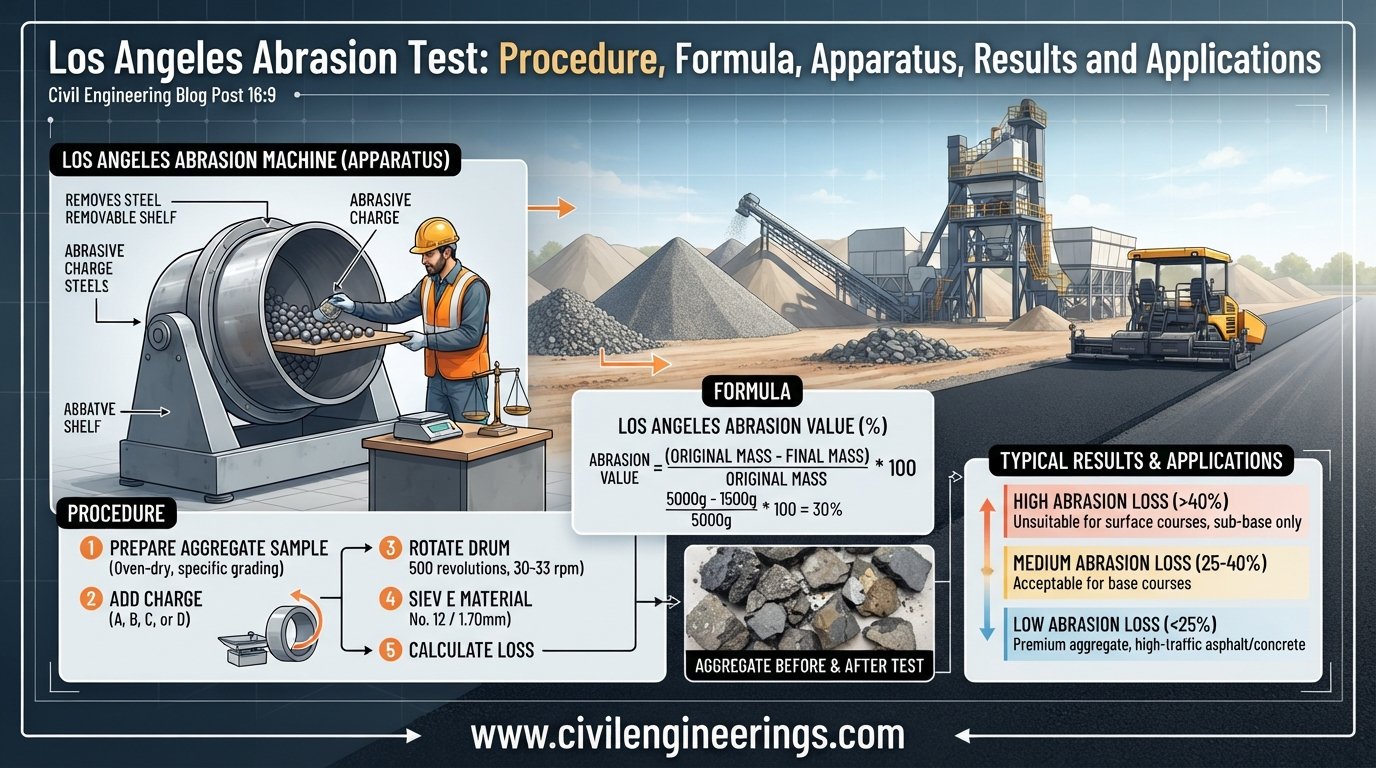
Aggregate may look strong when examined visually, yet its performance under repeated traffic can tell a very different story. Coarse aggregates in pavement layers experience impact, rubbing, grinding, and repeated movement. If the particles break down too quickly, the pavement can lose surface texture, generate excessive fines, and deteriorate earlier than expected.
The Los Angeles Abrasion Test is one of the most widely used laboratory methods for evaluating the resistance of coarse aggregate to degradation caused by abrasion and impact. It helps engineers judge whether an aggregate is suitable for demanding applications such as highway pavements, asphalt mixtures, concrete, rail ballast, and other infrastructure works.
The test uses a rotating steel drum and a specified abrasive charge. After a controlled number of revolutions, engineers determine the percentage of material lost from the original sample. A lower loss generally indicates better resistance to mechanical degradation.
This guide explains the Los Angeles Abrasion Test from an engineering perspective, including its principle, apparatus, sample preparation, procedure, formula, calculations, result interpretation, common errors, standards, applications, and practical recommendations.
What Is the Los Angeles Abrasion Test?
The Los Angeles Abrasion Test is a laboratory test used to determine the resistance of coarse aggregate to abrasion and mechanical degradation under a combination of impact and grinding actions.
During the test, a prepared aggregate sample is placed inside a rotating cylindrical steel drum together with a specified quantity and grading of steel abrasive spheres. As the drum rotates, the aggregate repeatedly falls, rolls, strikes the steel balls, and rubs against other particles and the drum.
The resulting degradation produces smaller particles and fines. Engineers measure the mass loss after the specified test cycle and report it as the Los Angeles Abrasion Value (LAAV) or percentage abrasion loss.
The test therefore provides an indication of aggregate durability under mechanical action. It should not, however, be interpreted as a direct measurement of every form of aggregate durability.
Modern Los Angeles machines commonly use a steel drum approximately 711 mm in internal diameter and 508 mm long, with a controlled rotational speed around 31–33 rpm for relevant ASTM/AASHTO configurations. (lithostek.com)


Principle of the Los Angeles Abrasion Test
The basic principle is straightforward: subject aggregate to controlled abrasion and impact, then measure the resulting mass loss.
A representative aggregate sample is first prepared according to the applicable testing standard. The sample is then combined with a specified abrasive charge inside the Los Angeles drum.
When the drum rotates, the internal shelf lifts the aggregate and abrasive charge. At a particular point in the rotation, the material falls. This creates impact, while the continuous movement produces rubbing and grinding.
The combined action can be represented conceptually as:
Aggregate + abrasive charge + controlled rotation → impact + abrasion + fragmentation → measurable mass loss
The test is therefore more representative of mechanical degradation than a simple rubbing test.
A typical Los Angeles machine incorporates an internal shelf that lifts and drops the material during rotation. California’s published test method, for example, specifies a wear-resistant shelf and controlled drum rotation for the test apparatus. (dot.ca.gov)
Why Impact and Abrasion Matter
Road aggregates do not experience only one type of mechanical stress. Heavy vehicles repeatedly load pavement surfaces, while aggregate particles interact with neighboring particles and other materials.
During construction, handling and compaction can also contribute to particle breakage.
The Los Angeles test attempts to reproduce these combined effects under standardized laboratory conditions. It is particularly useful when comparing different aggregate sources before selecting materials for a project.
Objectives of the Los Angeles Abrasion Test
The main objectives include:
- Determining aggregate resistance to abrasion.
- Evaluating resistance to mechanical degradation.
- Comparing aggregates from different sources.
- Supporting aggregate quality control.
- Checking compliance with project specifications.
- Helping engineers select suitable coarse aggregate for pavement and concrete applications.
- Assessing the potential of aggregate to generate excessive fines under mechanical action.
The test is especially important for materials used in locations exposed to repeated traffic or mechanical handling.
Apparatus Required for the Los Angeles Abrasion Test
A standard test setup contains several important components.
Los Angeles Abrasion Machine
The machine consists of a horizontal cylindrical steel drum mounted on a rigid frame. The drum rotates at a controlled speed and contains an internal shelf.
Commercial machines designed around ASTM C131, ASTM C535, AASHTO T96, or EN 1097-2 configurations commonly provide an automatic revolution counter. (lithostek.com)
Abrasive Charge
Hardened steel spheres form the abrasive charge.
The number, diameter, mass, and grading of the spheres depend on the selected test method and aggregate grading. This point is important because engineers should never assume that one steel-ball charge applies to every Los Angeles abrasion procedure.
Weighing Balance
A calibrated balance is required to determine:
- Initial dry sample mass
- Final retained mass
- Mass loss
The balance should have adequate capacity and resolution for the applicable standard.
Sieves
Appropriate test sieves are required for separating the degraded material. The exact sieve size depends on the governing test method.
Oven
An oven is used to dry the aggregate to the required condition before weighing.
Receiving Tray
A metal tray collects the material after the drum completes its rotation cycle.
Other Laboratory Equipment
Depending on the standard, the laboratory may also require:
- Sample splitter
- Brushes
- Containers
- Dust protection equipment
- Cleaning tools
- Thermometer or temperature monitoring equipment
- Sieve shaker


Sample Preparation for the Los Angeles Abrasion Test
Correct sample preparation has a major influence on test reliability.
First, obtain a representative aggregate sample. Poor sampling can produce a laboratory result that does not represent the actual quarry material.
The aggregate is separated according to the grading required by the relevant standard. Oversized, undersized, contaminated, or incorrectly graded material should not simply be substituted without following the prescribed method.
The prepared material is normally washed where required and oven-dried to substantially constant mass.
After cooling to a suitable laboratory condition, the aggregate is weighed accurately. This measurement becomes the initial mass used in calculating abrasion loss.
Importance of Representative Sampling
Suppose a stockpile contains a mixture of strong and weak rock particles. Taking material only from the visually strongest portion could produce an unrealistically low abrasion value.
A representative sample should therefore reflect the material that will actually enter production.
For construction quality control, sampling is often just as important as the machine operation itself.
Los Angeles Abrasion Test Procedure
The exact procedure should always follow the applicable project standard. The following sequence explains the general engineering workflow.
Step 1: Prepare the Aggregate
Select and grade the aggregate according to the specified test method.
Clean and dry the sample as required.
Step 2: Determine the Initial Mass
Weigh the prepared dry aggregate and record the initial mass.
Let:
W₁ = Initial mass of aggregate sample
The value should be recorded carefully because even a small weighing error affects the final percentage.
Step 3: Place the Sample in the Drum
Transfer the aggregate into the clean Los Angeles abrasion drum.
Add the specified abrasive charge.
The abrasive charge must match the selected grading and testing standard.
Step 4: Close and Secure the Drum
Close the cover securely.
A poorly secured cover can create a serious laboratory safety problem and may also allow material to escape.
Step 5: Rotate the Drum
Set the machine to the required number of revolutions and operating speed.
Many configurations operate at approximately 31–33 rpm. The required number of revolutions depends on the test method and grading. Some procedures use 500 revolutions, while others may require 1,000 revolutions. (testmak.com)
Do not change the revolution count simply because another laboratory uses a different value.
Step 6: Discharge the Material
After completing the specified number of revolutions, carefully discharge the aggregate and abrasive charge into the receiving tray.
Separate the steel balls from the aggregate.
Step 7: Sieve the Tested Material
Pass the material through the sieve specified by the applicable standard.
The fine material passing the specified sieve represents the degraded fraction for the calculation.
Step 8: Wash and Dry When Required
Depending on the applicable procedure, wash the retained aggregate to remove adhering fines.
Dry the material to the required condition and allow it to cool.
Step 9: Weigh the Final Material
Record the final mass of the material retained after the specified separation process.
Let:
W₂ = Final mass of aggregate retained after testing
Step 10: Calculate the Abrasion Value
Use the prescribed equation:
Los Angeles Abrasion Value (%) = [(W₁ − W₂) / W₁] × 100
This gives the percentage mass loss under the conditions of the test.


Los Angeles Abrasion Test Formula
The standard calculation is:
LA Abrasion Value = [(W₁ − W₂) / W₁] × 100
Where:
- W₁ = Original dry mass of the test sample
- W₂ = Mass retained after the specified abrasion test and sieving
- W₁ − W₂ = Mass loss
- LA Abrasion Value = Percentage mass loss
Example Calculation
Assume:
- Initial mass, W₁ = 5,000 g
- Final retained mass, W₂ = 3,950 g
Mass loss:
5,000 − 3,950 = 1,050 g
Therefore:
LA Value = (1,050 / 5,000) × 100
LA Value = 21%
The reported abrasion loss is therefore 21%, subject to the applicable standard’s reporting requirements.
How to Interpret the Result
A lower percentage mass loss generally indicates better resistance to abrasion and fragmentation.
For example, an aggregate producing 18% loss would generally show greater resistance to the test action than one producing 35% loss, assuming both results were obtained using the same test method and grading.
However, engineers should not compare values produced under different standards or different test configurations without checking the methodology.
What Is a Good Los Angeles Abrasion Value?
There is no single universal pass/fail value for every construction application.
The acceptable Los Angeles abrasion value depends on factors such as:
- Type of pavement
- Traffic loading
- Aggregate application
- Wearing course requirements
- Concrete or asphalt specification
- Local construction standard
- Project authority
- Aggregate size and grading
- Applicable test method
For this reason, engineers should compare the laboratory result with the specific project specification rather than relying on a generic internet value.
In road construction, stricter abrasion requirements are normally associated with applications where aggregates experience greater traffic-related mechanical action.
A highway wearing course, for example, demands more durable aggregate than a low-stress application.
Factors Affecting Los Angeles Abrasion Test Results
Several variables can influence the result.
Aggregate Mineralogy
The parent rock has a major influence on aggregate durability. Strong, well-cemented mineral structures can resist degradation better than weak or highly weathered materials.
Particle Shape
Particle shape affects how particles interact during impact and rotation.
Angular particles, rounded particles, flaky particles, and elongated particles may respond differently under mechanical action.
Aggregate Grading
The grading determines how particles and abrasive charges interact.
Therefore, the prescribed grading must be followed precisely.
Moisture Condition
Moisture can influence aggregate behavior and sample mass. Standardized drying and conditioning procedures reduce this source of variability.
Abrasive Charge
The mass and grading of steel spheres affect the severity of the mechanical action.
Using an incorrect charge can invalidate the comparison.
Drum Speed
The machine should operate within the prescribed speed range.
Excessive or insufficient speed changes the impact mechanism and can produce misleading results.
Number of Revolutions
The revolution count directly affects the amount of mechanical action imposed on the aggregate.
Sample Contamination
Dust, soil, organic matter, or other contaminants can influence the measured result.
Clean laboratory equipment is therefore essential.
Applications of the Los Angeles Abrasion Test
The test has broad applications in civil and highway engineering.
Highway Pavement Aggregates
One of its most important applications is evaluating aggregates used in road construction.
Aggregates in pavement layers must withstand repeated traffic action without excessive breakdown.
Asphalt Pavement
Coarse aggregate forms a major component of many asphalt mixtures. Excessive degradation can change gradation and influence mixture performance.
Concrete
Aggregate quality affects concrete durability and mechanical behavior. The Los Angeles test can contribute to aggregate selection, although it should be considered alongside other relevant aggregate tests.
Railways
Railway ballast experiences repeated impact and mechanical loading. Aggregate durability is therefore an important consideration.
Airport Pavements
Aircraft loading and pavement maintenance requirements make aggregate quality particularly important in airport construction.
Quarry Quality Control
Quarries can use abrasion testing to monitor production quality and compare different rock sources.
Research and Material Selection
Researchers use LA abrasion testing to compare natural aggregates, crushed rock, recycled aggregates, and alternative construction materials.
Los Angeles Abrasion Test vs Aggregate Impact Test
These two tests are related but should not be treated as identical.
The Los Angeles Abrasion Test exposes aggregate to a combination of impact and abrasion inside a rotating drum with an abrasive charge.
The Aggregate Impact Value (AIV) test applies a more localized impact loading through a standardized impact mechanism.
Both provide useful information about aggregate mechanical behavior, but they measure different test responses.
An engineer may therefore use both results when evaluating aggregate quality rather than relying on only one indicator.
Los Angeles Abrasion Test vs Aggregate Crushing Value
The Aggregate Crushing Value (ACV) evaluates resistance to crushing under a gradually applied compressive load.
The Los Angeles test, by comparison, focuses on degradation produced by repeated impact and abrasion.
A material can therefore behave differently in these tests.
This illustrates an important engineering principle: aggregate quality cannot always be described by one laboratory number.
Other properties such as soundness, water absorption, flakiness, elongation, polishing resistance, and particle shape may also matter depending on the application.
Standards and Specifications for the Los Angeles Abrasion Test
Several major standards cover Los Angeles-type aggregate degradation testing.
ASTM Standards
C131 is widely associated with resistance to degradation of small-size coarse aggregate by abrasion and impact in the Los Angeles machine.
ASTM C535 covers larger-size coarse aggregate applications.
The selected ASTM procedure should match the aggregate grading and project requirement.
AASHTO T96
AASHTO T96 is a major highway materials test method covering resistance to degradation of small-size coarse aggregate by abrasion and impact in the Los Angeles machine.
Laboratories working on highway projects should always use the current edition specified by the contract or governing authority.
IS 2386 Part 4
In India and projects following Indian Standards, IS 2386 (Part 4) addresses mechanical properties of aggregates, including abrasion-related testing.
Commercial laboratory equipment is commonly configured for IS 2386 Part 4 as well as ASTM procedures. (Primetek Instruments & Technology)
EN 1097-2
European laboratories may use EN 1097-2, which addresses methods for determining resistance to fragmentation of aggregates. Equipment manufacturers commonly distinguish EN configurations from ASTM/AASHTO charge arrangements. (lithostek.com)
IRC, MoRTH and ICE Context
In highway projects, the Los Angeles abrasion result is normally interpreted together with the applicable road specification rather than in isolation.
Indian road projects may combine relevant IRC guidance, MoRTH specifications, and IS test methods when establishing aggregate acceptance criteria.
For international projects, ICE guidance and project specifications can provide broader engineering and procurement context, while the actual abrasion procedure should be tied to the test standard named in the contract.
The key rule is simple: use the current edition of the standard explicitly required by the project.
Common Errors in the Los Angeles Abrasion Test
Even a standardized laboratory test can produce unreliable results when technicians overlook basic controls.
Using the Wrong Aggregate Grading
The abrasive charge and aggregate grading are method-dependent.
Recommendation: Verify the required grading before starting the test.
Incorrect Steel-Ball Charge
An incorrect number or mass of steel balls changes the severity of the test.
Recommendation: Check the abrasive charge against the current standard.
Poor Sample Representation
A non-representative sample can produce a technically correct test result that does not represent the quarry or stockpile.
Recommendation: Use proper sampling and sample reduction procedures.
Incorrect Revolution Count
Running 500 revolutions instead of a method requiring 1,000, or vice versa, can make the result invalid.
Recommendation: Confirm the programmed revolution count before operation.
Inadequate Cleaning
Residual fines from a previous test may contaminate the next sample.
Recommendation: Clean the drum, shelf, tray, and associated equipment after each test.
Inaccurate Weighing
Small weighing errors directly affect the calculated percentage loss.
Recommendation: Use a calibrated balance and record masses carefully.
Comparing Different Test Methods
Results from different standards or different grading configurations should not automatically be treated as equivalent.
Recommendation: Always report the standard and test grading alongside the LA value.
Practical Recommendations for Students
Civil engineering students should understand the test concept rather than memorizing only the formula.
Focus on these points:
- Understand why abrasion resistance matters in pavement aggregates.
- Learn the function of the drum, shelf, and abrasive charge.
- Memorize the basic mass-loss formula.
- Practice sample calculations.
- Understand why lower mass loss generally indicates better resistance.
- Learn the difference between LA abrasion, aggregate impact, and crushing tests.
- Always identify the test standard before quoting a permissible value.
A good laboratory report should include the sample identification, grading, initial mass, abrasive charge, revolution count, final mass, calculated LA value, standard used, and observations.
Practical Recommendations for Highway Engineers
Engineers should treat the LA abrasion value as one component of aggregate qualification.
Before approving an aggregate source:
- Confirm the governing specification.
- Review test certificates.
- Check the test method and grading.
- Verify laboratory calibration.
- Consider traffic level and pavement function.
- Evaluate other aggregate properties.
- Conduct source approval testing where required.
- Monitor quarry production for consistency.
For high-volume highways, aggregate durability deserves particular attention because premature aggregate degradation can affect pavement texture, gradation, rutting resistance, and maintenance requirements.
Practical Recommendations for Contractors
Contractors should avoid assuming that an aggregate source remains compliant simply because an earlier laboratory report passed.
Material can vary within a quarry, crushing operation, or stockpile.
Contractors should:
- Maintain traceable material sources.
- Keep laboratory test records.
- Prevent contamination during stockpiling.
- Follow approved sampling procedures.
- Check new quarry or supplier material before incorporation.
- Coordinate testing with the supervising engineer.
- Use the current project specification for acceptance.
Good material control at the source is usually cheaper than correcting pavement defects after construction.
Advantages and Limitations of the Los Angeles Abrasion Test
Advantages
- Relatively simple laboratory procedure.
- Widely recognized internationally.
- Useful for aggregate source comparison.
- Produces a numerical percentage result.
- Suitable for routine quality control.
- Relevant to pavement and infrastructure material selection.
- Combines impact and abrasion effects.
Limitations
The test does not reproduce every field condition.
It does not directly measure:
- Polishing resistance under traffic
- Freeze-thaw durability
- Chemical weathering
- Aggregate adhesion to bitumen
- Concrete aggregate alkali reactivity
- Long-term pavement performance by itself
A low LA abrasion value is therefore valuable, but it should not be treated as a guarantee of overall aggregate performance.
Frequently Asked Questions About the Los Angeles Abrasion Test
What is the Los Angeles Abrasion Test?
It is a laboratory test used to evaluate the resistance of coarse aggregate to degradation caused by abrasion and impact in a rotating drum containing a specified abrasive charge.
What does the Los Angeles Abrasion Value indicate?
It indicates the percentage mass loss of the aggregate under the specified test conditions. Lower loss generally represents better resistance to mechanical degradation.
What is the formula for the Los Angeles Abrasion Test?
The basic formula is:
LA Abrasion Value (%) = [(W₁ − W₂) / W₁] × 100
where W₁ is the initial sample mass and W₂ is the final retained mass.
How many revolutions are used in the test?
The required number depends on the applicable standard and aggregate grading. Common procedures use 500 or 1,000 revolutions, so the laboratory must follow the specified method rather than assuming one value. (eieinstruments.com)
What is the standard speed of a Los Angeles abrasion machine?
Many ASTM/AASHTO-type machines operate at approximately 31–33 rpm, although the exact requirement should be checked against the applicable standard. (Laboratory Tester)
Why are steel balls used?
Steel balls provide the standardized abrasive and impact charge. Their movement inside the rotating drum creates repeated impact, rubbing, and grinding on the aggregate.
Is a lower Los Angeles abrasion value better?
Generally, yes. A lower percentage mass loss indicates greater resistance to the specified degradation action. However, the acceptable value depends on the project specification and application.
Can the Los Angeles abrasion test determine aggregate hardness?
It provides useful information about aggregate resistance to mechanical degradation, but it should not be considered a direct or complete measurement of mineral hardness.
Is the Los Angeles abrasion test suitable for road construction?
Yes. It is widely used in highway and pavement materials laboratories to assess coarse aggregate resistance to abrasion and fragmentation. It is especially useful for aggregate selection and quality control.
Can one LA abrasion value be compared with another from a different standard?
Not automatically. Differences in aggregate grading, abrasive charge, revolution count, sieve requirements, and test procedure can affect the result. Compare results only after confirming that the test methods are compatible.
Conclusion
The Los Angeles Abrasion Test remains an important aggregate quality-control tool in highway engineering, pavement construction, concrete production, railway infrastructure, and other civil engineering applications. Its strength lies in its ability to expose aggregate to standardized mechanical action and convert the resulting degradation into a simple percentage mass-loss value.
The test is not complicated, but accuracy depends heavily on details. Representative sampling, correct aggregate grading, appropriate abrasive charge, proper machine speed, specified revolution count, accurate sieving, and reliable weighing all contribute to a dependable result.
For engineers and contractors, the most important lesson is not to judge an aggregate from the LA value alone. The result should be considered alongside aggregate impact resistance, crushing resistance, soundness, absorption, particle shape, polishing characteristics, and the requirements of the pavement or concrete application.
When the correct standard and project specification are followed, the Los Angeles Abrasion Test provides a practical basis for selecting durable aggregate and reducing the risk of premature material degradation.

Kamran Malik is a passionate civil engineering writer and researcher who specializes in construction, transportation, structural engineering, and infrastructure topics. Through his articles on CivilEngineerings.com, he simplifies complex engineering concepts and shares practical insights, industry trends, and educational resources for students, professionals, and engineering enthusiasts.