
Introduction
Every successful highway begins with one critical engineering decision: selecting the right alignment. A carefully planned alignment improves traffic flow, reduces construction costs, enhances road safety, and minimizes environmental impacts. Poor alignment, on the other hand, can increase project expenses, create maintenance challenges, and reduce the service life of the roadway.
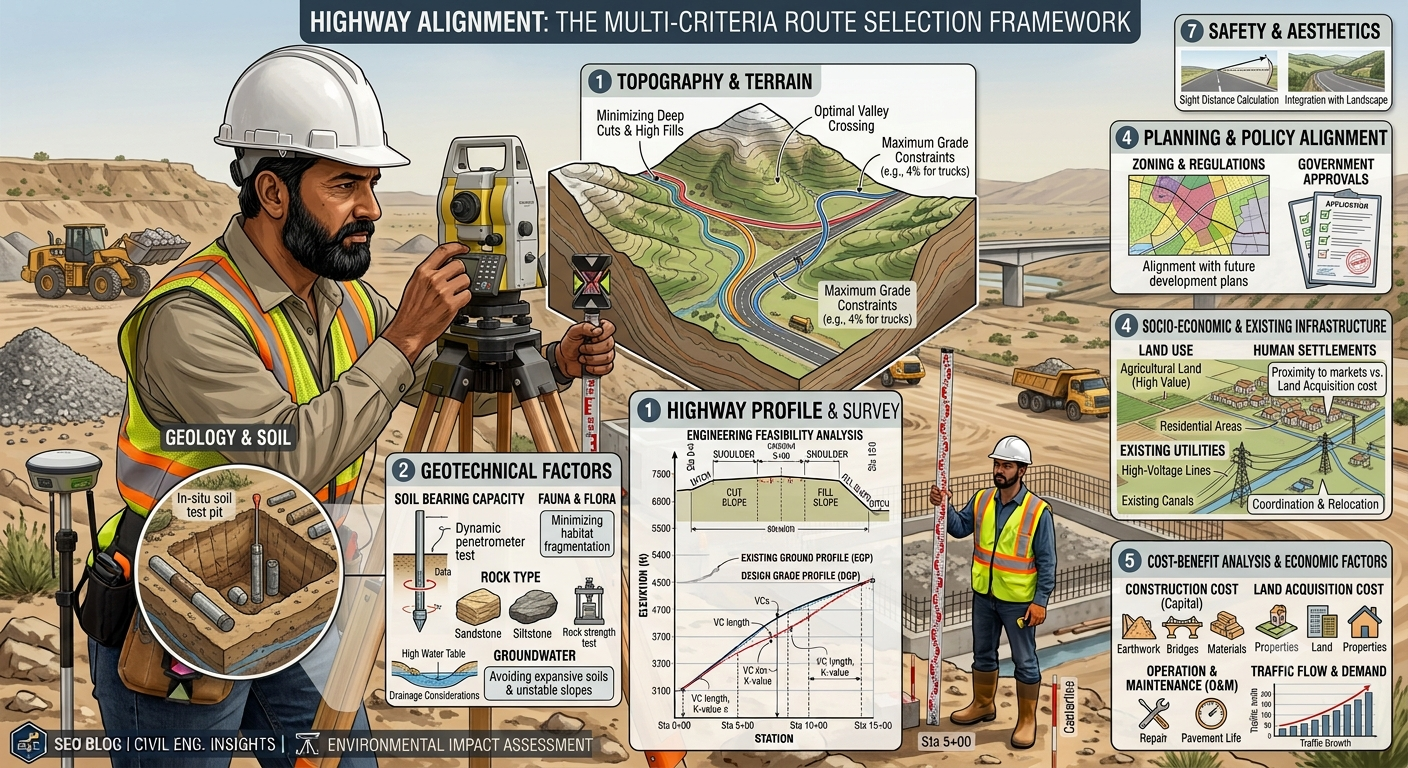
Highway Alignment: Factors Affecting Route Selection is one of the most important topics in highway engineering because it directly influences the technical, economic, environmental, and social success of a road project. Engineers evaluate numerous factors before deciding where a highway should pass. They analyze terrain, traffic demand, soil conditions, drainage patterns, environmental constraints, land use, and future development to identify the most suitable route.
Modern highway alignment combines transportation engineering, geotechnical engineering, surveying, hydrology, environmental science, and construction management. The goal is to develop a route that provides safe, efficient, and sustainable transportation while balancing construction costs and long-term maintenance requirements.
This guide explains the principles of highway alignment, the major factors affecting route selection, practical engineering applications, and industry best practices for engineers, contractors, and students.
What Is Highway Alignment?
Highway alignment refers to the selected path or route that a highway follows between two or more locations. It defines the exact position of the roadway on the ground and determines its horizontal and vertical geometry.
A well-designed alignment ensures that vehicles can travel safely, comfortably, and efficiently while minimizing construction costs and environmental impacts.
Highway alignment involves much more than drawing a line on a map. Engineers carefully evaluate technical data, field surveys, traffic forecasts, and environmental constraints before selecting the final route.
Main Components of Highway Alignment
- Horizontal alignment
- Vertical alignment
- Cross-sectional design
- Intersection layout
- Drainage provisions
Each component contributes to the overall safety, durability, and operational performance of the highway.
Why Highway Alignment Matters
Selecting the proper alignment influences every stage of a highway project, from planning and design to construction and maintenance.
An optimized alignment offers several advantages:
- Reduces travel distance and travel time.
- Improves road safety.
- Minimizes earthwork quantities.
- Lowers construction and maintenance costs.
- Protects environmentally sensitive areas.
- Enhances driving comfort.
- Supports future traffic growth.
A poorly selected route can create steep gradients, sharp curves, drainage problems, and expensive maintenance requirements.
Objectives of Route Selection
The primary goal of route selection is to identify the most practical, economical, and sustainable highway corridor.
Key Objectives
- Provide the shortest practical route.
- Maintain safe operating speeds.
- Reduce construction costs.
- Minimize environmental impacts.
- Improve transportation efficiency.
- Ensure proper drainage.
- Avoid unstable geological conditions.
- Support future expansion.
Successful route selection balances engineering performance with economic and environmental considerations.
Types of Highway Alignment
Horizontal Alignment
Horizontal alignment defines the roadway’s direction when viewed from above.
It consists of:
- Straight sections (tangents)
- Circular curves
- Transition curves
Proper horizontal alignment improves driver comfort, vehicle stability, and visibility.
Good Practice
Engineers should avoid unnecessary sharp curves because they reduce design speed and increase accident risks.
Vertical Alignment
Vertical alignment represents the roadway profile along its length.
It includes:
- Gradients
- Crest curves
- Sag curves
Proper vertical alignment ensures smooth vehicle movement, adequate sight distance, and effective drainage.
Engineering Principle
Gentle gradients improve fuel efficiency and reduce vehicle operating costs, particularly for heavy trucks.
Highway Alignment: Factors Affecting Route Selection
Selecting the final highway alignment requires evaluating numerous engineering, environmental, and economic factors.
1. Terrain and Topography
Terrain is often the first factor engineers examine during route selection.
The physical characteristics of the land significantly influence construction methods, project costs, and long-term maintenance.
Types of Terrain
- Plain terrain
- Rolling terrain
- Mountainous terrain
- Coastal terrain
Engineering Considerations
Engineers evaluate:
- Natural slopes
- Hills and valleys
- Existing rivers
- Rock formations
- Flood-prone areas
Practical Example
A highway crossing mountainous terrain may require tunnels, retaining walls, or viaducts. These structures increase construction costs, so engineers often compare alternative alignments to determine the most economical solution.
2. Traffic Demand
Traffic studies determine the capacity and geometric standards required for the highway.
Transportation engineers analyze:
- Average Daily Traffic (ADT)
- Peak-hour traffic
- Vehicle classifications
- Freight movement
- Future traffic growth
Why It Matters
Higher traffic volumes may require:
- Additional lanes
- Wider medians
- Larger interchanges
- Improved access control
Selecting an alignment that accommodates future traffic growth reduces the need for expensive upgrades.
3. Soil and Geological Conditions
The strength and stability of the ground directly affect pavement performance and construction costs.
Engineers Evaluate
- Soil bearing capacity
- Rock formations
- Expansive clay
- Loose sand
- Groundwater level
- Landslide potential
Engineering Application
Weak soils may require:
- Soil stabilization
- Geotextiles
- Geogrids
- Deep foundations
- Increased pavement thickness
Choosing a route with stable soil conditions improves long-term pavement performance.
4. Hydrology and Drainage
Water is one of the leading causes of pavement deterioration. Proper drainage planning begins during route selection.
Hydrological Factors
- Rivers
- Streams
- Wetlands
- Floodplains
- Rainfall intensity
- Groundwater conditions
Engineering Objective
The selected alignment should:
- Minimize river crossings.
- Reduce flood risks.
- Allow efficient stormwater drainage.
- Prevent erosion.
Practical Example
If one alignment crosses several rivers while another avoids major waterways, engineers often select the second option because it requires fewer bridges and lower maintenance costs.
5. Environmental Considerations
Modern highway projects must balance transportation needs with environmental protection.
Engineers Assess
- Forests
- Wildlife habitats
- Wetlands
- Protected parks
- Agricultural land
- Air quality
- Noise impacts
Sustainable Engineering Practice
Route selection should minimize impacts on sensitive ecosystems while maintaining transportation efficiency.
Where avoidance is not possible, engineers may include mitigation measures such as wildlife crossings, noise barriers, and erosion control systems.
6. Economic Factors
Cost plays a major role in selecting a highway alignment.
Engineers compare alternative routes based on total life-cycle costs rather than only initial construction expenses.
Cost Components
- Earthwork
- Bridges
- Tunnels
- Land acquisition
- Utility relocation
- Drainage structures
- Pavement construction
- Future maintenance
Engineering Principle
The least expensive alignment is not always the best option. Engineers seek the route that delivers the greatest long-term value while meeting technical and safety requirements.
7. Social Considerations
Highway projects affect communities, businesses, and public services.
Route selection should minimize disruptions while maximizing public benefits.
Social Factors Include
- Residential areas
- Schools
- Hospitals
- Cultural heritage sites
- Public utilities
- Local businesses
Practical Application
Early consultation with local communities helps identify concerns and reduces the likelihood of project delays during later stages.
8. Road Safety
Safety remains one of the most important objectives of highway alignment.
Engineers design alignments that reduce crash risks and provide comfortable driving conditions.
Safety Considerations
- Adequate sight distance
- Gentle curves
- Appropriate gradients
- Safe intersections
- Median width
- Roadside clear zones
Engineering Best Practice
Design consistency is essential. Sudden changes in alignment can confuse drivers and increase accident rates.
Highway Alignment Decision Flow Diagram
Transportation Need
         │
         ▼
 Traffic Studies
         │
         ▼
 Topographic Survey
         │
         ▼
 Soil & Geological Investigation
         │
         ▼
 Environmental Assessment
         │
         ▼
 Alternative Route Comparison
         │
         ▼
 Economic Evaluation
         │
         ▼
 Final Highway Alignment
This structured process enables engineers to select a route that balances safety, cost, environmental protection, and long-term operational efficiency.
9. Land Acquisition and Right of Way (ROW)
Land acquisition is one of the most challenging aspects of highway route selection. Even a technically perfect alignment may become impractical if it requires excessive land acquisition or affects densely populated areas.
Key Considerations
- Availability of land
- Right of Way (ROW) requirements
- Property ownership
- Relocation of residents
- Compensation costs
- Utility relocation
Engineering Perspective
Engineers aim to select an alignment that minimizes displacement while providing sufficient space for:
- Future road widening
- Drainage systems
- Service roads
- Utility corridors
- Pedestrian and cycling facilities
A wider ROW may increase initial costs, but it can significantly reduce future expansion expenses.
10. Future Urban Development
Highway engineers must design for tomorrow rather than today’s traffic conditions.
A route that appears suitable today may become congested if nearby cities expand rapidly.
Factors to Evaluate
- Population growth
- Industrial development
- Commercial zones
- Residential expansion
- Future transportation corridors
- Planned infrastructure projects
Practical Example
A bypass road constructed outside a city may become part of the urban network within two decades. Planning sufficient right of way during the initial project phase avoids costly reconstruction later.
11. Construction Feasibility
Construction feasibility evaluates how easily contractors can build the highway.
Some routes require:
- Deep rock excavation
- Long bridges
- Large retaining walls
- Extensive embankments
- Tunnel construction
These conditions increase project duration, risks, and costs.
Engineering Objective
Engineers compare alternative alignments and select one that provides the best balance between construction complexity and long-term performance.
12. Availability of Construction Materials
The distance between material sources and the project site affects construction costs considerably.
Common Materials
- Aggregates
- Sand
- Gravel
- Bitumen
- Cement
- Reinforcing steel
Why It Matters
Transporting materials over long distances increases:
- Fuel consumption
- Equipment operating costs
- Construction time
- Carbon emissions
Selecting a route near approved material sources often improves project efficiency.
Engineering Principles for Highway Alignment
Successful highway alignment follows several fundamental engineering principles.
1. Safety First
Safety always takes priority over cost savings. Engineers provide adequate sight distance, smooth curves, and appropriate gradients to reduce accident risks.
2. Design Consistency
Drivers expect predictable road geometry. Consistent alignment improves driver confidence and reduces sudden braking or steering.
3. Economy
Engineers evaluate life-cycle costs rather than focusing only on initial construction expenses. A slightly higher investment during construction often reduces maintenance costs over many years.
4. Environmental Sustainability
Modern highway projects integrate environmental protection into every stage of planning. Engineers avoid sensitive ecosystems whenever practical and adopt mitigation measures when avoidance is impossible.
5. Efficient Drainage
Proper drainage protects pavement layers from moisture damage and extends the service life of the highway.
Highway Alignment Survey Process
Accurate surveys provide the information needed for selecting the most suitable alignment.
Reconnaissance Survey
Engineers conduct a preliminary inspection to identify possible corridors and major obstacles.
Preliminary Survey
This stage includes:
- Topographic mapping
- Traffic observations
- Soil investigation
- Environmental screening
Detailed Survey
Survey teams collect precise data for:
- Horizontal alignment
- Vertical profile
- Cross sections
- Drainage structures
- Property boundaries
Final Location Survey
Engineers establish the centerline and set out construction control points before detailed design and construction begin.
Practical Engineering Examples
Example 1: Mountain Highway
A proposed highway crosses a mountainous region.
Option A
- Shorter route
- Steep gradients
- Several tunnels
- High construction cost
Option B
- Slightly longer route
- Gentler slopes
- Fewer bridges
- Lower maintenance cost
Engineers may select Option B because it provides safer driving conditions and better long-term value despite the additional distance.
Example 2: Urban Bypass
A rapidly growing city experiences severe traffic congestion.
Instead of widening existing urban roads, engineers propose a bypass around the city.
Benefits include:
- Reduced city traffic
- Faster freight movement
- Improved road safety
- Lower travel times
- Reduced vehicle emissions within urban areas
Best Practices for Highway Route Selection
- Begin planning with accurate traffic forecasts.
- Conduct comprehensive topographic and geotechnical surveys.
- Compare multiple alignment alternatives before making a final decision.
- Prioritize road safety over the shortest distance.
- Design for future traffic growth.
- Protect environmentally sensitive areas.
- Minimize unnecessary earthwork.
- Coordinate with local authorities and utility agencies.
- Maintain detailed project documentation.
- Review alignment using modern GIS, GPS, drone surveys, and digital terrain models.
Practical Recommendations
Civil Engineers
- Study terrain carefully before preparing alignment options.
- Integrate drainage design during the planning stage.
- Consider maintenance requirements during route selection.
- Evaluate life-cycle costs instead of focusing solely on construction costs.
Contractors
- Review alignment drawings thoroughly before mobilization.
- Identify construction challenges early.
- Verify survey control points before earthwork begins.
- Coordinate with utility providers to avoid delays.
Engineering Students
- Understand the relationship between alignment and pavement design.
- Learn topographic surveying techniques.
- Study highway geometric design standards.
- Visit highway construction projects to observe alignment decisions in practice.
- Develop proficiency in GIS and highway design software.
General Discussion of IRC, AASHTO, and ICE Practices
Although engineering standards differ among countries, leading organizations such as IRC, AASHTO, and ICE promote similar principles for highway alignment.
These principles generally include:
- Selecting routes based on detailed traffic forecasts.
- Conducting comprehensive topographic and geotechnical investigations.
- Designing safe horizontal and vertical alignments.
- Providing effective drainage systems.
- Protecting environmentally sensitive areas where practical.
- Considering long-term maintenance and operational costs.
- Incorporating appropriate road safety measures from the design stage.
- Maintaining strict quality assurance throughout planning and construction.
Following these internationally recognized engineering principles helps deliver highways that are safe, durable, economical, and sustainable.
Highway Route Selection Process Diagram
Identify Transportation Need
            │
            ▼
Reconnaissance Survey
            │
            ▼
Topographic & Traffic Surveys
            │
            ▼
Geotechnical Investigation
            │
            ▼
Environmental Assessment
            │
            ▼
Alternative Route Evaluation
            │
            ▼
Economic & Safety Analysis
            │
            ▼
Final Highway Alignment
            │
            ▼
Detailed Engineering Design
Frequently Asked Questions (FAQs)
1. What is highway alignment?
Highway alignment is the selected path or route that a highway follows between two locations while meeting safety, engineering, environmental, and economic requirements.
2. Why is route selection important in highway engineering?
Proper route selection improves safety, reduces construction and maintenance costs, minimizes environmental impacts, and ensures efficient traffic movement.
3. Which factor has the greatest influence on highway alignment?
No single factor dominates every project. Engineers evaluate terrain, traffic demand, soil conditions, drainage, environmental constraints, safety, and economic feasibility together before selecting the best route.
4. How does terrain affect highway alignment?
Terrain influences earthwork quantities, gradients, bridge requirements, drainage, and construction costs. Flat terrain generally allows simpler and more economical alignments than mountainous regions.
5. Why are geotechnical investigations necessary before selecting a route?
Geotechnical investigations identify soil and rock conditions, allowing engineers to avoid unstable areas and design suitable foundations and pavement structures.
6. How do environmental factors influence route selection?
Environmental assessments help engineers avoid sensitive ecosystems, reduce pollution, protect wildlife habitats, and comply with environmental regulations.
7. Why should future traffic growth be considered during alignment selection?
Highways remain in service for decades. Designing for projected traffic growth reduces future congestion and minimizes expensive widening projects.
8. What is the purpose of a reconnaissance survey?
A reconnaissance survey identifies potential corridors, major obstacles, terrain conditions, and alternative routes before detailed investigations begin.
9. What role does drainage play in highway alignment?
Effective drainage protects pavement layers, prevents erosion, reduces water-related damage, and extends the service life of the highway.
10. Which organizations provide guidance for highway alignment?
Organizations such as the Indian Roads Congress (IRC), the American Association of State Highway and Transportation Officials (AASHTO), and the Institution of Civil Engineers (ICE) publish engineering guidance and best practices that support safe and efficient highway design.
Conclusion
Selecting the right highway alignment is one of the most important decisions in any road infrastructure project. A successful alignment balances engineering requirements, traffic demand, environmental protection, construction feasibility, public safety, and long-term economic performance. Engineers must carefully evaluate terrain, soil conditions, hydrology, land acquisition, urban development, and future transportation needs before finalizing the route. Modern surveying technologies, geospatial analysis, and established engineering standards further improve the accuracy of route selection and reduce project risks.
By following proven planning methods and internationally accepted engineering practices, project teams can deliver highways that remain safe, durable, and cost-effective for decades. Understanding Highway Alignment: Factors Affecting Route Selection enables civil engineers, contractors, and students to make informed decisions that enhance transportation efficiency, minimize maintenance costs, and support sustainable infrastructure development. Careful alignment planning ultimately creates highways that benefit communities, strengthen regional connectivity, and accommodate future growth with confidence.
