
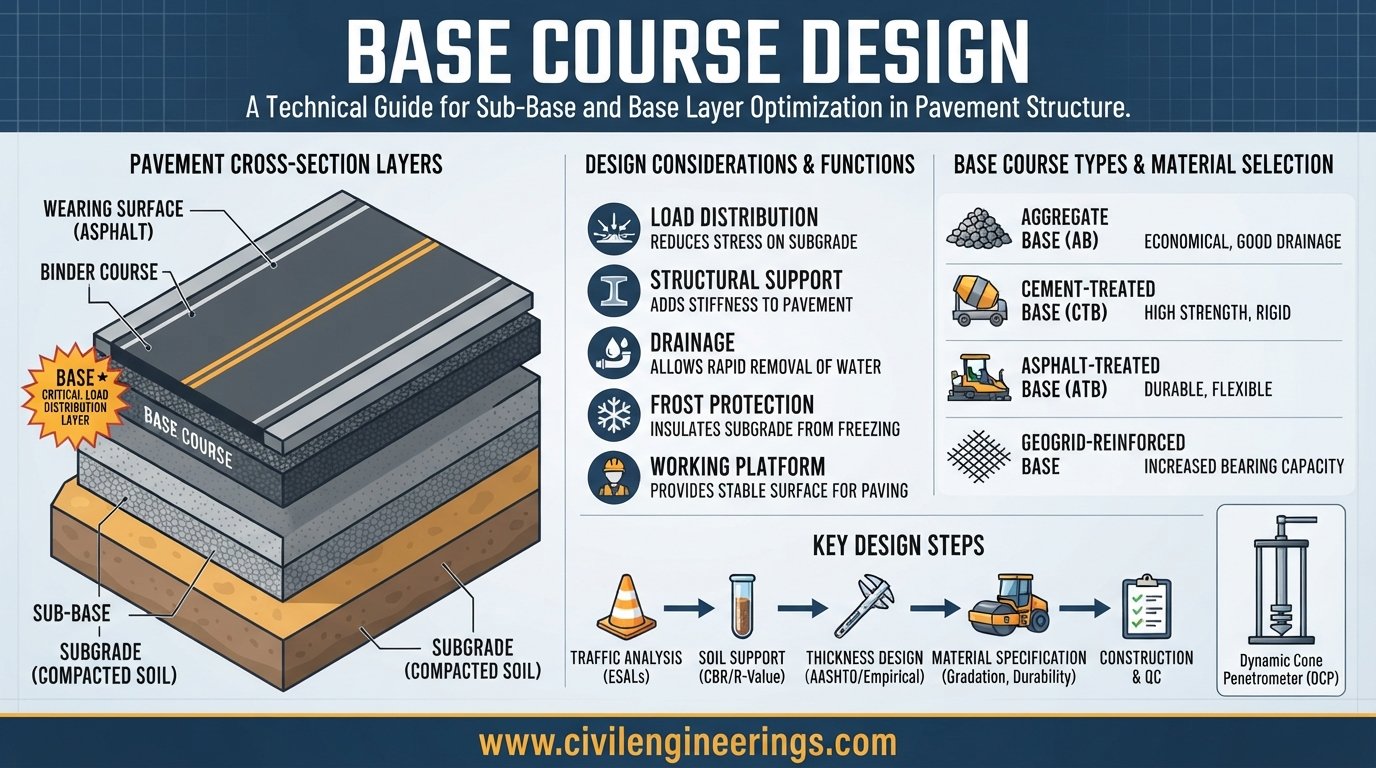
A road pavement can look perfectly smooth on the surface while hiding serious weaknesses underneath. One of the most important structural layers responsible for preventing those weaknesses is the base course. It receives traffic-induced stresses from the upper pavement layers, spreads those stresses over a larger area, and helps protect the subgrade from excessive deformation.
Base Course Design therefore requires much more than selecting an aggregate and specifying a thickness. Engineers must consider traffic loading, subgrade strength, material properties, drainage, climate, construction quality, compaction, pavement type, and the expected service life. A poorly designed base can contribute to rutting, fatigue cracking, pumping, settlement, moisture-related deterioration, and premature pavement failure.
This guide explains the principles of Base Course Design from an engineering and construction perspective. It covers base-course functions, design inputs, material selection, thickness determination, aggregate gradation, drainage, compaction, testing, quality control, common failures, practical examples, and recommendations for students, engineers, and contractors.
What Is a Base Course in Road Pavement?
The base course is a structural pavement layer located below the surface or binder course and normally above the sub-base. In some pavement structures, particularly low-volume roads or specially designed sections, the base may be placed directly over the prepared subgrade.
The base course carries a substantial portion of the pavement’s structural demand. Its primary role is to distribute wheel loads before they reach the weaker layers below.
A conventional flexible pavement may contain:
Surface course → Binder course → Base course → Sub-base → Subgrade
The exact arrangement varies according to pavement type, traffic, design method, materials, drainage requirements, and governing specifications. FHWA describes unbound granular base and subbase as important components of pavement systems, while also emphasizing the role of drainage in maintaining pavement performance. (Federal Highway Administration)


A good base course should provide adequate strength, stiffness, durability, stability, drainage characteristics, and resistance to deformation.
Functions of a Base Course
Base-course performance affects nearly every aspect of pavement behavior. It is not simply a layer of crushed stone placed beneath asphalt.
Load Distribution
Vehicle wheel loads are concentrated over relatively small contact areas. The pavement structure gradually spreads these stresses as they move downward.
The base course helps reduce the stress reaching the subgrade.
Conceptually:
Wheel load → Surface → Binder → Base → Sub-base → Subgrade
The stress transmitted to the subgrade should remain within acceptable limits.
Structural Support
The base contributes significantly to the structural capacity of flexible pavement.
A high-quality base with adequate stiffness can reduce vertical deformation and improve pavement serviceability under repeated traffic loading.
Resistance to Rutting
Permanent deformation can develop when the base or underlying layers cannot withstand repeated wheel loading.
A properly graded, well-compacted aggregate base interlocks under load and provides resistance against shear deformation.
Drainage
Water is one of the major causes of pavement deterioration.
Depending on its gradation and pavement configuration, a base can assist in moving infiltrated water toward drainage outlets. However, engineers should not assume that every dense-graded base automatically provides effective drainage.
Drainage must be designed as a complete system.
Protection of the Subgrade
The base reduces the magnitude of stresses transmitted to the subgrade. This becomes particularly important where the subgrade has relatively low strength or is sensitive to moisture.
Construction Platform
A stable base also provides a firm platform for subsequent pavement operations.
This improves paving accuracy and reduces construction problems associated with unstable or yielding underlying layers.
Major Factors Affecting Base Course Design
A successful Base Course Design starts with the correct design inputs.
Traffic Loading
Traffic is one of the most important variables.
The engineer should evaluate:
- Initial commercial traffic
- Heavy vehicle percentage
- Axle-load distribution
- Equivalent axle loading
- Traffic growth
- Lane distribution
- Design period
- Directional distribution
- Vehicle damage factors where applicable
A road carrying mainly passenger cars requires a very different structural approach from a highway carrying large numbers of heavily loaded trucks.
Subgrade Strength
The base cannot be designed independently of the soil beneath it.
Common subgrade parameters include:
- CBR
- Resilient modulus
- Elastic modulus
- Shear strength
- Moisture sensitivity
- Density
- Plasticity
- Drainage condition
For example, IRC-based pavement work commonly relates subgrade strength to resilient modulus. An IRC technical paper cites the relationship:
MR = 10 × CBR
for CBR values below 5%, subject to the applicable IRC design provisions. (IRCTC)
The actual design should always use the current governing standard rather than treating a simplified relationship as universally applicable.
Climate and Moisture
Climate affects base performance through:
- Rainfall
- Groundwater
- Temperature
- Freeze-thaw cycles
- Seasonal moisture variation
- Flooding
- Drying and wetting cycles
A strong aggregate can still perform poorly if water remains trapped inside the pavement.
Material Availability
The design should consider locally available aggregates.
Engineers often have to balance:
Engineering performance + transportation distance + cost + environmental impact
A technically excellent material may not be economical if it must be transported hundreds of kilometers.
Construction Quality
Laboratory material properties do not automatically translate into field performance.
Poor spreading, excessive moisture, inadequate compaction, segregation, weak formation, or poor drainage can undermine an otherwise excellent design.
Materials Used in Base Course Construction
Base materials depend on pavement type and project specifications.
Crushed Aggregate Base
Crushed rock is widely used because angular particles provide good mechanical interlock.
Important properties include:
- Particle size distribution
- Aggregate crushing resistance
- Abrasion resistance
- Soundness
- Shape
- Flakiness and elongation
- Cleanliness
- Plasticity of fines
- Water absorption
- Durability
Wet Mix Macadam
Wet Mix Macadam, commonly called WMM in South Asian highway practice, uses well-graded crushed aggregate mixed with controlled moisture and compacted to form a dense base.
Its performance depends heavily on:
- Correct gradation
- Proper moisture
- Uniform mixing
- Appropriate layer thickness
- Effective compaction
IRC publications include specifications and guidance for road pavement materials and construction, including documents associated with flexible pavement design and granular road construction. (IRCTC)
Cement-Treated Base
Cement-treated materials can provide greater stiffness than conventional unbound aggregate.
They may be considered when:
- Traffic is heavy
- Available aggregate quality is limited
- Greater stiffness is required
- Pavement thickness optimization is desired
- Stabilization offers economic advantages
However, treated bases require careful control of binder content, mixing, moisture, curing, strength, cracking behavior, and construction timing.
Recycled Aggregate
Recycled asphalt pavement and recycled concrete aggregate can sometimes be incorporated into pavement base systems where specifications permit.
Their use requires careful assessment of:
- Source quality
- Contamination
- Gradation
- Durability
- Moisture behavior
- Environmental suitability
Current IRC practice also recognizes recycling and full-depth reclamation technologies as part of modern pavement rehabilitation approaches. (IRCTC)
Aggregate Gradation for Base Course
Gradation is one of the most important characteristics of an aggregate base.
A well-graded material contains an appropriate combination of coarse particles, intermediate particles, and fines. This allows the aggregate particles to fit together efficiently.
The basic concept is:
Large particles → intermediate particles → smaller particles → controlled fines
The objective is not simply to maximize the amount of material passing a particular sieve. The complete grading envelope specified by the governing standard must be satisfied.
Why Gradation Matters
Proper gradation can improve:
- Particle interlock
- Density
- Stability
- Load distribution
- Workability
- Resistance to deformation
Excessive fines can create problems, particularly when they are plastic or moisture-sensitive.
Too little fine material can make the aggregate difficult to compact and may create excessive voids.
Therefore, the engineer must balance density, stability, permeability, and constructability.
How to Determine Base Course Thickness
There is no single universal base-course thickness that applies to every road.
Thickness depends on the complete pavement design.
Important inputs include:
- Design traffic
- Subgrade strength
- Pavement type
- Base material properties
- Climate
- Drainage
- Design life
- Reliability
- Construction quality
- Applicable pavement design method
For mechanistic-empirical design, engineers may evaluate pavement responses such as:
- Tensile strain
- Compressive strain
- Vertical stress
- Permanent deformation
- Fatigue damage
- Rutting
For example, a simplified structural concept can be represented as:
Total pavement capacity = f(material properties, layer thickness, traffic, subgrade, environment)
The actual pavement thickness should come from the selected design procedure rather than a simple rule-of-thumb value.
IRC technical material illustrates this approach by using traffic, subgrade CBR, resilient modulus, pavement-layer properties, and strain criteria in pavement design. (IRCTC)
Basic Base Course Design Procedure
A practical design workflow can be organized into several stages.
Step 1: Establish Design Traffic
Determine the design traffic over the selected design period.
For simplified traffic forecasting:
Future traffic = Initial traffic × (1 + r)^n
Where:
- r = annual traffic growth rate
- n = number of years
For formal pavement design, engineers should use the traffic methodology required by the governing standard.
Step 2: Investigate the Subgrade
Conduct field and laboratory investigations.
Typical tests include:
- CBR
- Particle-size analysis
- Atterberg limits
- Moisture-density relationship
- In-situ density
- Plate load or modulus testing where required
- DCP testing
- Resilient modulus testing where applicable
The weakest representative subgrade condition should receive particular attention.
Step 3: Select the Base Material
Evaluate available sources against project specifications.
Do not select aggregate solely on the basis of compressive strength.
Durability, gradation, particle shape, fines, moisture behavior, and construction characteristics also matter.
Step 4: Select Preliminary Thickness
Use the appropriate pavement design procedure.
The base thickness should be evaluated together with the:
- Surface course
- Binder course
- Sub-base
- Subgrade
- Drainage system
Step 5: Check Structural Performance
Verify that the proposed pavement can resist expected loading.
For mechanistic approaches, calculate or model critical pavement responses.
Step 6: Check Drainage
Review:
- Crossfall
- Side drains
- Edge drains
- Subsurface drainage
- Outlet locations
- Groundwater
- Permeable layers
- Filter/separation requirements
FHWA guidance emphasizes that pavement drainage features must be integrated into the pavement system rather than treated as an afterthought. (Federal Highway Administration)
Step 7: Verify Constructability
A theoretically efficient design can become impractical if contractors cannot place and compact the layer consistently.
Review:
- Maximum loose lift thickness
- Available rollers
- Haul distance
- Water availability
- Weather
- Mixing equipment
- Material segregation
- Construction access
Step 8: Establish Quality-Control Requirements
Define acceptance criteria before construction begins.
This prevents disputes and gives the site team measurable targets.
Base Course Construction Process


Design quality means little if construction quality is poor.
Prepare the Underlying Layer
Before placing the base, verify that the sub-base or formation has:
- Correct elevation
- Correct crossfall
- Adequate compaction
- Proper moisture
- Acceptable surface condition
- No soft spots
- No standing water
Transport and Spread Aggregate
Material should be delivered without excessive segregation.
Graders or suitable spreading equipment should distribute the aggregate uniformly.
Avoid uncontrolled dumping and long stockpiles that cause coarse and fine particles to separate.
Control Moisture
For unbound aggregate, moisture is critical to achieving target density.
Too little water can prevent proper particle rearrangement.
Too much water can cause:
- Pumping
- Instability
- Rutting
- Delayed compaction
- Loss of bearing capacity
Compact the Base
Compaction should follow the approved method trial or project specification.
Typical equipment can include:
- Vibratory smooth-drum rollers
- Pneumatic rollers
- Static rollers
- Combination rollers
The correct roller type depends on aggregate characteristics and project requirements.
Check Finished Level
Survey the finished surface for:
- Elevation
- Crossfall
- Thickness
- Width
- Surface regularity
An apparently minor level error in the base can affect the thickness of the asphalt layer placed above it.
Quality Control and Testing
A professional Base Course Design must be supported by a practical testing program.
Aggregate Testing
Depending on the governing specification, testing may include:
- Sieve analysis
- Aggregate crushing value
- Los Angeles abrasion
- Aggregate impact value
- Soundness
- Flakiness and elongation
- Water absorption
- Specific gravity
- Plasticity tests for fines
Field Density
Field density testing verifies whether the placed material achieved the required degree of compaction.
Possible methods include:
- Sand-cone method
- Nuclear density gauge
- Other approved in-situ density techniques
The acceptance percentage should come from the project specification.
Moisture-Density Testing
The laboratory moisture-density relationship helps establish an appropriate target density and optimum moisture condition.
A common conceptual relationship is:
Dry density = Dry mass / Total volume
The field result is then compared with the specified laboratory reference density.
Thickness Verification
Engineers should verify the actual compacted thickness rather than relying solely on the quantity delivered to the site.
Base Course Drainage Design
Water management deserves special attention.
Even a strong aggregate can lose performance when saturated and repeatedly loaded.
Surface Drainage
Provide appropriate:
- Camber
- Crossfall
- Shoulders
- Side drains
- Catch drains
- Culverts
Subsurface Drainage
Where conditions require it, consider:
- Edge drains
- Drainage blankets
- Permeable layers
- Filter layers
- Geotextiles
- Drainage outlets
A drainage layer is only effective if water has somewhere to go.
This is an important field lesson: never design a permeable layer without designing its outlet system.
Common Base Course Design Mistakes
Designing Without Reliable Subgrade Data
A base thickness selected without adequate subgrade investigation can be seriously misleading.
Using Poor-Quality Aggregate
Cheap aggregate can become expensive when early pavement failures lead to reconstruction.
Ignoring Moisture
Moisture should be considered during both design and construction.
Insufficient Compaction
Under-compaction increases the risk of settlement and deformation.
Excessive Fines
Plastic fines can reduce stability and increase moisture sensitivity.
Poor Drainage
Blocked outlets, inadequate crossfall, and trapped water frequently contribute to pavement deterioration.
Ignoring Construction Variability
Laboratory performance represents controlled conditions. Field construction introduces variability.
Designers should account for realistic construction tolerances and quality-control procedures.
Practical Example of Base Course Design
Consider a hypothetical two-lane highway project with:
- Moderate-to-heavy commercial traffic
- Design period of 15 years
- Moderate-strength subgrade
- Well-drained terrain
- Crushed aggregate available locally
The engineer would first establish design traffic and investigate the subgrade.
Suppose laboratory testing indicates a representative CBR of 6%.
The engineer should then:
- Determine design traffic according to the selected pavement standard.
- Establish the required pavement structural capacity.
- Select a suitable base material.
- Determine base thickness using the adopted pavement design method.
- Check the interaction between base, sub-base, and subgrade.
- Confirm drainage requirements.
- Verify that the proposed thickness can be constructed and compacted properly.
- Establish material and field-density acceptance criteria.
The important lesson is that CBR alone does not determine base thickness.
The final pavement section results from the interaction of traffic, subgrade, materials, climate, drainage, design method, and reliability.
IRC, AASHTO, and ICE Considerations
Base Course Design should follow the standard specified by the project authority.
IRC
In India and many South Asian projects, engineers commonly encounter IRC pavement-design documents, including IRC:37 for flexible pavement design. IRC materials also demonstrate the use of traffic, resilient modulus, CBR, strain criteria, and layer properties in pavement analysis.
IRC’s current publication ecosystem continues to evolve, so engineers should verify the latest applicable edition and amendments before preparing final designs. (IRCTC)
AASHTO
AASHTO pavement procedures are widely used in North America and internationally. They provide established approaches for considering traffic, pavement materials, reliability, environmental effects, and structural performance.
Engineers should use the current project-specified AASHTO procedure rather than mixing equations from different editions.
ICE
The Institution of Civil Engineers emphasizes that effective highway design should consider material properties, design loading, engineering principles, validated design methods, existing ground conditions, environment, and safety. (Institution of Civil Engineers (ICE))
The key principle is universal:
Use the governing standard consistently from investigation through final design and construction.
Best Practices for Engineers and Contractors
For Civil Engineering Students
Students should understand the mechanics behind the pavement rather than memorizing thickness tables.
Focus on:
- Load distribution
- CBR and resilient modulus
- Aggregate gradation
- Compaction
- Drainage
- Pavement failure mechanisms
- Traffic loading
Learn to read pavement cross-sections and laboratory test reports.
For Highway Engineers
Engineers should maintain close coordination between:
- Geotechnical investigation
- Pavement design
- Materials laboratory
- Drainage design
- Survey
- Construction team
Review field results continuously instead of treating design as a document completed before construction begins.
For Site Engineers
Pay particular attention to:
- Moisture
- Layer thickness
- Material segregation
- Roller passes
- Surface levels
- Crossfall
- Density results
- Soft spots
Small construction errors in the base layer can become expensive problems after asphalt placement.
For Contractors
Use a controlled trial section when required.
Determine the practical combination of:
- Moisture content
- Roller type
- Roller speed
- Number of passes
- Lift thickness
Then maintain those controls throughout production.
Advantages of a Properly Designed Base Course
A well-designed and properly constructed base can provide:
- Improved pavement structural capacity
- Better load distribution
- Reduced subgrade stress
- Greater resistance to deformation
- Improved pavement life
- Better construction platform
- More consistent surface-layer performance
- Potentially lower lifecycle costs
Limitations and Challenges
Base-course design also involves challenges.
These include:
- Variable aggregate quality
- Seasonal moisture changes
- Weak subgrade
- Limited material sources
- Haul costs
- Construction variability
- Drainage failures
- Heavy axle loads
- Increasing environmental requirements
A technically sound design must therefore remain practical and adaptable to site conditions.
FAQs About Base Course Design
1. What is Base Course Design?
Base Course Design is the engineering process used to determine the material, thickness, strength, gradation, drainage characteristics, and construction requirements of the pavement’s structural base layer.
2. What is the main purpose of a base course?
Its primary purpose is to distribute traffic loads, provide structural support, protect the subgrade, and contribute to pavement durability.
3. What materials are commonly used for base courses?
Common materials include crushed aggregate, WMM, mechanically stabilized aggregates, cement-treated materials, and approved recycled aggregates.
4. How is base-course thickness determined?
Thickness depends on traffic loading, subgrade strength, material properties, pavement type, climate, drainage, reliability, and the applicable pavement design method.
5. Is CBR enough to design a base course?
No. CBR is an important subgrade parameter, but a complete design also considers traffic, material stiffness, environmental conditions, drainage, pavement configuration, and design criteria.
6. Why is compaction important in base construction?
Compaction increases particle contact and reduces unwanted voids, helping the aggregate develop adequate density, stability, and resistance to deformation.
7. What happens if the base course becomes saturated?
Saturation can reduce effective support, increase deformation risk, promote pumping in susceptible systems, and accelerate pavement deterioration.
8. What tests are used for base-course aggregates?
Depending on the specification, engineers may perform gradation, abrasion, crushing, impact, soundness, particle-shape, water-absorption, and plasticity-related tests.
9. Can recycled materials be used in a base course?
Yes, where permitted by the governing specification and supported by appropriate testing. Recycled aggregates must meet the required engineering and environmental criteria.
10. What is the most important factor in base-course performance?
There is no single factor. Material quality, structural design, drainage, subgrade condition, and construction quality must work together. A failure in any one of these areas can reduce pavement performance.
Conclusion
A durable road does not begin with asphalt. It begins with a pavement structure that can safely transfer traffic loads while controlling moisture, deformation, and environmental effects. The base course plays a central role in that system.
Effective Base Course Design requires engineers to consider design traffic, subgrade strength, aggregate properties, gradation, thickness, drainage, compaction, climate, reliability, and construction variability as interconnected factors. A strong material placed at the wrong thickness or on a poorly drained foundation may still fail. Likewise, an excellent design can lose its intended performance through inadequate field compaction or poor moisture control.
For students, the key lesson is to understand the engineering principles behind pavement layers. For engineers, the priority should be integrated structural and drainage design supported by reliable site data. Contractors and site teams should focus on material consistency, moisture, compaction, levels, and quality control.
When design and construction work together, the base becomes more than a layer of aggregate—it becomes a reliable structural foundation for a safer, smoother, and longer-lasting road.
