
Introduction
Every successful highway, expressway, urban road, or public transportation system begins with one essential question: How many people and vehicles will use it? The answer comes from Traffic Demand Analysis, a fundamental process in transportation engineering that estimates current and future travel demand. Without accurate traffic forecasting, engineers cannot design efficient roads, determine the required number of lanes, or justify infrastructure investments.
Traffic demand continues to grow due to urbanization, population expansion, industrial development, and increasing vehicle ownership. Transportation planners must evaluate travel patterns, predict future traffic volumes, and identify infrastructure needs before construction begins. This analytical process reduces congestion, improves road safety, optimizes project costs, and supports sustainable transportation planning.
Whether you are a civil engineer, transportation planner, contractor, researcher, or engineering student, understanding Traffic Demand Analysis helps you make informed decisions throughout the highway project lifecycle. This guide explains the principles, methods, applications, and engineering practices used to forecast traffic demand accurately.
What Is Traffic Demand Analysis?
Traffic Demand Analysis is the systematic process of estimating the number of trips that people and goods will make within a transportation network during a specific period. It helps engineers understand travel behavior and predict future traffic volumes for roads, highways, intersections, bridges, and public transportation systems.
Transportation agencies rely on this analysis before planning new infrastructure or upgrading existing facilities. Accurate demand estimates help engineers design road networks that can accommodate future traffic safely and efficiently.
Key Elements of Traffic Demand Analysis
- Travel demand estimation
- Traffic volume forecasting
- Population and employment analysis
- Land-use assessment
- Vehicle ownership trends
- Trip purpose evaluation
- Transportation network analysis
Practical Example
A rapidly expanding industrial zone may attract thousands of additional workers and freight vehicles every day. Engineers conduct traffic demand analysis to determine whether existing roads can handle the increased traffic or if a new highway, bypass, or interchange is required.
Why Traffic Demand Analysis Is Important
Transportation infrastructure represents a significant investment. Poor planning can lead to congestion, safety issues, and unnecessary construction costs. Traffic demand analysis provides the information needed to make sound engineering decisions.
Major Benefits
- Supports efficient highway planning.
- Reduces traffic congestion.
- Improves road safety.
- Optimizes construction budgets.
- Enhances freight movement.
- Reduces travel time.
- Improves public transportation planning.
- Supports sustainable urban development.
Engineering Perspective
A road designed for today’s traffic may become congested within a few years if future demand is ignored. Engineers therefore forecast traffic growth over the expected design life of the facility to ensure long-term performance.
Objectives of Traffic Demand Analysis
Traffic demand analysis serves multiple objectives throughout the planning and design process.
Primary Objectives
- Estimate current travel demand.
- Predict future traffic growth.
- Determine roadway capacity requirements.
- Evaluate transportation alternatives.
- Support pavement design.
- Improve intersection performance.
- Reduce congestion.
- Enhance transportation safety.
- Optimize public investment.
Secondary Objectives
- Support environmental studies.
- Improve public transit planning.
- Assist economic evaluations.
- Prioritize infrastructure projects.
- Develop traffic management strategies.
By achieving these objectives, transportation planners can allocate resources effectively and create resilient transportation systems.
Traffic Demand Analysis Process
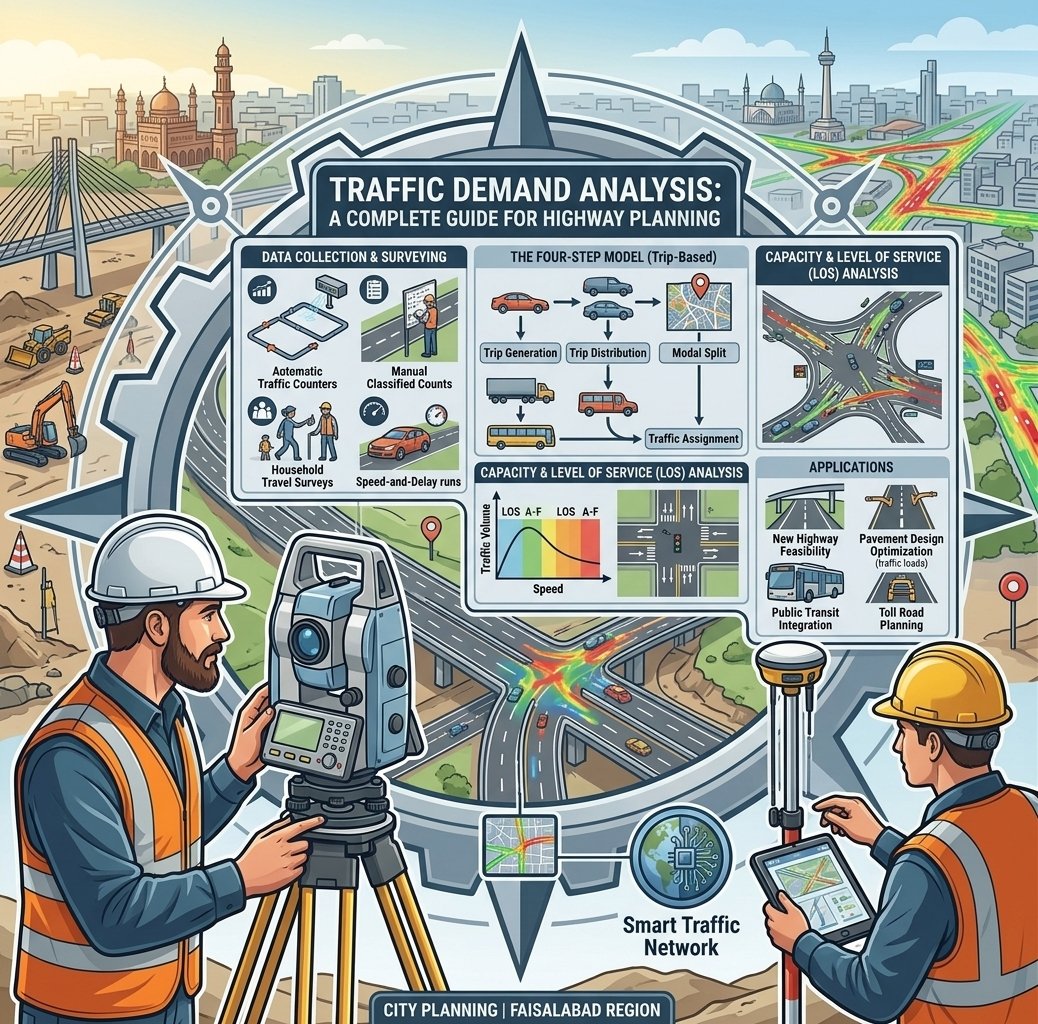
Traffic demand analysis follows a structured methodology. Each stage builds upon the previous one to create reliable traffic forecasts.
Population & Land Use
          │
          ▼
Define Study Area
          │
          ▼
Traffic Data Collection
          │
          ▼
Trip Generation
          │
          ▼
Trip Distribution
          │
          ▼
Mode Choice
          │
          ▼
Traffic Assignment
          │
          ▼
Future Traffic Forecast
This sequence forms the foundation of transportation planning worldwide.
Step 1: Define the Study Area
Every traffic demand study begins by defining the geographic area to be analyzed. Engineers identify the project boundaries, transportation corridors, and zones that influence travel patterns.
Factors Considered
- Existing road network
- Urban and rural boundaries
- Residential areas
- Commercial districts
- Industrial zones
- Schools and universities
- Airports and railway stations
- Major activity centers
Traffic Analysis Zones (TAZ)
Engineers divide the study area into smaller Traffic Analysis Zones (TAZs). Each zone represents an area with similar land-use characteristics and travel behavior.
The use of TAZs simplifies data collection and improves the accuracy of travel demand models.
Practical Example
For a proposed ring road around a city, the study area may include:
- Central business district
- Residential neighborhoods
- Industrial estates
- Nearby towns
- Major highways connecting the city
This approach ensures that all significant travel movements are considered.
Step 2: Collect Traffic and Socioeconomic Data
Reliable data forms the backbone of every traffic demand analysis. Engineers gather traffic information together with demographic and economic data to understand existing travel conditions.
Traffic Data Collection Methods
Traffic Volume Counts
Engineers measure the number of vehicles passing a location during specific time periods.
Common techniques include:
- Manual counting
- Automatic traffic counters
- Video-based traffic surveys
- Drone traffic monitoring
Vehicle Classification Surveys
These surveys record different vehicle types, such as:
- Cars
- Motorcycles
- Buses
- Light commercial vehicles
- Heavy trucks
Vehicle classification supports pavement design and capacity analysis.
Speed Surveys
Speed studies help engineers evaluate traffic flow characteristics and identify congestion.
Origin–Destination Surveys
These surveys determine where trips begin and where they end. The information helps planners understand travel patterns across the study area.
Socioeconomic Data Collection
Traffic demand depends heavily on demographic and economic conditions. Engineers collect data on:
- Population
- Employment
- Household income
- Vehicle ownership
- Land use
- School enrollment
- Industrial activity
Why Data Quality Matters
Incomplete or inaccurate data can lead to poor forecasts and costly design errors. Engineers should verify survey results and use reliable sources to maintain accuracy.
Step 3: Trip Generation Analysis
Trip generation estimates the number of trips produced and attracted by each Traffic Analysis Zone.
This stage answers two important questions:
- How many trips originate from a zone?
- How many trips end in that zone?
Trip Producers
Trip-producing areas typically include:
- Residential neighborhoods
- Student housing
- Villages
- Apartment complexes
Trip Attractors
Trip-attracting areas generally include:
- Shopping centers
- Industrial parks
- Hospitals
- Offices
- Universities
- Airports
Factors Affecting Trip Generation
Several variables influence travel demand:
- Population size
- Employment opportunities
- Household income
- Vehicle ownership
- Land-use type
- Economic development
- Availability of public transportation
Example
A newly developed technology park employing 8,000 workers will attract thousands of daily trips. Engineers estimate these trips to determine whether nearby roads require widening, new intersections, or additional public transport services.
Common Trip Generation Methods
- Cross-classification analysis
- Regression analysis
- Category analysis
- Land-use-based estimation
- Household travel survey models
Selecting the appropriate method depends on data availability, project scale, and planning objectives.
Engineering Principles Behind Traffic Demand Analysis
Traffic demand analysis combines engineering, economics, geography, and behavioral science. Engineers use these principles to create realistic travel forecasts.
Fundamental Principles
- Travel demand depends on land use.
- Population growth increases trip production.
- Employment centers attract more trips.
- Better roads influence travel behavior.
- Public transport availability affects vehicle usage.
- Economic growth increases traffic volumes.
- Accurate forecasting requires reliable data.
Understanding these relationships enables engineers to develop transportation systems that meet both present and future needs.
Practical Applications of Traffic Demand Analysis
Traffic demand analysis supports a wide range of transportation projects, including:
- National highways
- Urban expressways
- Rural road improvements
- Bridge projects
- Interchanges
- Airports
- Bus Rapid Transit (BRT) systems
- Metro rail corridors
- Freight logistics networks
- Smart city transportation planning
Transportation agencies also use traffic demand forecasts to prioritize investments and justify funding for large infrastructure projects.
Step 4: Trip Distribution
After estimating the number of trips generated by each Traffic Analysis Zone (TAZ), transportation engineers determine where those trips will travel. This stage is known as Trip Distribution.
Trip distribution connects trip-producing zones with trip-attracting zones. The results help engineers understand travel patterns across the transportation network.
Purpose of Trip Distribution
Trip distribution helps engineers:
- Estimate travel between different zones.
- Identify major travel corridors.
- Forecast traffic on proposed highways.
- Plan new road connections.
- Improve network efficiency.
Factors Affecting Trip Distribution
Several factors influence how trips are distributed.
- Distance between origins and destinations
- Travel time
- Fuel and transportation costs
- Road connectivity
- Employment opportunities
- Commercial activities
- Land-use characteristics
Common Methods
Transportation planners commonly use:
- Gravity Model
- Growth Factor Model
- Opportunity Model
- Entropy Model
Among these, the Gravity Model remains one of the most widely adopted methods because it considers both trip attraction and travel resistance.
Practical Example
A residential suburb generates thousands of work-related trips every morning. Most commuters travel toward the nearby business district instead of neighboring residential areas. Trip distribution identifies these dominant travel patterns and supports better roadway planning.
Step 5: Mode Choice Analysis
Not every traveler uses the same mode of transportation. Some prefer private vehicles, while others use buses, trains, bicycles, or walk.
Mode Choice Analysis estimates how travelers select their preferred mode based on convenience, cost, and travel time.
Common Transportation Modes
- Private cars
- Motorcycles
- Public buses
- Metro rail
- Light rail transit
- Walking
- Cycling
- Ride-sharing services
Factors Influencing Mode Choice
Engineers evaluate several variables, including:
- Travel time
- Ticket or fuel cost
- Vehicle ownership
- Parking availability
- Comfort
- Reliability
- Safety
- Accessibility
Engineering Application
Suppose a city introduces a new metro line connecting residential neighborhoods with commercial districts. Transportation planners estimate how many commuters will shift from private cars to public transit. This information helps forecast future highway traffic and supports sustainable mobility planning.
Step 6: Traffic Assignment
Traffic assignment determines the specific routes travelers choose within the transportation network.
After estimating trip generation, trip distribution, and mode choice, engineers assign projected traffic volumes to individual roads and intersections.
Objectives of Traffic Assignment
- Predict roadway traffic volumes.
- Identify congested corridors.
- Evaluate alternative routes.
- Support intersection design.
- Improve traffic management strategies.
Common Traffic Assignment Methods
All-or-Nothing Assignment
This method assumes that all travelers choose the shortest available route.
Incremental Assignment
Traffic enters the network in stages, allowing travel times to adjust as congestion increases.
User Equilibrium Assignment
Travelers select routes that minimize their own travel time until no one can improve their journey by changing routes.
System Optimal Assignment
Traffic distributes across the network to minimize total travel time for all users rather than for individual drivers.
Practical Example
If engineers predict that a proposed bypass will divert 40% of heavy trucks from an urban corridor, traffic assignment models estimate the resulting traffic volumes on both the bypass and the existing roadway.
Step 7: Future Traffic Forecasting
Forecasting future traffic demand is the final stage of the traffic demand analysis process.
Transportation projects often have design lives of 20 to 40 years. Engineers therefore estimate future traffic volumes rather than relying solely on current conditions.
Factors Affecting Future Traffic Growth
- Population growth
- Urban expansion
- Industrial development
- Economic growth
- Vehicle ownership trends
- Tourism
- Freight movement
- Government policies
Forecasting Techniques
Common forecasting methods include:
- Trend analysis
- Growth factor models
- Regression analysis
- Land-use forecasting
- Integrated travel demand models
Benefits of Accurate Forecasting
Reliable forecasts help engineers:
- Determine the required number of lanes.
- Design stronger pavement structures.
- Plan future road widening.
- Improve investment decisions.
- Reduce future congestion.
- Enhance transportation safety.
Topic-Related Diagram: Four-Step Travel Demand Model
                  TRAFFIC DEMAND ANALYSIS
                           │
                           ▼
                +----------------------+
                |   Trip Generation    |
                +----------------------+
                           │
                           ▼
                +----------------------+
                |  Trip Distribution   |
                +----------------------+
                           │
                           ▼
                +----------------------+
                |     Mode Choice      |
                +----------------------+
                           │
                           ▼
                +----------------------+
                |  Traffic Assignment  |
                +----------------------+
                           │
                           ▼
                 Future Traffic Forecast
Engineering Principles of Traffic Demand Analysis
Traffic demand analysis combines engineering knowledge with mathematical modeling and planning principles.
Fundamental Engineering Concepts
- Transportation demand changes with land use.
- Population growth increases travel demand.
- Employment centers attract more trips.
- Highway capacity influences traffic flow.
- Travel behavior changes with transportation policies.
- Reliable data improves forecasting accuracy.
- Continuous monitoring supports better planning decisions.
These principles enable engineers to develop transportation systems that remain efficient throughout their design life.
Best Practices for Traffic Demand Analysis
Transportation professionals can improve forecasting accuracy by following established best practices.
- Define clear project objectives.
- Divide the study area into appropriate Traffic Analysis Zones.
- Use recent and reliable survey data.
- Combine traffic counts with socioeconomic information.
- Validate forecasting models before implementation.
- Update forecasts when land-use patterns change.
- Evaluate multiple growth scenarios.
- Integrate environmental and sustainability considerations.
- Use Geographic Information Systems (GIS) and traffic modeling software where appropriate.
- Document assumptions and methodologies for future review.
Practical Recommendations
Civil Engineers
- Review traffic forecasts before finalizing pavement and geometric designs.
- Coordinate with urban planners during project development.
- Consider future traffic growth instead of current volumes alone.
- Verify field survey data before using it in design calculations.
Contractors
- Understand projected traffic volumes before planning construction staging.
- Coordinate temporary traffic management with project consultants.
- Protect survey control points during construction activities.
- Follow approved traffic control plans to minimize disruption.
Engineering Students
- Learn the four-step travel demand model thoroughly.
- Practice interpreting traffic survey data.
- Study the relationship between land use and transportation demand.
- Gain experience with transportation planning software and GIS tools.
General Discussion of IRC, AASHTO, and ICE Practices
Highway authorities worldwide follow similar principles when conducting traffic demand analysis.
In general, guidance from organizations such as IRC (Indian Roads Congress), AASHTO (American Association of State Highway and Transportation Officials), and ICE (Institution of Civil Engineers) emphasizes:
- Collecting accurate traffic and socioeconomic data.
- Designing infrastructure based on projected traffic demand rather than current conditions.
- Evaluating multiple design scenarios.
- Incorporating road safety into planning decisions.
- Considering lifecycle costs and future expansion.
- Maintaining comprehensive documentation throughout the planning process.
- Updating forecasts periodically as travel patterns evolve.
Following these widely accepted engineering practices improves project reliability, safety, and long-term performance.
Frequently Asked Questions (FAQs)
1. What is Traffic Demand Analysis?
Traffic Demand Analysis estimates current and future travel demand to support the planning, design, and operation of transportation infrastructure.
2. Why is Traffic Demand Analysis important in highway engineering?
It helps engineers determine roadway capacity, predict future traffic volumes, optimize investments, and improve road safety.
3. What are the four steps of the travel demand model?
The traditional model consists of Trip Generation, Trip Distribution, Mode Choice, and Traffic Assignment.
4. What data is required for Traffic Demand Analysis?
Typical inputs include traffic counts, vehicle classifications, travel speeds, population, employment, land use, household characteristics, and vehicle ownership.
5. Which factors influence future traffic demand?
Population growth, economic development, urban expansion, industrial activity, tourism, and transportation policies all affect future travel demand.
6. What is the purpose of Traffic Analysis Zones (TAZs)?
TAZs divide the study area into manageable units that simplify data collection, modeling, and forecasting.
7. How does Traffic Demand Analysis improve road safety?
It supports the design of appropriate roadway capacity, intersections, and traffic control measures, reducing congestion and conflict points.
8. Which software tools support Traffic Demand Analysis?
Transportation professionals commonly use GIS platforms, travel demand modeling software, traffic simulation tools, and spreadsheet-based forecasting models.
9. How often should traffic forecasts be updated?
Forecasts should be reviewed whenever major land-use changes, infrastructure projects, or significant socioeconomic developments occur.
10. Can Traffic Demand Analysis support public transportation planning?
Yes. It helps estimate passenger demand, evaluate route performance, optimize transit networks, and improve multimodal transportation systems.
Conclusion
Traffic Demand Analysis forms the backbone of modern transportation planning and highway engineering. It provides engineers with the information needed to understand travel behavior, forecast future traffic volumes, and design infrastructure that meets long-term transportation needs. From defining the study area and collecting reliable data to trip generation, trip distribution, mode choice, traffic assignment, and future forecasting, every stage contributes to informed engineering decisions. Accurate analysis improves roadway capacity, reduces congestion, enhances safety, and ensures efficient use of public resources. Engineers, planners, contractors, and students who understand Traffic Demand Analysis can develop transportation systems that adapt to population growth, economic expansion, and changing travel patterns. Applying recognized engineering practices together with reliable data and sound forecasting techniques leads to resilient, sustainable, and cost-effective transportation networks.

Kamran Malik is a passionate civil engineering writer and researcher who specializes in construction, transportation, structural engineering, and infrastructure topics. Through his articles on CivilEngineerings.com, he simplifies complex engineering concepts and shares practical insights, industry trends, and educational resources for students, professionals, and engineering enthusiasts.