
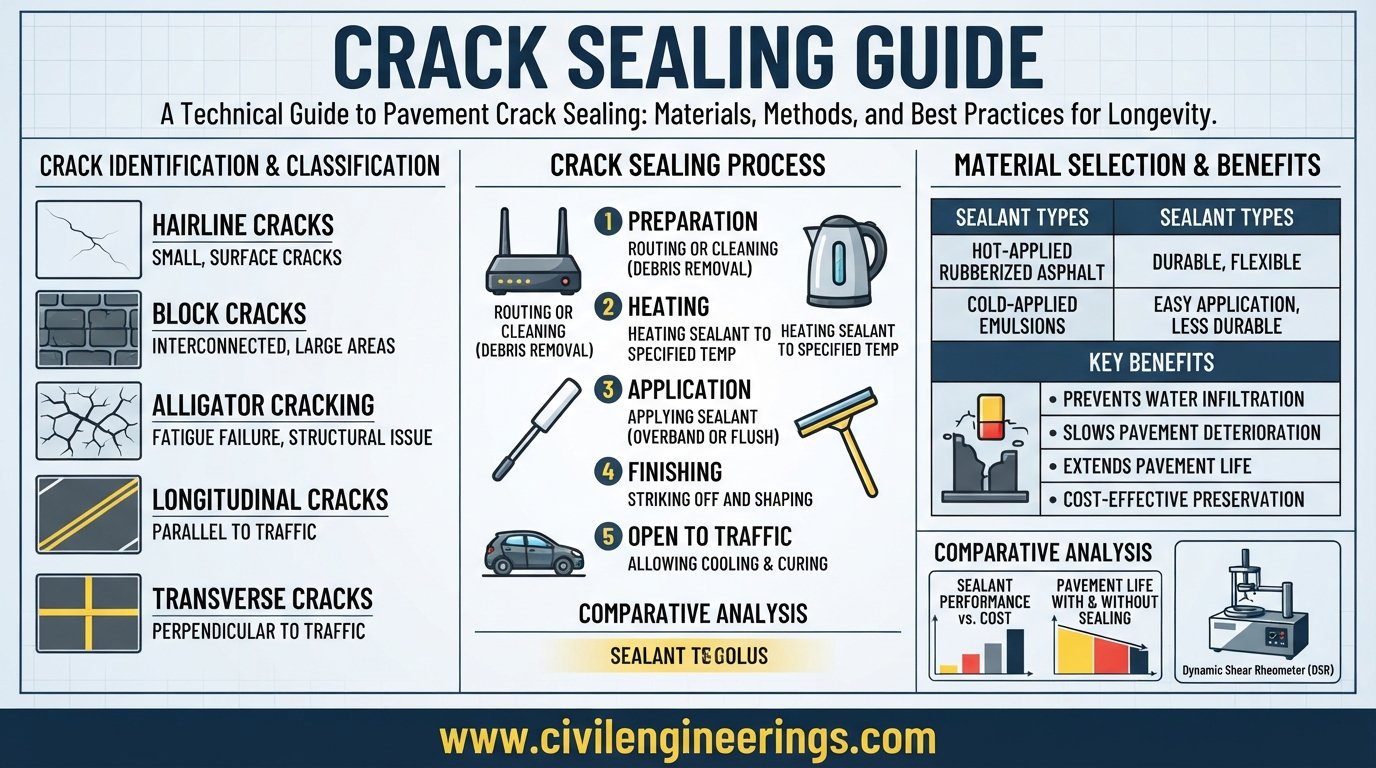
Cracks are among the earliest visible signs of pavement deterioration. A narrow crack may look harmless, but once water, dust, and incompressible materials enter the pavement structure, deterioration can accelerate beneath the surface. For this reason, timely crack treatment remains one of the most practical pavement preservation techniques used by highway agencies.
A well-planned Crack Sealing Guide should go beyond simply filling visible cracks. Engineers need to identify the crack type, understand its movement, evaluate pavement condition, select a compatible sealant, prepare the crack correctly, and apply the material under suitable environmental conditions. Poor preparation or inappropriate material can result in debonding, raveling, sealant pickup, or premature failure.
This guide explains the principles and field practices behind asphalt pavement crack sealing. It covers crack identification, sealing versus filling, material selection, equipment, preparation, application procedures, quality control, common failures, safety, and practical recommendations for students, engineers, contractors, and highway agencies. The discussion is based on established pavement-preservation practice, including FHWA guidance and the broader principles used in AASHTO, IRC, and ICE-related engineering practice. (InfoPave)
What Is Crack Sealing?
Crack sealing is a pavement maintenance treatment in which a suitable sealant is placed into or over a pavement crack to reduce water infiltration and prevent the entry of incompressible materials.
The treatment is primarily intended for working cracks—cracks that experience meaningful opening and closing movement caused by temperature changes, traffic, moisture, or other factors. FHWA describes crack sealing as a preventive pavement treatment designed to reduce water infiltration and intrusion of incompressible materials. (Federal Highway Administration)
The basic principle is simple:
Identify the crack → prepare the crack → apply compatible sealant → allow adequate setting/cooling → reopen to traffic.
However, successful crack sealing depends on much more than placing material into a visible gap.
Crack Sealing vs. Crack Filling
The terms crack sealing and crack filling are sometimes used interchangeably, but they represent different treatment philosophies.
Crack sealing generally involves greater crack preparation and may include routing or sawing a reservoir to accommodate a flexible sealant.
Crack filling generally involves less preparation and places a suitable material into a relatively non-working crack.
FHWA distinguishes sealing from filling based partly on preparation and material requirements. Sealing commonly involves preparation of the crack channel or reservoir and generally uses higher-performance materials. (Federal Highway Administration)
The correct choice depends on crack movement, pavement condition, climate, traffic, and agency specifications.
Why Crack Sealing Is Important
Water is one of the major enemies of pavement performance. When water enters through untreated cracks, it can reach lower pavement layers, weaken moisture-sensitive materials, reduce support, and contribute to further cracking and deformation.
Crack treatment therefore supports pavement preservation by addressing the pathway through which moisture enters the pavement.
FHWA identifies crack sealing as a preventive maintenance technique intended for pavements that remain structurally sound. Preventive treatments work best when applied before deterioration becomes extensive. (Federal Highway Administration)
Key benefits include:
- Reducing water infiltration.
- Limiting entry of sand and other incompressible materials.
- Protecting pavement layers from moisture-related deterioration.
- Delaying crack-related deterioration.
- Reducing the rate of pavement condition decline.
- Extending useful pavement service life.
- Reducing the need for more expensive rehabilitation.
- Improving the effectiveness of pavement preservation programs.
Crack sealing is not a substitute for structural rehabilitation. If the pavement has severe fatigue cracking, extensive base failure, deep settlement, widespread rutting, or major structural deficiencies, sealing individual cracks will not solve the underlying problem.


Types of Pavement Cracks
Correct crack identification is one of the most important steps in a crack sealing project. Different cracks indicate different mechanisms, and not every crack should receive the same treatment.
Transverse Cracks
Transverse cracks generally run approximately perpendicular to the pavement centerline.
They commonly develop because of thermal contraction, asphalt aging, temperature cycling, or reflection from underlying pavement features.
Working transverse cracks can be good candidates for sealing when the surrounding pavement remains structurally sound.
Longitudinal Cracks
Longitudinal cracks run approximately parallel to the pavement centerline.
Possible causes include:
- Lane-joint construction problems.
- Differential movement.
- Reflection cracking.
- Poor compaction.
- Environmental effects.
- Wheel-path-related deterioration.
Engineers should determine the cause before selecting treatment.
Block Cracking
Block cracking forms interconnected rectangular or polygonal patterns.
It is commonly associated with thermal contraction and aging of asphalt binder. If block cracking becomes extensive, widespread surface treatment or rehabilitation may be more appropriate than individual crack sealing.
Fatigue or Alligator Cracking
Fatigue cracking typically appears as interconnected cracks resembling alligator skin.
This is fundamentally different from an isolated working crack. It can indicate structural distress caused by inadequate pavement thickness, weak support, repeated heavy loading, drainage problems, or other structural issues.
Extensive fatigue cracking generally requires structural investigation rather than routine crack sealing.
Reflection Cracking
Reflection cracks develop when cracks, joints, or other discontinuities in an underlying layer propagate into an overlying asphalt layer.
Their treatment depends heavily on the underlying pavement structure and the extent of movement.
FHWA pavement-distress documentation separately identifies longitudinal, transverse, reflection, and fatigue cracking, reinforcing the importance of proper distress classification before maintenance decisions are made.
When Should Pavement Cracks Be Sealed?
Timing strongly influences treatment performance.
Crack sealing is most appropriate when:
- The pavement remains structurally sound.
- Cracks are clearly identifiable.
- Crack movement is suitable for the selected sealant.
- Water infiltration represents a significant concern.
- The surrounding asphalt is not excessively deteriorated.
- The treatment can be completed under suitable weather conditions.
- The expected benefit justifies the cost.
A simple engineering decision can be expressed as:
Seal when:
Expected preservation benefit > Treatment cost + operational disruption
This is not a formal design equation, but it represents the economic principle behind pavement preservation.
FHWA emphasizes selecting the appropriate treatment at the appropriate time. Applying preservation too late can result in poor performance, while applying it unnecessarily early can waste maintenance resources. (Federal Highway Administration)
When Crack Sealing Is Usually Inappropriate
Do not automatically seal every visible crack.
Treatment may be inappropriate where there is:
- Severe fatigue cracking.
- Major pavement settlement.
- Extensive potholing.
- Severe rutting caused by structural problems.
- Failed pavement edges.
- Extensive base or subgrade failure.
- Large areas of disintegrated asphalt.
- Active structural movement beyond the capability of the sealant.
In such situations, patching, milling, overlaying, recycling, full-depth repair, drainage correction, or reconstruction may be required.
Crack Sealing Materials
Sealant selection is a critical engineering decision. The material must tolerate pavement movement while maintaining adequate adhesion and resistance to traffic and environmental exposure.
Common categories include:
Hot-Applied Sealants
Hot-applied materials are heated in specialized melters and pumped into prepared cracks.
Advantages can include:
- Good adhesion.
- Rapid installation.
- Suitable flexibility when correctly selected.
- Compatibility with high-production operations.
The material must not be overheated. Excessive heating can damage sealant properties, while insufficient heating can cause poor flow and adhesion.
Cold-Applied Sealants
Cold-applied products are installed without heating the sealant to the temperatures required by hot-applied systems.
They may be useful where product specifications, equipment, climate, or project requirements favor cold application.
The contractor should follow the manufacturer’s specified mixing, application, curing, and traffic-opening requirements.
Modified and Polymer-Enhanced Sealants
Modified sealants can provide improved flexibility, adhesion, temperature resistance, or durability compared with conventional materials.
The best product is not necessarily the most expensive product. Selection should consider:
- Crack movement.
- Climate.
- Pavement temperature.
- Traffic volume.
- Sealant compatibility.
- Expected service conditions.
- Agency specifications.
- Manufacturer requirements.
FHWA specifically recommends selecting sealants according to specifications, pavement condition, climate temperature extremes, and traffic effects. (Federal Highway Administration)
Crack Sealing Equipment
A professional crack sealing operation may require several pieces of equipment.
Crack Router or Saw
A router or saw can create a controlled reservoir around suitable working cracks.
FHWA’s crack-treatment checklist identifies rotary-impact routers or random-crack saws as equipment used to create sealant reservoirs where required. (Federal Highway Administration)
Air Compressor
Compressed air removes loose dust and debris from the crack.
FHWA’s checklist notes that equipment should provide sufficient pressure and air volume for effective cleaning and should incorporate moisture and oil controls. (Federal Highway Administration)
Hot-Air Lance
A hot-air lance may help remove moisture and warm the crack immediately before applying hot sealant. Operators must avoid overheating or burning the asphalt surface.
Sealant Melter
Hot-applied sealants require appropriate heating equipment. FHWA recommends indirectly heated, double-boiler-type melters with mechanical agitation for hot-applied sealants. (Federal Highway Administration)
Pump and Applicator Wand
The pump delivers sealant at a controlled rate, while the wand allows the operator to maintain the specified application configuration.
Vacuum Equipment
Vacuum systems can improve cleaning, particularly where blowing debris into surrounding areas is undesirable. FHWA recommends vacuum cleaning in urban applications where appropriate. (Federal Highway Administration)


Crack Sealing Procedure: Step-by-Step Guide
A controlled sequence produces more reliable results than simply pouring sealant into cracks.
1. Inspect the Pavement
Begin with a pavement condition survey.
Record:
- Crack type.
- Crack severity.
- Crack width.
- Crack spacing.
- Crack density.
- Crack movement where relevant.
- Other pavement distresses.
- Drainage conditions.
- Traffic characteristics.
The FHWA checklist recommends determining the type, frequency, and severity of cracking as well as other pavement distresses before selecting the treatment. (Federal Highway Administration)
2. Determine Treatment Suitability
Separate suitable cracks from cracks requiring other forms of repair.
This is where engineering judgment matters most. A crack should not be sealed simply because a sealant crew is available.
3. Repair Other Distresses First
Potholes, severe edge failures, unstable patches, and other major defects should be addressed according to the project treatment strategy.
4. Route or Saw the Crack When Specified
Routing creates a controlled reservoir that can improve sealant geometry and movement accommodation.
FHWA’s checklist indicates routing or sawing for suitable working cracks, with the reservoir centered over the crack and extending into sound pavement. (Federal Highway Administration)
5. Clean the Crack
Cleaning is one of the most important steps.
Remove:
- Dust.
- Sand.
- Loose aggregate.
- Vegetation.
- Old loose sealant.
- Moisture.
- Other contaminants.
A dirty crack can prevent proper bonding even when a high-quality sealant is used.
6. Verify Dryness
Moisture can cause adhesion problems and bubbling.
Do not proceed merely because the pavement surface appears dry. The crack and reservoir sidewalls must also be sufficiently dry.
7. Apply Sealant
Apply the selected material according to the manufacturer’s specified temperature and configuration.
For hot-applied materials, the sealant should be maintained within the manufacturer’s recommended application range and should not exceed the maximum allowable temperature. (Federal Highway Administration)
8. Finish the Sealant
Depending on the specified configuration, the sealant may be recessed, flush, or finished using a squeegee.
Avoid excessive overbanding unless the specification specifically requires it.
9. Allow Adequate Cooling or Curing
Do not open the pavement to traffic prematurely.
The sealant must have sufficient strength and resistance to tire pickup before traffic is allowed.
10. Inspect the Completed Work
Check for:
- Poor adhesion.
- Voids.
- Bubbles.
- Insufficient material.
- Excessive overbanding.
- Sealant pickup.
- Debonding.
- Contamination.
- Uneven application.


Weather and Temperature Requirements
Weather can significantly influence crack sealing performance.
As a general field principle:
Clean + dry crack + suitable pavement temperature + compatible sealant = better adhesion and durability.
FHWA’s 2019 checklist states that ambient and surface temperatures should satisfy manufacturer and agency requirements and notes that routing and sealing is typically performed at a minimum temperature of about 40°F (4.4°C) and rising. It also advises against application when rain is imminent or when moisture exists in the crack. (Federal Highway Administration)
These values should not replace project specifications or product instructions.
Engineers should also consider seasonal crack movement. FHWA research notes that sealant selection must account for temperature extremes, pavement movement, installation methods, and climate. Flexible materials may be more appropriate where cracks experience substantial movement, while stiffer materials can be advantageous under other conditions. (Federal Highway Administration)
Crack Sealing Quality Control
Quality control should cover the entire operation rather than only the final appearance.
Pre-Application Checks
Verify:
- Approved sealant.
- Correct batch or product.
- Storage condition.
- Equipment calibration.
- Pavement condition.
- Weather.
- Surface temperature.
- Traffic-control arrangements.
- Crack cleanliness.
During Application
Monitor:
- Sealant temperature.
- Application rate.
- Crack preparation.
- Reservoir dimensions where applicable.
- Sealant configuration.
- Adhesion.
- Surface contamination.
- Equipment performance.
Post-Application Inspection
Inspect the treated section for:
- Debonding.
- Cracking of sealant.
- Sealant loss.
- Bubbles.
- Inadequate filling.
- Excessive material.
- Tire pickup.
- Poor workmanship.
FHWA specifically identifies sealant adhesion, application temperature, cleaning, reservoir dimensions, and traffic-opening time among the factors that can cause common field problems. (Federal Highway Administration)
Common Crack Sealing Problems and Solutions
Sealant Does Not Adhere
Possible causes include:
- Dirty crack.
- Moisture.
- Incorrect application temperature.
- Unsuitable sealant.
- Poor pavement condition.
Solution: Reclean and dry the crack, verify application temperature, and reassess material compatibility.
Sealant Cracks During Winter
A sealant that is too stiff may not accommodate pavement movement.
Solution: Select a material with properties appropriate for the expected temperature range and crack movement.
Sealant Pulls Out
Poor adhesion, inadequate preparation, excessive crack movement, or unsuitable geometry may cause sealant loss.
Solution: Improve cleaning and preparation and review the sealant and reservoir configuration.
Sealant Sticks to Tires
This can occur when the pavement opens to traffic too soon, the sealant is too soft, the application is excessive, or the material temperature is incorrect.
Solution: Allow adequate cooling or curing and follow the manufacturer’s application requirements. FHWA identifies premature traffic opening and excessive sealant application as common contributors to pickup. (Federal Highway Administration)
Bubbles Form in the Sealant
Moisture trapped in the crack can produce bubbles during hot application.
Solution: Dry the crack thoroughly and use approved heating equipment where appropriate.
Crack Sealing: Engineering Considerations
A good Crack Sealing Guide should account for more than construction technique.
Crack Movement
The amount of seasonal crack movement influences sealant selection and treatment configuration.
One FHWA research application differentiates working cracks with movement greater than approximately 3 mm annually from cracks with lower movement when discussing treatment approaches. (Federal Highway Administration)
Traffic Loading
Heavy truck traffic increases stresses on pavement and sealant systems. High-volume roads may require more durable materials and tighter quality control.
Climate
Hot climates can cause softening and tracking, while cold climates can produce significant crack opening and sealant contraction.
Therefore:
Sealant performance = material properties + pavement movement + climate + installation quality + traffic exposure
Pavement Condition
Crack sealing works best as preservation, not as a cure for structural failure.
The FHWA pavement-preservation framework emphasizes using preventive treatments while pavement condition remains suitable rather than waiting until extensive deterioration develops. (Federal Highway Administration)
Simple Crack-Sealing Quantity Calculation
For estimating sealant requirements, engineers can use a basic volume relationship:
Sealant Volume = Crack Length × Average Crack Area
For a simplified rectangular crack:
V = L × W × D
Where:
- V = sealant volume
- L = crack length
- W = effective crack/reservoir width
- D = effective sealant depth
For example, if a project contains 1,000 m of crack with an effective width of 10 mm (0.010 m) and an average sealant depth of 10 mm (0.010 m):
V = 1,000 × 0.010 × 0.010
V = 0.10 m³
If the sealant density is approximately 1,100 kg/m³, the theoretical mass would be:
Mass = 0.10 × 1,100 = 110 kg
Actual procurement should include allowances for reservoir geometry, application losses, irregular cracks, overbanding where specified, and site wastage.
Practical Recommendations for Students, Engineers, and Contractors
For Civil Engineering Students
Learn to distinguish:
- Transverse cracking.
- Longitudinal cracking.
- Block cracking.
- Fatigue cracking.
- Reflection cracking.
Understand that pavement maintenance begins with distress diagnosis, not material application.
For examinations and field work, remember the basic sequence:
Inspection → Selection → Preparation → Cleaning → Sealing → Inspection
For Highway Engineers
Develop treatment-selection criteria based on:
- Pavement condition.
- Crack movement.
- Climate.
- Traffic.
- Sealant performance.
- Maintenance history.
- Life-cycle cost.
Do not evaluate a crack-sealing project only by initial construction cost. Consider expected performance and future maintenance requirements.
For Contractors
Workmanship has a major effect on performance.
Focus particularly on:
- Proper crack cleaning.
- Dryness.
- Correct sealant temperature.
- Controlled application.
- Equipment maintenance.
- Traffic control.
- Protection of workers.
- Final inspection.
A premium sealant cannot compensate for poor surface preparation.
For Government and Infrastructure Agencies
A pavement management system should help identify roads where preventive crack treatment can produce the greatest preservation benefit.
FHWA recognizes crack sealing as part of pavement preservation and provides dedicated checklists and training resources for project selection, preparation, application, inspection, and troubleshooting. (Federal Highway Administration)
IRC, AASHTO, ICE, and Other References
Crack-sealing work should always follow the project’s governing specifications rather than relying on a generic article.
IRC
In projects following Indian practice, engineers should consult the applicable Indian Roads Congress (IRC) publications, relevant Ministry of Road Transport and Highways specifications, contract documents, and agency maintenance requirements.
AASHTO
AASHTO provides an important framework for pavement materials, testing, maintenance, preservation, and transportation engineering practice. Project-specific AASHTO specifications and test methods should be checked for the applicable material and application.
ICE
The Institution of Civil Engineers provides professional engineering knowledge and guidance relevant to infrastructure, asset management, construction, risk, and transportation engineering. ICE material is best treated as professional guidance rather than assuming that it provides a universal crack-sealing specification.
FHWA
FHWA provides particularly detailed crack-treatment resources, including its Crack Treatment Checklist and the Materials and Procedures for Sealing and Filling Cracks in Asphalt-Surfaced Pavements manual. These documents discuss treatment selection, materials, equipment, construction procedures, quality control, and performance evaluation. (Federal Highway Administration)
Always check the latest edition of the governing standard before preparing specifications or executing a project.
Frequently Asked Questions About Crack Sealing
1. What is the main purpose of crack sealing?
The primary purpose is to reduce water infiltration and prevent incompressible materials from entering pavement cracks. It also helps preserve otherwise sound pavement by slowing moisture-related deterioration. (InfoPave)
2. Is crack sealing the same as crack filling?
No. Crack sealing generally involves greater preparation and is commonly used for working cracks. Crack filling normally requires less preparation and is often applied to relatively non-working cracks.
3. Which pavement cracks should be sealed?
Suitable cracks depend on pavement condition, crack movement, climate, traffic, and the selected treatment. Isolated working transverse and other appropriate cracks may be good candidates, while extensive fatigue cracking generally requires structural evaluation.
4. Can crack sealing repair structural pavement failure?
No. Crack sealing is primarily a preservation treatment. It cannot restore a failed base, subgrade, severely weakened pavement structure, or widespread fatigue damage.
5. Why must cracks be cleaned before sealing?
Dust, moisture, vegetation, loose aggregate, and other contaminants can prevent the sealant from bonding properly to the crack walls.
6. What happens if pavement is opened to traffic too early?
The sealant may be pulled from the crack or picked up by vehicle tires. Adequate cooling or curing must occur before traffic is restored. (Federal Highway Administration)
7. Does climate affect sealant selection?
Yes. Temperature extremes and pavement movement strongly influence sealant performance. Material properties should match the expected environmental and traffic conditions. (Federal Highway Administration)
8. Can crack sealing extend pavement life?
Yes, when properly selected and applied to an appropriate pavement. FHWA identifies crack sealing as a preventive maintenance treatment that can contribute to pavement preservation and service-life extension. (Federal Highway Administration)
9. Why does sealant sometimes crack during winter?
The sealant may lack sufficient flexibility for the amount of crack opening that occurs at low temperatures. Poor cleaning, unsuitable reservoir geometry, or excessive pavement distress can also contribute to failure. (Federal Highway Administration)
10. How often should pavement cracks be sealed?
There is no universal interval. Inspection should determine when treatment is justified based on crack condition, pavement performance, climate, traffic, previous treatment performance, and agency maintenance strategy.
Conclusion
A successful Crack Sealing Guide is ultimately about making the right engineering decision at the right time. Crack sealing should not be viewed simply as filling a visible gap with bituminous material. The engineer must first identify the crack mechanism, evaluate overall pavement condition, determine whether the crack is suitable for sealing, and select a sealant compatible with climate, movement, and traffic.
Preparation remains one of the most important factors in performance. Proper routing where required, thorough cleaning, moisture control, correct sealant temperature, appropriate application geometry, and adequate curing or cooling can make a substantial difference in service life. FHWA guidance consistently emphasizes these aspects through its crack-treatment manuals and field checklist. (Federal Highway Administration)
For students, crack sealing provides an excellent example of how pavement distress diagnosis connects with maintenance engineering. For highway engineers and contractors, it demonstrates why material selection and workmanship must work together. When applied to structurally sound pavement at the appropriate stage, crack sealing can be a practical and economical component of a broader pavement preservation strategy.
