
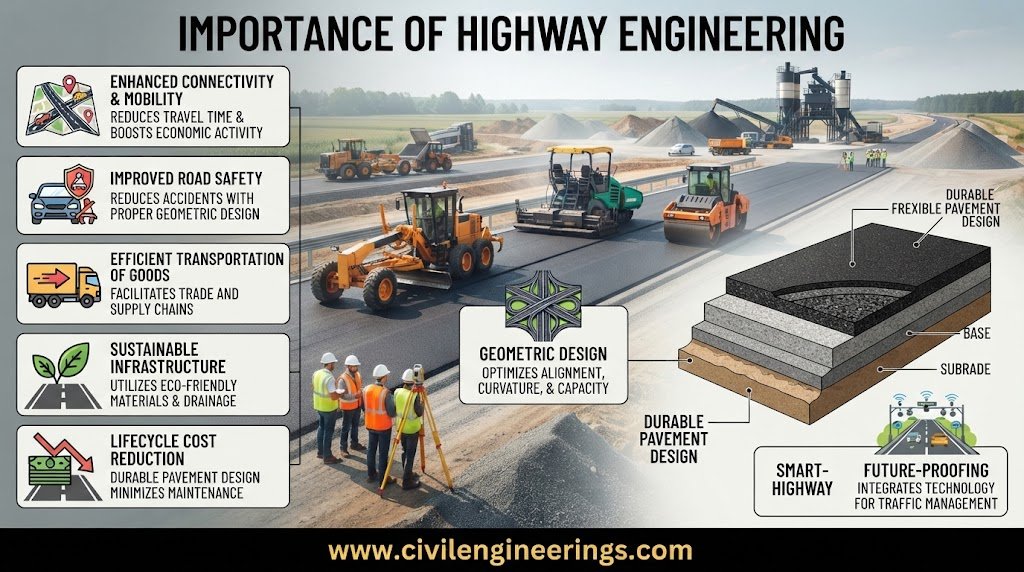
A highway may look like a simple strip of pavement, but its performance depends on hundreds of engineering decisions made before the first layer of soil is compacted. Route selection, traffic demand, geometric design, pavement materials, drainage, structures, safety, construction quality, and long-term maintenance all have to work together. When these elements are properly coordinated, a highway can move people and goods safely, efficiently, and economically for decades.
This is why understanding the Importance of Highway Engineering matters to everyone involved in transportation infrastructure. Highway engineering is not limited to drawing road alignments or designing pavement thickness. It connects civil engineering principles with traffic behavior, economics, surveying, geotechnical engineering, environmental management, construction technology, and road safety.
For students, it provides the foundation for understanding how transportation infrastructure is planned and built. For engineers, contractors, consultants, and government agencies, it provides the framework for delivering roads that meet functional, structural, safety, and economic requirements.
This article explains the major reasons highway engineering is essential, its role throughout a highway’s life cycle, practical engineering applications, benefits, challenges, and recommendations for professionals.
What Is Highway Engineering?
Highway engineering is a specialized branch of civil and transportation engineering concerned with the planning, investigation, design, construction, operation, maintenance, rehabilitation, and management of highways and related infrastructure.
It combines several engineering disciplines rather than treating the road as an isolated structure. A highway project may require:
- Traffic engineering
- Transportation planning
- Surveying and geomatics
- Geotechnical engineering
- Pavement engineering
- Hydrology and drainage design
- Structural engineering
- Environmental engineering
- Construction management
- Road safety engineering
- Asset management
Modern highway design considers the interaction between the driver, vehicle, roadway, traffic conditions, terrain, and surrounding environment. Geometric design, for example, deals with horizontal and vertical alignment, cross-sections, intersections, interchanges, sight distance, and related features that influence safety and operational performance. (Alberta.ca)
The ultimate objective is not simply to build a road. The objective is to create a transportation facility that provides safe, reliable, comfortable, economical, and sustainable movement.
Importance of Highway Engineering in Transportation Infrastructure


Highway engineering plays a central role in converting transportation requirements into functional infrastructure. A well-engineered highway must respond to present traffic while allowing reasonable consideration of future demand, changing vehicle characteristics, environmental conditions, maintenance requirements, and community needs.
1. Improves Road Safety
One of the most important responsibilities of highway engineering is reducing the risk and severity of crashes.
Road safety does not depend on one feature. Engineers consider a combination of:
- Sight distance
- Horizontal curves
- Vertical curves
- Superelevation
- Lane width
- Shoulder width
- Roadside clear zones
- Intersections
- Median treatments
- Guardrails and barriers
- Signs and pavement markings
- Lighting
- Pedestrian and cyclist facilities
- Access control
For example, a sharp horizontal curve combined with inadequate sight distance can create a serious safety problem. Proper geometric design addresses these risks during planning rather than waiting for crashes to reveal them.
AASHTO geometric design principles similarly emphasize the relationship between roadway geometry, vehicle characteristics, driver behavior, safety, and operating conditions. Engineering education and professional practice use these principles to establish suitable design controls for different highway classes and conditions. (NUST)
2. Supports Efficient Traffic Movement
Highway engineering helps determine how much traffic a facility can accommodate and how that traffic should move through the network.
Engineers analyze:
- Traffic volume
- Peak-hour demand
- Heavy vehicle percentage
- Design speed
- Traffic composition
- Intersection performance
- Highway capacity
- Level of service
- Access points
- Merging and weaving
- Future traffic growth
A road designed only for today’s traffic can become congested relatively quickly if population, freight movement, or economic activity increases.
Traffic forecasting therefore becomes an important part of highway planning. Engineers may compare existing traffic with projected demand and determine whether improvements should involve widening, intersection modification, access management, public transport integration, or construction of a new corridor.
3. Enables Proper Highway Route Selection
Selecting the right route can have a greater impact on project cost and performance than many later design decisions.
Route selection considers factors such as:
- Terrain
- Geology
- Soil conditions
- Hydrology
- Existing settlements
- Land use
- Environmental constraints
- Utility corridors
- Right-of-way requirements
- Construction cost
- Travel distance
- Connectivity
- Social impacts
A highway that crosses difficult terrain without sufficient investigation may require extensive excavation, retaining structures, drainage works, bridges, or slope stabilization.
Modern surveying and aerial techniques can assist engineers during route studies. Transportation agencies have long used aerial surveys and photogrammetry to evaluate terrain, land use, environmental conditions, route alternatives, and earthwork requirements. (Federal Highway Administration)
4. Reduces Construction and Life-Cycle Costs
A cheap highway is not necessarily an economical highway.
Highway engineering focuses on life-cycle cost, which considers initial construction expenditure together with future maintenance, rehabilitation, user impacts, and expected service life.
For example, an engineer may compare:
- A lower-cost pavement with frequent maintenance
- A higher-quality pavement with greater initial cost but longer service life
A simplified life-cycle concept can be expressed as:
Life-Cycle Cost = Initial Cost + Maintenance Cost + Rehabilitation Cost + User/Agency Costs − Residual Value
The actual economic analysis is more sophisticated and depends on discount rates, analysis periods, traffic, deterioration models, maintenance strategies, and local conditions.
Good engineering can reduce unnecessary earthwork, optimize pavement thickness, improve drainage, avoid problematic alignments, and reduce premature failures.
5. Provides Durable Pavement Design
The pavement is one of the most visible components of a highway, but its performance depends heavily on what lies underneath it.
Highway pavement engineering evaluates:
- Subgrade strength
- Subbase properties
- Base-course quality
- Aggregate characteristics
- Bituminous materials
- Concrete properties
- Drainage
- Traffic loading
- Climate
- Construction quality
Common pavement systems include flexible pavement and rigid pavement.
Flexible pavement typically distributes traffic loads through multiple granular and bound layers. Rigid pavement relies significantly on the structural capacity of a concrete slab.
The engineer must select an appropriate pavement structure based on design traffic, environmental conditions, material properties, reliability requirements, and applicable design methodology.
A pavement can have excellent asphalt or concrete at the surface and still fail early if the subgrade is weak, drainage is poor, or compaction is inadequate.
Importance of Highway Engineering in Geometric Design
Geometric design determines the three-dimensional form of a highway. It directly affects safety, comfort, operating speed, capacity, drainage, earthwork, and construction cost.
Horizontal Alignment
Horizontal alignment describes the roadway’s position in plan.
Engineers work with:
- Tangents
- Circular curves
- Transition curves
- Curve radius
- Superelevation
- Design speed
- Sight distance
A simplified relationship often used to understand horizontal curve behavior is:
e + f = V² / (127R)
Where:
- e = superelevation rate
- f = side-friction factor
- V = speed in km/h
- R = curve radius in metres
Actual design values and limiting criteria must come from the governing road authority’s current design standard.
Vertical Alignment
Vertical alignment controls how the highway rises and falls.
It includes:
- Grades
- Crest curves
- Sag curves
- Vertical sight distance
- Drainage considerations
- Vehicle performance
Excessive grades can reduce heavy-vehicle speeds and increase operating costs. Poorly designed crest curves can restrict visibility, while inadequate sag-curve design can create drainage and headlight sight-distance problems.
Cross-Section Design
The cross-section may include:
- Travel lanes
- Shoulders
- Median
- Side slopes
- Drainage channels
- Kerbs
- Footways
- Cycle facilities
- Safety barriers
- Clear zones
Every element has a purpose. A shoulder can provide emergency stopping space and lateral support, while appropriate drainage prevents water from remaining on the pavement.
Highway geometric design guides commonly organize design around alignment, cross-section, intersections, interchanges, roadside facilities, and access management. (Alberta.ca)
Importance of Highway Engineering for Drainage
Water is one of the major causes of highway deterioration.
Highway engineering provides a systematic approach to managing:
- Surface runoff
- Rainfall
- Groundwater
- Cross-drainage
- Roadside drainage
- Culverts
- Stormwater channels
- Subsurface drainage
If water infiltrates pavement layers, it can weaken granular materials and subgrade soils. Repeated traffic loading may then accelerate rutting, cracking, pumping, potholes, and deformation.
A basic rational-method relationship often used for estimating peak runoff is:
Q = CIA
Where:
- Q = peak runoff
- C = runoff coefficient
- I = rainfall intensity
- A = drainage area
The units and conversion factor depend on the chosen unit system.
Drainage design should never be treated as an afterthought. During highway planning, engineers should examine natural drainage paths, catchments, flood levels, culvert locations, erosion risks, and outlet conditions.
Importance of Highway Engineering in Construction Quality
Design documents only become useful when construction teams translate them accurately into physical infrastructure.
Highway engineering establishes requirements for:
- Earthwork
- Embankment construction
- Subgrade preparation
- Layer thickness
- Compaction
- Aggregate grading
- Asphalt production and placement
- Concrete production
- Drainage installation
- Survey control
- Quality assurance
- Testing and inspection
For example, a pavement layer designed at a particular thickness cannot simply be placed without checking actual levels and compaction. Field density testing, material testing, level checks, temperature control, and proper construction procedures help verify compliance.
Engineers and contractors should maintain a strong connection between design intent and field execution.
Importance of Highway Engineering in Economic Development
Road infrastructure influences the movement of goods, workers, agricultural products, raw materials, and services.
A reliable highway can:
- Reduce travel time
- Connect production centers with markets
- Improve freight movement
- Support tourism
- Increase regional accessibility
- Improve access to education and healthcare
- Encourage commercial development
- Strengthen supply chains
The economic value of a highway therefore extends beyond its construction budget.
For example, improving a freight corridor may reduce vehicle operating costs and travel delays. Better connectivity can also make remote areas more accessible to markets and public services.
Highway engineering helps ensure that such infrastructure investments provide practical transportation benefits rather than simply increasing paved road length.
Importance of Highway Engineering for Environmental Sustainability
Modern highway engineering increasingly considers environmental performance from the planning stage.
Engineers may evaluate:
- Land disturbance
- Deforestation
- Water resources
- Wildlife crossings
- Noise
- Air quality
- Construction waste
- Material consumption
- Carbon emissions
- Stormwater quality
Route selection is particularly important. Avoiding environmentally sensitive areas may reduce both ecological damage and future project complications.
Sustainable highway engineering can also include:
- Recycled pavement materials
- Warm-mix asphalt
- Optimized earthwork
- Durable pavement designs
- Energy-efficient lighting
- Stormwater management
- Vegetation and erosion control
- Intelligent transportation systems
Sustainability does not mean selecting the cheapest or most environmentally attractive option in isolation. Engineers should evaluate the overall life-cycle performance of the project.
Importance of Highway Engineering in Highway Maintenance
A highway remains an engineering asset after construction is complete.
Maintenance activities may include:
- Crack sealing
- Pothole repair
- Pavement resurfacing
- Shoulder maintenance
- Drain cleaning
- Culvert maintenance
- Road marking renewal
- Guardrail repair
- Slope stabilization
- Bridge maintenance
Preventive maintenance is usually more effective than allowing minor defects to develop into major structural problems.
Engineers can use pavement condition surveys, traffic information, drainage inspections, deflection testing, imagery, and other asset-management data to determine maintenance priorities.
Aerial surveying can also support highway maintenance by documenting erosion, pavement-related issues, encroachments, drainage problems, and right-of-way conditions. (Federal Highway Administration)
Role of Highway Engineering in Modern Technology
Technology has changed how highway projects are surveyed, designed, constructed, and monitored.
Important technologies include:
- Total stations
- GNSS/RTK surveying
- UAV and drone mapping
- LiDAR
- GIS
- Digital terrain models
- Building Information Modeling
- Civil engineering design software
- Automated machine control
- Pavement monitoring systems
- Intelligent transportation systems
Drone-based photogrammetry, for instance, can produce orthomosaics, digital elevation models, point clouds, and construction-progress information. Recent engineering research has demonstrated its usefulness for earthwork measurement and comparing design surfaces with as-built conditions. (DOI)
However, technology should support engineering judgment rather than replace it. Survey data still requires quality control, appropriate coordinate systems, verification, and professional interpretation.
Highway Engineering Standards and Professional Practice
Highway projects should follow the standards and specifications adopted by the relevant road authority and jurisdiction.
Internationally recognized references may include:
IRC
The Indian Roads Congress (IRC) publishes guidance and standards covering areas such as highway geometric design, pavement engineering, traffic signs, bridges, materials, and road safety. In projects where IRC documents govern, engineers should always use the applicable and current edition rather than relying on outdated values.
AASHTO
The American Association of State Highway and Transportation Officials (AASHTO) provides widely used guidance for highway geometric design, pavement design, transportation infrastructure, and related engineering practice.
AASHTO-based approaches are frequently referenced in academic programs and engineering practice, particularly for geometric and pavement design.
ICE
The Institution of Civil Engineers (ICE) contributes to professional engineering knowledge, competence, infrastructure practice, and project delivery. Its broader professional principles are valuable when considering technical competence, safety, sustainability, ethics, and project management.
The important point is that engineers should not mix numerical requirements from different standards without checking compatibility. Design speed, pavement parameters, traffic assumptions, safety criteria, material specifications, and drainage requirements should come from the governing project standard.
Practical Applications of Highway Engineering
The importance of highway engineering becomes clearer when applied to real project situations.
Example 1: Highway Through Hilly Terrain
Suppose a proposed highway crosses mountainous terrain.
The engineering team must investigate:
- Topography
- Geological conditions
- Landslide risk
- Drainage patterns
- Road gradients
- Horizontal alignment
- Cut and fill quantities
- Retaining structures
- Slope protection
- Construction access
A route that looks shortest on a map may be unsuitable because it requires excessive excavation or creates unstable slopes.
Example 2: Urban Highway Expansion
For an urban corridor, engineers may need to consider:
- Existing traffic
- Future traffic growth
- Property acquisition
- Pedestrian movement
- Utility relocation
- Public transport
- Intersections
- Drainage
- Construction staging
- Traffic management
The technically easiest solution may not be the best solution if it creates unacceptable impacts on businesses or communities.
Example 3: Pavement Failure
Consider a newly constructed pavement that develops rutting within a short period.
An experienced investigation should not automatically blame the asphalt.
Engineers should examine:
- Traffic loading
- Asphalt properties
- Aggregate quality
- Layer thickness
- Temperature
- Compaction
- Base and subbase condition
- Subgrade strength
- Drainage
This illustrates a fundamental principle of highway engineering: road failures are often system failures rather than failures of a single material.
Benefits of Proper Highway Engineering
Well-planned highway engineering provides several long-term benefits.
Safety Benefits
- Better sight distance
- More predictable road geometry
- Safer intersections
- Improved roadside protection
- Better traffic control
Economic Benefits
- Lower vehicle operating costs
- Reduced travel delays
- Improved freight efficiency
- Better asset utilization
- Controlled life-cycle expenditure
Engineering Benefits
- Appropriate pavement performance
- Better drainage
- Improved constructability
- Reduced premature deterioration
- Easier maintenance planning
Social Benefits
- Improved accessibility
- Better regional connectivity
- Easier access to services
- Improved mobility
Environmental Benefits
- Better route planning
- Reduced unnecessary earthwork
- Improved stormwater management
- More efficient material use
- Greater consideration of sensitive areas
Common Mistakes to Avoid in Highway Projects
Even a technically strong project can experience problems when basic engineering controls are neglected.
Common mistakes include:
- Starting detailed design without adequate surveys
- Ignoring geotechnical conditions
- Underestimating traffic growth
- Treating drainage as a secondary issue
- Using inappropriate pavement materials
- Poor construction quality control
- Failing to coordinate utilities
- Ignoring maintenance requirements
- Applying outdated design standards
- Designing without considering constructability
- Focusing only on initial construction cost
A particularly important lesson for young engineers is to verify field conditions instead of assuming that drawings always represent reality.
Practical Recommendations for Civil Engineering Students
Students can build strong highway engineering knowledge by connecting classroom theory with practical applications.
Focus on understanding:
- Highway geometric design
- Traffic engineering
- Surveying
- Soil mechanics
- Pavement materials
- Pavement design
- Hydrology
- Road construction methods
- Quantity estimation
- Highway safety
Do not memorize formulas without understanding their engineering meaning.
For example, when studying superelevation, understand why a vehicle experiences lateral acceleration on a curve and how roadway geometry helps manage it.
Students should also practice reading:
- Plan and profile drawings
- Cross-sections
- Typical pavement details
- Drainage layouts
- Earthwork calculations
- Construction specifications
Practical Recommendations for Highway Engineers
Engineers should approach every project as an integrated system.
Before finalizing a design:
- Verify survey information.
- Review geotechnical data.
- Confirm traffic assumptions.
- Check drainage requirements.
- Review horizontal and vertical coordination.
- Assess constructability.
- Coordinate utilities and structures.
- Evaluate road safety.
- Confirm applicable standards.
- Consider maintenance and rehabilitation.
Independent design checks are especially valuable for critical alignments, drainage structures, intersections, pavement calculations, and quantities.
Practical Recommendations for Contractors
Contractors influence the final quality of a highway as much as the design team.
Contractors should:
- Follow approved method statements.
- Maintain survey control.
- Test incoming materials.
- Control moisture during earthwork.
- Achieve specified compaction.
- Monitor layer thickness.
- Maintain asphalt temperature and placement quality.
- Protect completed drainage works.
- Document inspection and testing.
- Report unexpected ground conditions promptly.
Quality should be built into the process rather than inspected only at the end.
Future of Highway Engineering
The future of highway engineering is moving toward more connected, data-driven, resilient, and sustainable infrastructure.
Emerging areas include:
- Smart highways
- Connected vehicles
- Intelligent transportation systems
- Digital twins
- AI-assisted traffic analysis
- Automated surveying
- Predictive pavement maintenance
- Electric-vehicle infrastructure
- Climate-resilient roads
- Advanced pavement materials
- Autonomous vehicle infrastructure
At the same time, fundamental engineering principles will remain important. A sophisticated digital model cannot compensate for poor drainage, unreliable survey control, inadequate geotechnical investigation, or poor construction practices.
Future highway engineers will therefore need both traditional engineering competence and digital skills.
Frequently Asked Questions About the Importance of Highway Engineering
1. Why is highway engineering important?
Highway engineering is important because it provides the technical framework for planning, designing, constructing, maintaining, and managing safe and efficient road infrastructure.
2. What is the main objective of highway engineering?
The main objective is to provide safe, efficient, economical, durable, and environmentally responsible transportation facilities that meet current and future travel requirements.
3. How does highway engineering improve road safety?
It improves safety through proper geometric design, sight distance, intersections, pavement conditions, drainage, roadside protection, signs, markings, and traffic management.
4. Why is geometric design important in highway engineering?
Geometric design determines the highway’s alignment, grades, curves, cross-section, and intersections. These features directly influence vehicle stability, visibility, comfort, capacity, and safety.
5. What is the relationship between highway engineering and pavement engineering?
Pavement engineering is a major component of highway engineering. It focuses on selecting, designing, constructing, evaluating, and maintaining pavement systems capable of carrying expected traffic and environmental loads.
6. How does highway engineering contribute to economic development?
It improves connectivity, reduces travel time, supports freight movement, connects markets, facilitates access to services, and can encourage regional economic activity.
7. Which standards are commonly used in highway engineering?
Depending on the jurisdiction, engineers may use standards and guidance from organizations such as IRC and AASHTO, along with national road authority specifications and other applicable professional guidance.
8. Is highway engineering only concerned with road construction?
No. Highway engineering covers the complete asset life cycle, including planning, route selection, surveys, design, construction, traffic operations, maintenance, rehabilitation, safety, and asset management.
9. Why is drainage important in highway engineering?
Effective drainage prevents water from accumulating on or entering the pavement structure, reduces erosion, protects slopes, and helps preserve pavement and earthwork performance.
10. What should civil engineering students learn first in highway engineering?
Students should begin with highway classification, traffic studies, surveying, geometric design, pavement materials, pavement design, drainage, construction methods, and basic highway safety principles.
Conclusion
The Importance of Highway Engineering extends far beyond the construction of paved roads. It provides the engineering framework needed to transform transportation needs into safe, durable, economical, and functional infrastructure. Every major decision—from selecting a corridor to designing pavement layers and drainage systems—can influence highway performance for decades.
Good highway engineering brings together surveying, traffic analysis, geometric design, geotechnical investigation, pavement engineering, hydrology, construction management, environmental assessment, and maintenance planning. It also requires engineers to balance safety, cost, constructability, sustainability, and future transportation demand.
For students, highway engineering develops the practical thinking needed to understand transportation infrastructure. Practicing engineers and contractors, it provides the principles required to control quality and reduce project risks. For governments and infrastructure owners, it supports better investment decisions and longer-lasting assets.
Ultimately, a successful highway is not simply one that is completed on schedule. It is one that serves its users safely, performs reliably, remains maintainable, and delivers value throughout its service life. That is the real purpose—and the lasting importance—of highway engineering.
