
Every kilometer of highway that cracks prematurely, ruts under traffic, or bleeds in the summer heat traces back to one overlooked step: inadequate asphalt testing. Pavements carry billions of vehicle movements every year, yet the material holding them together often gets less scrutiny than the design drawings that specify it. That gap between design intent and field reality is exactly where asphalt testing earns its importance.
For civil engineers, contractors, and researchers, asphalt testing isn’t a bureaucratic checkbox. It’s the mechanism that verifies whether a bituminous mix will actually perform the way the mix design promised. A road that looks perfect on paper can still fail within two years if the binder properties, aggregate gradation, or compaction density weren’t properly validated before and during construction.
This guide walks through the full spectrum of asphalt testing — from binder characterization to field density checks — explaining not just what each test measures, but why it matters and how professionals apply the results on real projects. Whether you’re a student preparing for site work, a site engineer running daily quality checks, or a consultant reviewing a contractor’s test reports, this article gives you a practical, standards-based reference you can actually use.
What Is Asphalt Testing?
Asphalt testing refers to the systematic evaluation of bituminous materials — binder, aggregates, and the compacted mix — to confirm they meet specified engineering and performance criteria. It spans laboratory testing during mix design, quality control testing during production, and field testing during and after construction.
The goal isn’t just compliance with a specification number. Good testing predicts how a pavement will behave under traffic loading, temperature swings, and moisture exposure over its design life, typically 10 to 20 years for flexible pavements. Skipping or rushing this process is one of the most common root causes of premature pavement distress worldwide.
Why Asphalt Testing Matters in Pavement Engineering
Pavement failure rarely happens overnight. Rutting, fatigue cracking, raveling, and stripping usually develop gradually, and most of these distresses can be traced back to a material property that wasn’t properly checked at the start.
Consider a binder with the wrong penetration grade for the local climate. In hot regions, a softer-than-specified bitumen leads to rutting within a single summer season. In cold regions, a binder that’s too stiff becomes brittle and cracks under thermal contraction. Testing catches this mismatch before it becomes a maintenance liability.
There’s also a financial angle that project owners care about deeply. Reconstruction costs far exceed the cost of proper testing at the outset. A well-run quality control program during construction, backed by proper laboratory verification, protects the owner’s investment and reduces long-term maintenance budgets. For government agencies managing thousands of kilometers of road network, this cost avoidance is significant at scale.
Categories of Asphalt Testing
Asphalt testing generally falls into three broad categories, each serving a distinct purpose in the pavement lifecycle.
1. Bitumen (Binder) Testing
These tests characterize the physical and rheological properties of the bituminous binder before it’s blended with aggregates.
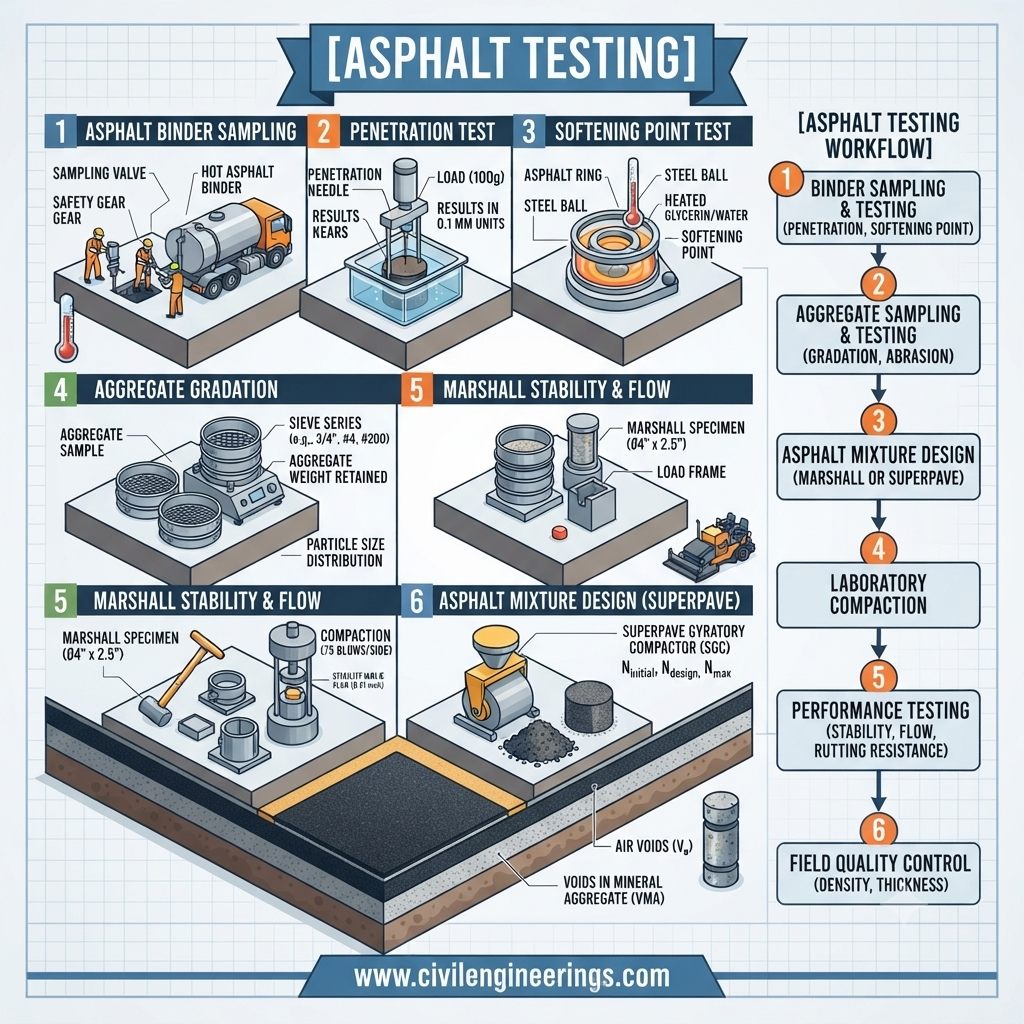
Penetration Test (IS 1203 / ASTM D5): Measures the hardness or consistency of bitumen by recording how far a standard needle penetrates the sample under fixed load, time, and temperature (usually 25°C, 100g, 5 seconds). A lower penetration value indicates a harder, stiffer binder — useful for identifying the correct grade for local traffic and climate conditions.
Softening Point Test (Ring and Ball Method, ASTM D36): Determines the temperature at which bitumen transitions from a semi-solid to a soft state. This value helps engineers anticipate rutting susceptibility in hot climates.
Ductility Test (ASTM D113): Assesses the binder’s ability to stretch before breaking, an indicator of its adhesive and cohesive strength. Low ductility often signals aged or oxidized bitumen unsuitable for flexible pavement use.
Viscosity Test: Evaluates flow characteristics at different temperatures, guiding mixing and compaction temperature selection during production.
Flash Point and Fire Point Test: Establishes safe handling temperatures during heating and storage, a safety-critical parameter for hot mix plants.
Specific Gravity Test: Confirms binder density, which feeds directly into volumetric mix design calculations.
Rotational Viscometer and Dynamic Shear Rheometer (DSR) Testing: Under Superpave protocols, these advanced tests evaluate binder performance grading (PG) across a range of service temperatures, offering a more climate-responsive classification than the older penetration grading system.
2. Aggregate Testing
Aggregates typically make up 90-95% of an asphalt mix by weight, so their quality directly governs pavement strength and durability.
Aggregate Impact Value (AIV) and Aggregate Crushing Value (ACV): Measure resistance to sudden impact and gradual crushing loads respectively, both critical for pavements carrying heavy commercial traffic.
Los Angeles Abrasion Test: Determines resistance to abrasion and degradation during handling, mixing, and service life. AASHTO T96 sets the widely referenced procedure.
Flakiness and Elongation Index: Flaky or elongated particles reduce interlock between aggregates and weaken the compacted mat. Specifications typically cap combined flakiness and elongation around 30-35%.
Water Absorption Test: High absorption values suggest porous aggregates that may compromise binder adhesion and long-term durability.
Soundness Test: Evaluates resistance to weathering through cycles of sodium or magnesium sulfate exposure, relevant in regions with freeze-thaw cycles.
Stripping Value / Coating Test: Checks how well bitumen adheres to aggregate in the presence of water, directly predicting moisture-induced stripping failures.
3. Asphalt Mix Testing
Once binder and aggregates pass individual testing, the combined mix undergoes its own battery of evaluations.
Marshall Stability and Flow Test (ASTM D6927): The most widely used mix design method globally. It measures the maximum load a compacted specimen can withstand before failure (stability) and the corresponding deformation (flow). Results guide optimum binder content selection.
Marshall Mix Design Parameters typically checked alongside stability include:
- Air voids (Va) — generally targeted between 3-5%
- Voids in Mineral Aggregate (VMA)
- Voids Filled with Bitumen (VFB)
- Unit weight of the compacted mix
Superpave Gyratory Compaction: A more advanced method that simulates field compaction more realistically than the Marshall hammer, increasingly adopted for high-traffic corridors and expressways.
Bulk and Theoretical Maximum Specific Gravity (Gmb and Gmm): Used to calculate air voids and compaction density, arguably the single most important quality indicator in asphalt paving.
Indirect Tensile Strength Ratio (TSR) Test: Evaluates moisture susceptibility by comparing tensile strength of conditioned versus unconditioned specimens. A TSR below 80% typically flags stripping risk, prompting anti-stripping additives.
Wheel Tracking Test: Simulates repeated traffic loading to predict rutting potential, particularly relevant for airport runways and heavy-duty pavements.
Bitumen Extraction Test: Determines actual binder content in a produced mix, verifying it matches the job mix formula.
Field Testing During Construction
Laboratory testing alone doesn’t guarantee a good pavement — field verification closes the loop between design and construction reality.
Core Cutting and Density Testing: Cores extracted from the compacted pavement determine in-situ density and compaction percentage relative to the laboratory reference density. Most specifications require 95-98% of theoretical maximum density.
Nuclear Density Gauge Testing: Offers a rapid, non-destructive alternative to coring, widely used for real-time compaction monitoring during rolling operations.
Sand Patch Test: Measures pavement surface texture depth, an indicator of skid resistance, especially important on high-speed corridors.
Straight Edge and Camber Check: Verifies surface regularity and cross-fall, catching construction defects before they affect drainage and rideability.
Temperature Monitoring: Infrared thermometers track mix temperature at the plant, during transport, and at laying — since laying below the recommended range compromises compaction and long-term durability.
Relevant Standards and Codes
Professionals across regions typically reference a mix of national and international standards. IRC (Indian Roads Congress) guidelines, particularly IRC:111 for dense graded bituminous mixes and the Ministry of Road Transport specifications, govern practice across South Asia. AASHTO standards, including AASHTO M320 for performance-graded binders, form the backbone of US highway specifications. ASTM methods provide the detailed test procedures referenced by both. Internationally, the Institution of Civil Engineers (ICE) publishes guidance documents and technical papers that inform best practice discussions, particularly around performance-based specifications and sustainable pavement materials. Engineers working across borders should always confirm which standard governs their specific contract, since acceptance criteria can vary meaningfully between them.
Common Pavement Failures Linked to Poor Testing
Understanding failure modes helps explain why each test exists.
Rutting typically traces back to insufficient binder stiffness, excess asphalt content, or inadequate aggregate angularity — all preventable through proper Marshall or Superpave testing.
Fatigue Cracking often results from under-compaction or a mix design that doesn’t account for actual traffic loading, highlighting the importance of density testing and TSR checks.
Stripping and Raveling almost always point to moisture susceptibility issues that a proper TSR test would have flagged during mix design.
Bleeding frequently occurs when binder content exceeds optimum levels, something extraction testing during production would catch immediately.
Practical Recommendations
For Students: Spend time in the laboratory, not just the textbook. Understanding penetration and Marshall testing conceptually is useful, but running the tests yourself builds intuition for how small variations in temperature or compaction effort change results. Pair every lab session with the relevant IS, ASTM, or AASHTO code to understand why tolerances exist.
For Site Engineers: Build a testing schedule into your quality plan before construction starts, not after problems appear. Calibrate nuclear density gauges and thermometers regularly, and never approve a paving lift without checking mix temperature and compaction density. Keep test records organized by chainage — they become invaluable during dispute resolution.
For Contractors: Treat testing costs as risk insurance, not overhead. A rejected pavement section costs far more in remedial work than the testing that would have prevented it. Invest in a properly equipped site laboratory for larger projects rather than relying solely on remote testing labs, which introduces delay and sample degradation risk.
For Consultants and Government Engineers: Cross-check contractor-submitted test reports against independent verification samples periodically. Statistical quality control, using control charts for density and binder content, catches trends before they become widespread defects.
Best Practices for Reliable Asphalt Testing
Sample representatively — a single grab sample from one truckload doesn’t represent an entire day’s production. Maintain calibrated equipment and document calibration dates. Test at the specified temperatures precisely, since bitumen properties are highly temperature-sensitive. Cross-verify unusual results with a repeat test before rejecting material, since equipment error is more common than material failure. Finally, maintain a chain of custody for samples, particularly on contractual disputes where test validity may be challenged later.
FAQs
1. What is the main purpose of asphalt testing? Asphalt testing verifies that binder, aggregates, and the final compacted mix meet the strength, durability, and performance criteria needed to withstand traffic loading and environmental exposure over the pavement’s design life.
2. Which test is most commonly used for asphalt mix design? The Marshall Stability and Flow test remains the most widely used globally, though Superpave gyratory compaction is gaining adoption for high-traffic and expressway projects.
3. What is the acceptable air void range in a compacted asphalt mix? Most specifications target 3-5% air voids for dense graded bituminous mixes, since values outside this range accelerate either rutting or moisture damage.
4. How is asphalt density tested in the field? Field density is typically checked through core cutting and laboratory measurement, or through nuclear density gauges for rapid, non-destructive real-time monitoring during compaction.
5. What causes stripping in asphalt pavements? Stripping occurs when water displaces the bitumen film from aggregate surfaces, usually linked to poor aggregate-binder adhesion, which the Tensile Strength Ratio test is designed to detect during mix design.
6. Why is the penetration test important for bitumen? It quantifies binder hardness, helping engineers select the correct bitumen grade for local climate and traffic conditions, since an incorrect grade leads to either rutting or thermal cracking.
7. What is the difference between Marshall and Superpave mix design? Marshall design uses impact compaction and empirical stability-flow criteria, while Superpave uses gyratory compaction that better simulates field densification and incorporates performance-graded binder selection.
8. How often should asphalt testing be conducted during construction? Testing frequency depends on project specifications, but density and temperature checks typically occur continuously during paving, while binder content and gradation checks follow a statistical sampling frequency defined in the contract.
Conclusion
Asphalt testing sits at the heart of every durable, cost-effective pavement, connecting laboratory mix design to real-world field performance. From penetration and Marshall stability tests to density checks and moisture susceptibility evaluation, each procedure exists because a specific failure mode has taught the industry a hard lesson over decades of highway construction. Engineers, contractors, and researchers who treat asphalt testing as a core engineering discipline — rather than a compliance formality — consistently deliver pavements that outperform their design life expectations. As traffic loads increase and climate variability challenges traditional material assumptions, the role of rigorous, standards-based asphalt testing will only grow more critical across highway, urban, and airport pavement projects worldwide. Building this expertise early, whether you’re a student or a practicing engineer, pays dividends across an entire career in pavement engineering.

Kamran Malik is a passionate civil engineering writer and researcher who specializes in construction, transportation, structural engineering, and infrastructure topics. Through his articles on CivilEngineerings.com, he simplifies complex engineering concepts and shares practical insights, industry trends, and educational resources for students, professionals, and engineering enthusiasts.