
Introduction
Roads are the backbone of modern transportation systems, connecting cities, industries, ports, airports, and rural communities. Among the various pavement types used worldwide, Asphalt Road Construction remains the preferred choice for highways, urban streets, expressways, airport runways, and industrial roads because of its durability, flexibility, smooth riding surface, and cost-effectiveness. As traffic volumes continue to increase and infrastructure demands become more complex, engineers must understand not only how asphalt roads are built but also the engineering principles that ensure long-term pavement performance.
Successful asphalt road construction involves much more than placing hot asphalt on the ground. Every stage—from planning and geotechnical investigation to pavement design, material selection, construction techniques, compaction, and quality control—directly influences the pavement’s service life. Poor workmanship or inadequate design can result in premature cracking, rutting, potholes, and costly maintenance.
This comprehensive guide explains the complete asphalt road construction process using internationally recognized engineering practices. It discusses design concepts, construction methods, quality assurance procedures, equipment selection, and major standards such as IRC, AASHTO, ICE, ASTM, EN/BS, and related specifications. Whether you are a civil engineering student, highway engineer, contractor, consultant, or infrastructure professional, this article provides practical knowledge that can be applied to real-world highway projects.
What Is Asphalt Road Construction?
Asphalt Road Construction is the engineering process of building flexible pavements using asphalt mixtures composed of aggregates, mineral filler, and bitumen. These materials are combined in carefully controlled proportions to produce a durable surface capable of carrying repeated traffic loads while resisting environmental deterioration.
Unlike rigid concrete pavements, asphalt pavements distribute wheel loads through multiple flexible layers. This flexibility enables the pavement to absorb stresses caused by moving vehicles and slight ground movements without significant structural damage.
Modern asphalt pavements are designed to provide:
- High riding comfort
- Excellent skid resistance
- Fast construction
- Lower maintenance costs
- Easy rehabilitation
- Reduced traffic disruption
- Long service life
Because asphalt can be recycled repeatedly, it is also considered one of the most sustainable paving materials used in highway engineering.
Importance of Asphalt Roads in Modern Infrastructure
Transportation infrastructure significantly influences economic development. Well-designed asphalt roads reduce travel time, improve safety, support commercial activities, and facilitate emergency services.
Major applications include:
- National highways
- Expressways
- Urban roads
- Rural roads
- Airport runways
- Industrial estates
- Container terminals
- Parking facilities
- Logistics centers
- Residential developments
Many governments prioritize asphalt pavement because maintenance and resurfacing can often be completed with minimal traffic disruption compared to rigid pavements.
Basic Engineering Principles of Asphalt Pavement
A successful asphalt pavement is designed according to structural engineering principles rather than simply selecting a pavement thickness.
The pavement must safely distribute traffic loads from the surface to the underlying soil while limiting stresses and deformation.
The four primary engineering principles are:
1. Load Distribution
Wheel loads are gradually distributed through successive pavement layers.
Each lower layer experiences lower stress than the layer above it.
2. Structural Capacity
The pavement must support projected traffic loads over its design life without excessive cracking, rutting, or structural failure.
Traffic is commonly expressed as Equivalent Single Axle Loads (ESALs) under AASHTO design procedures.
3. Drainage Performance
Water is one of the greatest threats to pavement performance.
Proper drainage systems prevent:
- Loss of subgrade strength
- Moisture damage
- Pumping
- Frost action
- Surface deterioration
4. Material Compatibility
Each pavement layer must work together as an integrated structural system. Differences in stiffness, thermal expansion, or bonding quality can reduce pavement performance.
Components of an Asphalt Pavement
An asphalt road typically consists of several engineered layers.
1. Subgrade
The subgrade forms the foundation of the pavement structure.
It consists of compacted natural soil prepared to achieve the required bearing capacity.
Important properties include:
- California Bearing Ratio (CBR)
- Moisture content
- Density
- Plasticity
- Settlement characteristics
Weak subgrades often require stabilization using lime, cement, fly ash, or geosynthetics.
2. Subbase Course
The subbase provides additional structural support and improves drainage.
Common materials include:
- Granular crushed stone
- Gravel
- Stabilized soil
- Recycled aggregates
Functions include:
- Load distribution
- Frost protection
- Drainage improvement
- Separation between subgrade and base course
3. Base Course
The base course carries a significant portion of traffic loads.
Typical materials include:
- Wet Mix Macadam (WMM)
- Dense graded crushed aggregate
- Cement-treated base
- Asphalt-treated base
Proper compaction is essential because poor density can significantly reduce pavement life.
4. Binder Course
The binder course provides structural strength and forms the intermediate asphalt layer.
It uses larger aggregate sizes than the wearing course to achieve higher load-carrying capacity.
5. Wearing Course
The wearing course is the top asphalt layer directly exposed to traffic and weather.
Its functions include:
- Skid resistance
- Smooth riding quality
- Waterproofing
- Noise reduction
- Surface durability
Materials Used in Asphalt Road Construction
Material quality determines pavement performance more than almost any other factor.
Aggregates
Aggregates typically constitute approximately 90–95% of the asphalt mixture by weight.
Desired properties include:
- High strength
- Angular shape
- Durability
- Abrasion resistance
- Soundness
- Proper gradation
Common aggregate sources include:
- Granite
- Basalt
- Limestone
- Crushed gravel
Bitumen
Bitumen acts as the binder that coats and holds aggregates together.
Common grades vary by country and climatic conditions, such as VG-10, VG-30, VG-40, PG grades, or penetration grades.
Bitumen must provide:
- Adhesion
- Flexibility
- Waterproofing
- Fatigue resistance
- Temperature stability
Mineral Filler
Mineral fillers occupy microscopic voids within the asphalt mixture and improve cohesion.
Typical fillers include:
- Portland cement
- Hydrated lime
- Stone dust
- Fly ash
Asphalt Mix Types
Several asphalt mixtures are selected depending on project requirements.
Examples include:
- Dense Bituminous Macadam (DBM)
- Bituminous Concrete (BC)
- Stone Matrix Asphalt (SMA)
- Open Graded Friction Course (OGFC)
- Porous Asphalt
- Warm Mix Asphalt (WMA)
- Hot Mix Asphalt (HMA)
- Cold Mix Asphalt
Each mix offers specific advantages related to traffic loading, climate, drainage, or noise reduction.
International Standards for Asphalt Road Construction
High-quality asphalt pavements rely on internationally accepted standards that define design methods, materials, testing, construction practices, and quality assurance.
IRC (Indian Roads Congress)
IRC standards are widely adopted across India and several developing countries.
Key publications include guidance on:
- Flexible pavement design
- Bituminous materials
- Mix design
- Construction specifications
- Pavement maintenance
- Highway drainage
IRC emphasizes local climatic conditions, traffic growth, and CBR-based pavement design.
AASHTO (American Association of State Highway and Transportation Officials)
AASHTO provides one of the world’s most influential pavement design frameworks.
Major areas include:
- Mechanistic-empirical pavement design
- ESAL calculations
- Material specifications
- Performance grading of asphalt binders
- Pavement management systems
- Structural design procedures
Many countries adapt AASHTO principles for national highway projects.
ASTM International
ASTM develops standardized laboratory and field testing methods used globally.
Important areas include:
- Aggregate testing
- Bitumen testing
- Asphalt mixture testing
- Density determination
- Marshall Stability
- Moisture susceptibility
- Compaction testing
ASTM standards ensure consistent material quality and reliable testing procedures.
ICE (Institution of Civil Engineers)
ICE publications and technical guidance promote best practices in pavement engineering, project management, sustainability, construction quality, and asset management.
Although ICE does not function as a specification-writing body like ASTM or AASHTO, its guidance strongly influences engineering practice throughout the United Kingdom and many international infrastructure projects.
EN and British Standards (BS)
Across Europe, pavement construction commonly follows European Standards (EN) together with British Standards where applicable.
These standards address:
- Asphalt mixture requirements
- Aggregate classification
- Bitumen specifications
- Construction tolerances
- Laboratory testing
- CE marking and quality compliance
Planning Before Asphalt Road Construction
Successful highway construction begins long before paving operations.
Essential planning activities include:
- Topographic surveys
- Traffic studies
- Geotechnical investigations
- Hydrological analysis
- Environmental impact assessment
- Utility mapping
- Pavement design
- Material source evaluation
- Construction scheduling
- Risk assessment
Comprehensive planning minimizes delays, reduces costs, and improves pavement performance throughout its design life.
Practical Recommendations for Students, Engineers, and Contractors
Civil Engineering Students
- Develop a strong understanding of pavement layer functions rather than memorizing thickness values.
- Learn the basics of asphalt mix design, compaction principles, and laboratory testing.
- Study IRC, AASHTO, ASTM, and EN standards to appreciate how regional practices differ while following the same engineering fundamentals.
- Visit active road construction sites to observe paving equipment, quality control procedures, and field challenges.
Highway Engineers
- Base pavement thickness on projected traffic loading, subgrade strength, and environmental conditions.
- Prioritize drainage design, as water is one of the leading causes of pavement deterioration.
- Specify quality materials and enforce rigorous inspection throughout construction.
- Use performance-based specifications and modern pavement management practices to extend service life.
Contractors
- Maintain calibrated paving and compaction equipment to achieve uniform density.
- Ensure asphalt is transported and laid within the specified temperature range to prevent segregation and inadequate bonding.
- Implement systematic quality control for aggregates, bitumen, and asphalt mixtures before placement.
- Coordinate paving operations carefully to minimize construction joints and ensure a smooth, durable riding surface.
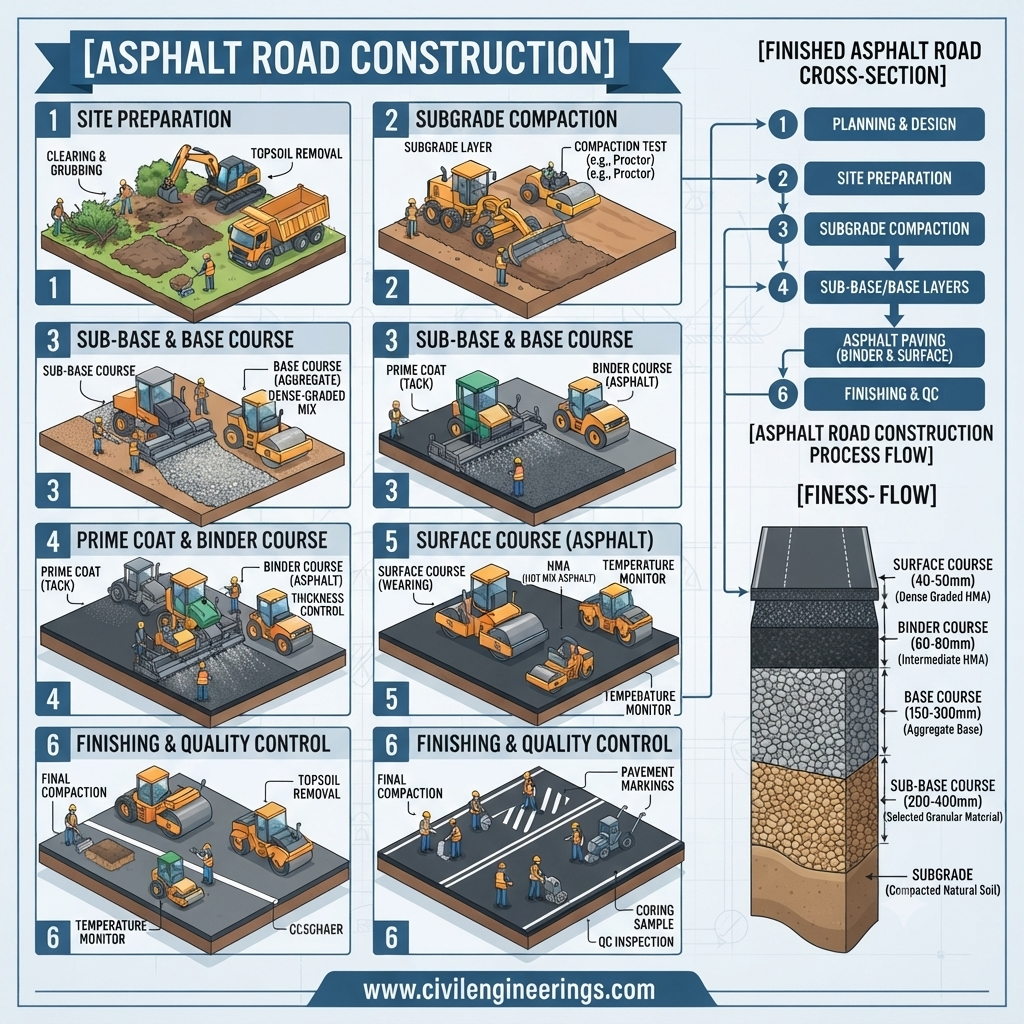
Step-by-Step Asphalt Road Construction Process
A successful asphalt pavement depends on proper execution at every stage. Even the highest-quality materials cannot compensate for poor construction practices. The following sequence represents the standard construction workflow adopted in most highway projects worldwide.
1. Site Preparation
Construction begins with clearing and grubbing the project area. Trees, vegetation, debris, unsuitable soil, and existing structures are removed to create a stable working platform.
Key activities include:
- Clearing vegetation and topsoil
- Removing unsuitable materials
- Excavation and embankment construction
- Utility relocation where required
- Temporary drainage arrangements
- Traffic management planning
A properly prepared site minimizes future settlement and ensures safe construction operations.
2. Earthwork and Subgrade Preparation
The subgrade forms the structural foundation of the pavement. Its performance directly affects the lifespan of the asphalt road.
Engineers evaluate:
- Soil classification
- Moisture content
- California Bearing Ratio (CBR)
- Field density
- Compaction level
- Bearing capacity
Weak soils may require stabilization using:
- Lime
- Cement
- Fly ash
- Geotextiles
- Geogrids
Compaction is carried out layer by layer until the specified density is achieved.
3. Construction of the Subbase
The subbase provides additional structural support and improves drainage.
Typical construction sequence:
- Material delivery
- Spreading using graders
- Moisture adjustment
- Compaction with vibratory rollers
- Surface trimming
- Quality testing
The finished surface should meet the required line, level, and cross slope before proceeding.
4. Base Course Construction
The base course carries a significant portion of traffic loading.
Common materials include:
- Wet Mix Macadam (WMM)
- Crushed aggregate base
- Asphalt-treated base
- Cement-treated base
Proper grading, moisture control, and compaction are essential to achieve the desired strength and stiffness.
5. Prime Coat Application
A prime coat is applied over granular base layers before placing asphalt.
Its primary functions are:
- Binding loose particles
- Reducing dust
- Improving adhesion
- Waterproofing the base surface
Bituminous emulsion or cutback bitumen is commonly used depending on project specifications.
6. Tack Coat Application
The tack coat creates a strong bond between successive asphalt layers.
Without proper bonding, slippage cracks and layer separation may occur.
The application rate depends on:
- Surface condition
- Existing pavement texture
- Binder type
- Climatic conditions
Uniform spraying is essential for effective bonding.
7. Asphalt Mixing
Modern asphalt plants produce highly controlled asphalt mixtures.
The manufacturing process includes:
- Aggregate drying
- Aggregate heating
- Screening
- Hot bin storage
- Bitumen heating
- Mixing
- Quality inspection
- Loading into insulated trucks
Plant operators continuously monitor:
- Aggregate gradation
- Mixing temperature
- Bitumen content
- Moisture
- Mixing time
8. Transportation of Asphalt Mix
Temperature loss during transportation can significantly affect compaction quality.
Best practices include:
- Using insulated dump trucks
- Covering loads with tarpaulins
- Minimizing haul distance
- Avoiding unnecessary delays
The mix should arrive at the paving site within the specified temperature range.
9. Asphalt Paving
An asphalt paver spreads the mix uniformly across the roadway.
The paver controls:
- Pavement width
- Layer thickness
- Surface smoothness
- Cross slope
- Initial compaction
Continuous paving minimizes cold joints and improves ride quality.
10. Compaction
Compaction is one of the most critical stages in Asphalt Road Construction.
Proper density improves:
- Strength
- Fatigue resistance
- Rutting resistance
- Moisture resistance
- Durability
Typical rolling sequence includes:
Breakdown Rolling
Performed immediately after paving using steel drum vibratory rollers.
Intermediate Rolling
Uses pneumatic tire rollers to improve density and close internal voids.
Finish Rolling
Steel rollers eliminate roller marks and produce a smooth surface.
Compaction should continue until the target field density specified by the project is achieved.
Major Equipment Used in Asphalt Road Construction
Common construction equipment includes:
- Excavators
- Bulldozers
- Motor graders
- Wheel loaders
- Asphalt batching plants
- Bitumen storage tanks
- Asphalt pavers
- Mechanical broom machines
- Water tankers
- Vibratory rollers
- Pneumatic tire rollers
- Tandem steel rollers
- Milling machines
- Road marking machines
Regular equipment calibration significantly improves pavement quality.
Quality Control and Quality Assurance
Quality assurance begins before construction and continues throughout the project.
Material Testing
Common laboratory tests include:
Aggregate Tests
- Sieve analysis
- Los Angeles abrasion
- Aggregate impact value
- Flakiness index
- Elongation index
- Water absorption
- Specific gravity
Bitumen Tests
- Penetration test
- Softening point
- Ductility
- Viscosity
- Flash point
- Fire point
- Elastic recovery
Asphalt Mix Tests
- Marshall Stability and Flow
- Bulk density
- Air voids
- Voids in Mineral Aggregate (VMA)
- Voids Filled with Bitumen (VFB)
- Indirect tensile strength
- Moisture susceptibility
Field Quality Tests
Site engineers routinely perform:
- Field density test
- Core cutting
- Thickness measurement
- Surface regularity
- Temperature monitoring
- Cross-fall measurement
- Level survey
- Smoothness evaluation
Maintaining comprehensive inspection records supports quality compliance and future maintenance planning.
Common Asphalt Pavement Failures
Understanding pavement distress helps engineers identify underlying problems before they become severe.
Rutting
Cause:
- Insufficient compaction
- Weak base
- Heavy traffic
- High temperatures
Solution:
- Improve mix design
- Increase compaction
- Strengthen pavement layers
Fatigue Cracking
Cause:
- Repeated traffic loading
- Thin pavement structure
- Weak support layers
Solution:
- Structural overlay
- Reconstruction
- Improved pavement design
Thermal Cracking
Cause:
- Temperature fluctuations
- Binder aging
Solution:
- Appropriate binder selection
- Crack sealing
- Preventive maintenance
Potholes
Cause:
- Water infiltration
- Traffic loading
- Delayed maintenance
Solution:
- Prompt patch repairs
- Drainage improvement
- Surface sealing
Ravelling
Cause:
- Binder aging
- Poor compaction
- Aggregate loss
Solution:
- Surface treatment
- Thin overlay
- Preventive maintenance
Maintenance of Asphalt Roads
A well-maintained pavement can remain serviceable for decades.
Routine maintenance includes:
- Crack sealing
- Surface patching
- Drain cleaning
- Shoulder maintenance
- Road marking renewal
- Surface rejuvenation
Periodic maintenance includes:
- Micro-surfacing
- Slurry sealing
- Thin overlays
- Milling and resurfacing
Preventive maintenance is generally more economical than major rehabilitation.
Sustainable Asphalt Road Construction
Sustainability has become a key objective in modern highway engineering.
Innovative practices include:
- Reclaimed Asphalt Pavement (RAP)
- Warm Mix Asphalt (WMA)
- Recycled aggregates
- Rubber-modified asphalt
- Plastic-modified bitumen
- Low-emission asphalt plants
- Energy-efficient construction equipment
These practices reduce material consumption, lower greenhouse gas emissions, and improve resource efficiency without compromising pavement performance.
Best Practices for Engineers and Contractors
- Conduct thorough geotechnical investigations before design.
- Select asphalt binders suitable for local climate conditions.
- Ensure proper drainage throughout the pavement structure.
- Maintain asphalt temperature from plant to placement.
- Compact each layer within the recommended temperature window.
- Calibrate construction equipment regularly.
- Perform routine laboratory and field quality tests.
- Keep detailed construction and inspection records.
- Address minor pavement defects before they develop into structural failures.
- Follow project specifications and internationally recognized standards at every stage.
International Standards and Guidance
Professional highway projects typically reference internationally accepted standards for design, testing, construction, and quality management.
IRC (Indian Roads Congress)
IRC publications provide comprehensive guidance on flexible pavement design, bituminous materials, construction specifications, pavement evaluation, maintenance, and highway drainage. They are widely used across India and several neighboring regions.
AASHTO (American Association of State Highway and Transportation Officials)
AASHTO standards are internationally recognized for mechanistic-empirical pavement design, traffic loading analysis (ESAL), asphalt binder performance grading, structural design, and pavement management systems. Many countries adapt these principles to suit local conditions.
ASTM International
ASTM standards establish globally accepted laboratory and field testing methods for aggregates, bitumen, asphalt mixtures, density, moisture susceptibility, and performance evaluation. They help ensure consistent material quality and reliable test procedures.
ICE (Institution of Civil Engineers)
ICE promotes engineering excellence through technical guidance, asset management principles, sustainability practices, and construction best practices. Its publications influence infrastructure projects throughout the United Kingdom and internationally.
EN and British Standards (BS)
European Standards (EN) and British Standards specify requirements for asphalt mixtures, aggregates, bitumen, factory production control, testing procedures, and construction tolerances. They support quality assurance and regulatory compliance across Europe.
Frequently Asked Questions (FAQs)
1. What is asphalt road construction?
Asphalt road construction is the process of building flexible pavements using aggregates, bitumen, and mineral fillers to create durable and smooth road surfaces.
2. Why is asphalt preferred over concrete for many roads?
Asphalt offers faster construction, easier maintenance, lower initial costs, smoother riding quality, and simpler rehabilitation compared to rigid concrete pavements.
3. What is the typical design life of an asphalt road?
Depending on traffic loading, environmental conditions, and maintenance practices, a properly designed asphalt pavement generally has a design life of 15–30 years before major rehabilitation.
4. What are the main layers of an asphalt pavement?
A typical pavement consists of the subgrade, subbase, base course, binder course, and wearing course.
5. Which laboratory tests are essential for asphalt quality?
Common tests include Marshall Stability, penetration, softening point, sieve analysis, Los Angeles abrasion, density, air voids, and moisture susceptibility.
6. Why is compaction so important?
Proper compaction increases density, improves structural strength, reduces permeability, and significantly extends pavement service life.
7. What causes potholes in asphalt roads?
Potholes usually develop because of water infiltration, repeated traffic loading, inadequate drainage, freeze-thaw cycles in cold climates, or delayed maintenance.
8. Can old asphalt be recycled?
Yes. Reclaimed Asphalt Pavement (RAP) can be processed and incorporated into new asphalt mixtures, reducing material costs and environmental impact.
9. Which international standards are commonly used?
Major standards include IRC, AASHTO, ASTM, EN/BS, and guidance published by the Institution of Civil Engineers (ICE), depending on regional requirements.
10. How can contractors improve pavement quality?
Contractors should use high-quality materials, maintain calibrated equipment, control asphalt temperatures, achieve specified compaction, perform regular quality testing, and follow approved construction specifications.
Conclusion
Asphalt Road Construction is a multidisciplinary engineering process that combines sound pavement design, high-quality materials, modern construction equipment, skilled workmanship, and rigorous quality control. Every stage—from site investigation and subgrade preparation to asphalt production, paving, compaction, and long-term maintenance—plays a critical role in determining pavement performance and service life.
Engineers, contractors, consultants, and government agencies should adopt internationally recognized standards such as IRC, AASHTO, ASTM, ICE, and EN/BS while adapting designs to local traffic conditions, climate, available materials, and environmental requirements. Combining these standards with effective drainage, preventive maintenance, and sustainable technologies such as recycled asphalt and warm mix asphalt leads to safer, more durable, and cost-effective road infrastructure.
For civil engineering students, mastering these principles builds a strong technical foundation. For practicing professionals, continuous learning, strict quality assurance, and adherence to engineering best practices are essential for delivering reliable pavements that serve communities for decades. Investing in quality during construction ultimately reduces lifecycle costs and ensures that asphalt roads continue to support economic growth and safe transportation.

Kamran Malik is a passionate civil engineering writer and researcher who specializes in construction, transportation, structural engineering, and infrastructure topics. Through his articles on CivilEngineerings.com, he simplifies complex engineering concepts and shares practical insights, industry trends, and educational resources for students, professionals, and engineering enthusiasts.