
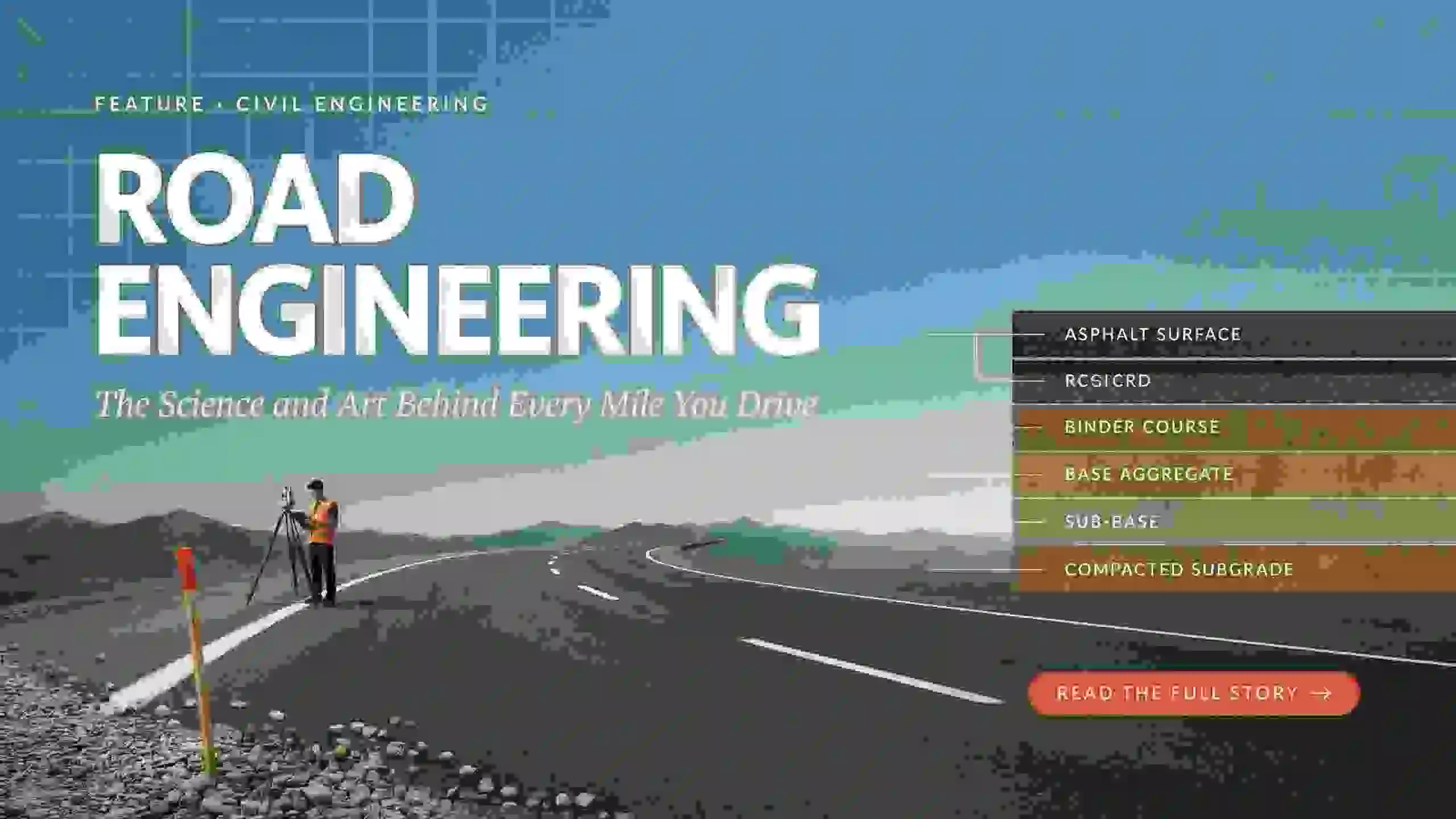
Every morning, millions of people climb into their cars, hop on motorcycles, or board buses without giving a second thought to the surface beneath their wheels. The road simply exists — smooth, reliable, and ready. But behind every kilometer of asphalt or concrete lies an extraordinary discipline that blends science, mathematics, geology, environmental planning, and human behavior into a single, functional strip of pavement. That discipline is road engineering.
Road engineering, also known as highway engineering, is a branch of civil engineering dedicated to the planning, design, construction, and maintenance of roads, highways, and other transportation infrastructure. It’s a field as old as civilization itself — and yet as modern as artificial intelligence and smart sensors. Understanding road engineering helps us appreciate not just how roads are built, but why they matter so deeply to economies, communities, and everyday life.
A Brief History of Road Engineering
The story of road engineering begins thousands of years ago. The Romans are arguably history’s most celebrated road builders. Their network of roads — stretching over 400,000 kilometers across Europe, North Africa, and the Middle East — was engineered with remarkable precision. Roman roads featured layers of compacted stone, gravel, and sand, crowned slightly in the middle to allow rainwater to drain off the edges. Many of these roads remained in use for centuries after the fall of the Roman Empire.
The 18th and 19th centuries brought new thinking. Scottish engineer John Loudon McAdam revolutionized road construction by arguing that a well-drained, compacted layer of small broken stones was sufficient to bear traffic — eliminating the need for large foundational stones underneath. His method, known as macadamization, formed the basis of modern road surfaces. Later, the addition of tar to bind these stones together produced what we now call tarmac.
The 20th century, with the rise of the automobile, transformed road engineering permanently. Speed, safety, traffic volume, and urban growth demanded roads of an entirely different scale and complexity — giving birth to expressways, freeways, and the sprawling highway systems we rely on today.
The Core Components of Road Engineering
1. Route Planning and Alignment
Before a single piece of earth is moved, road engineers spend considerable time on route selection and geometric alignment. This process involves identifying the most practical path between two points while minimizing cost, environmental disruption, and engineering challenges.
Horizontal alignment refers to how the road curves left or right when viewed from above. Engineers design curves with specific radii to ensure vehicles can navigate them safely at intended speeds. Sharp curves require either slower speed limits or additional design features like banking (superelevation) to counteract centrifugal forces.
Vertical alignment deals with the road’s profile — its rises and falls. Steep gradients strain engines and brakes, so engineers seek to balance cuts (removing earth from hills) with fills (depositing earth in valleys), keeping gradients within acceptable limits. The smooth transition between different gradients is achieved through vertical curves, calculated carefully so drivers have adequate sight distance at all times.
2. Soil Investigation and Geotechnical Analysis
A road is only as strong as the ground beneath it. Before design begins, engineers conduct extensive soil investigations — drilling bore holes, collecting samples, and analyzing the soil’s bearing capacity, moisture content, and behavior under load. Clay soils, for instance, can swell when wet and shrink when dry, making them particularly challenging subgrades. Sandy or loose soils may require stabilization through chemical treatment or replacement with better material.
Geotechnical data directly influences pavement thickness, foundation design, and drainage strategy. Ignoring this step is a recipe for premature road failure — something that costs governments and taxpayers enormously in repairs.
3. Pavement Design
Pavement is the engineered surface that carries vehicle loads and transfers them safely into the ground below. There are two main types:
Flexible Pavement (Asphalt): The most common road surface worldwide, flexible pavement consists of multiple layers — a surface course, a binder course, a base course, and a sub-base — all resting on the prepared subgrade. The term “flexible” refers to the pavement’s ability to bend slightly under load without cracking. The surface is made of bitumen (a petroleum product) mixed with aggregates like gravel and sand. It distributes traffic loads gradually through its layers down to the soil.
Rigid Pavement (Concrete): Used in heavy-traffic situations — airports, highways, and industrial areas — rigid pavement is made of Portland cement concrete slabs. Unlike flexible pavement, it distributes loads over a wide area due to the slab’s stiffness. Rigid pavements are more durable and require less frequent maintenance, though they cost more to construct and are harder to repair.
Pavement design is not guesswork. Engineers calculate the required pavement thickness based on anticipated traffic loads (measured in Equivalent Single Axle Loads, or ESALs), the strength of the subgrade (measured as California Bearing Ratio, or CBR), and the design life of the road — typically 20 to 30 years.
4. Drainage Engineering
Water is a road’s worst enemy. Poor drainage leads to weakened subgrades, pothole formation, surface cracking, hydroplaning hazards, and slope failures in embankments. Road engineers devote enormous attention to drainage design at every level.
Surface drainage is achieved through camber (the slight cross-slope of the road), roadside drains, kerbs, and culverts that channel water away from the pavement quickly. Subsurface drainage deals with groundwater that may rise into the pavement layers, using perforated pipes, drainage blankets, or filter materials to intercept and redirect it.
In hilly terrain, drainage design becomes even more critical. Inadequate culverts can lead to flooding that undermines embankments, causes landslides, and washes out roads entirely — a common and costly problem in regions with heavy monsoon rainfall.
5. Road Safety Engineering
A beautifully designed road that is unsafe is a failure. Road safety engineering is an integral part of the discipline, concerned with reducing the frequency and severity of accidents.
Key elements include sight distance (ensuring drivers can see far enough ahead to stop safely), appropriate speed design, road markings and signage, guardrails and crash barriers, junction and intersection design, pedestrian crossings, and lighting. Engineers use crash data, traffic behavior studies, and simulation models to identify hazardous locations — known as “black spots” — and design countermeasures.
Roundabouts, for example, have proven remarkably effective at reducing fatal accidents compared to signalized intersections, because they eliminate the most deadly collision types: high-speed right-angle crashes. Such insights come directly from road safety engineering research applied through design standards.
Types of Roads
Not all roads are created equal. Road classification systems vary by country, but generally follow a hierarchy:
Motorways and Expressways are the highest category — high-speed, limited-access roads designed for long-distance travel. They feature multiple lanes in each direction, grade-separated interchanges, wide medians, and no at-grade intersections. Engineering standards here are exacting: gentle curves, generous sight distances, sophisticated drainage, and high-quality pavement.
Arterial Roads carry significant traffic volumes between major zones within cities or between towns. They balance through movement with access to properties, and typically have traffic signals at major intersections.
Collector Roads gather traffic from local streets and feed it into arterials. They serve residential neighborhoods, schools, and commercial areas.
Local Roads form the finest mesh of the network — narrow, low-speed, designed primarily for access rather than movement.
Each category has its own geometric standards, pavement design requirements, and safety features, calibrated to the speeds, volumes, and purposes they serve.
Modern Challenges in Road Engineering
Environmental Sustainability
Road construction has a significant environmental footprint. Clearing land, quarrying aggregates, producing bitumen and cement, and operating heavy machinery all consume energy and generate emissions. Modern road engineering is grappling with how to reduce this impact.
Recycled asphalt pavement (RAP) is one solution — old asphalt is milled, processed, and reused in new pavement layers, reducing the need for virgin materials. Warm-mix asphalt technologies produce mixtures at lower temperatures, cutting fuel consumption and emissions. Engineers are also exploring the use of recycled plastic, fly ash, and other waste materials as road-building components.
Green infrastructure is increasingly integrated into road design — vegetated swales and bioretention basins manage stormwater naturally, wildlife crossings (tunnels or bridges) allow animals to cross roads safely, and tree-lined medians improve both aesthetics and air quality.
Climate Change Resilience
Rising temperatures, more intense rainfall events, and changing weather patterns are putting existing roads under stress and demanding new thinking in road design. Asphalt softens in extreme heat, leading to rutting and deformation — a problem already affecting roads in South Asia, the Middle East, and parts of Australia. Engineers are developing high-performance, heat-resistant binders to address this.
Flooding is becoming more frequent and severe in many parts of the world. Road drainage systems designed for historical rainfall patterns may be inadequate for the future. Updated engineering standards must account for climate projections, not just historical data.
Smart Roads and Technology Integration
The 21st century is bringing entirely new dimensions to road engineering. Smart roads embedded with sensors can monitor pavement condition, detect damage, measure traffic loads, and even charge electric vehicles wirelessly as they travel. Road surface monitoring systems using satellite data, drones, and AI can identify deterioration far earlier than traditional inspections, enabling proactive maintenance before major failure occurs.
Autonomous vehicles are also shaping road design. Self-driving cars may eventually reduce the need for wide lanes and complex signage, but in the transition period they require very consistent lane markings, clear road delineation, and reliable surface conditions — all engineering considerations.
Urban Roads and Mixed Mobility
As cities grow denser and the pressure to reduce car dependency increases, urban road engineering is shifting its focus. Streets are no longer designed solely for cars. Complete Streets design philosophy considers cyclists, pedestrians, public transit users, and people with disabilities equally. Protected bike lanes, wider footpaths, bus rapid transit corridors, and pedestrian plazas are transforming how urban roads function — requiring road engineers to think in terms of people movement rather than vehicle movement alone.
The Road Construction Process
Understanding how a road is built reveals the sheer scale of effort involved. In simplified form, the construction sequence runs as follows:
First comes site clearance — removing vegetation, topsoil, and any structures in the alignment. Then earthworks reshape the land to the designed profile: cutting through high ground and building embankments across low areas, compacting fill material in layers to achieve the required density.
Next, the subgrade is prepared and tested. Weak areas are stabilized or replaced. Then the sub-base layer is laid and compacted, followed by the base course. Each layer is tested for thickness, density, and bearing capacity before the next is placed.
Finally, the pavement surface is constructed — asphalt is mixed in a hot mix plant, transported to site in insulated trucks, spread by a paving machine to precise thickness, and compacted with heavy rollers while still hot. Line markings, signage, guardrails, drainage structures, and lighting complete the road.
The whole process for a major highway section can take months or years, involve hundreds of workers, and require extraordinary logistical coordination across materials, machinery, and quality control.
Road Maintenance: The Overlooked Imperative
Building a road is only the beginning. Maintenance is where most road agencies struggle — and where neglect has its most visible and costly consequences. Pavements deteriorate over time under the combined action of traffic, weather, and aging. Cracks develop, water infiltrates, potholes form, and if left unaddressed, the entire pavement structure can fail.
Preventive maintenance — sealing cracks, applying surface treatments, filling minor defects early — is far cheaper than rehabilitating a badly deteriorated road. Studies consistently show that a dollar spent on timely preventive maintenance saves several dollars in future reconstruction costs. Yet road maintenance budgets are often the first to be cut when governments face fiscal pressure, storing up enormous problems for the future.
Good road asset management — using data, inspection systems, and prioritization tools to allocate maintenance resources efficiently — is one of the most important areas of modern road engineering practice.
Road Engineering as a Career
For those drawn to problem-solving, outdoor work, and projects of visible public impact, road engineering offers a rewarding career. Highway engineers, geotechnical specialists, pavement designers, traffic engineers, drainage engineers, and road safety auditors all form part of the broader team that plans, builds, and maintains our road networks.
The field demands strong foundations in mathematics, physics, and applied mechanics, alongside skills in survey technology, design software (such as AutoCAD Civil 3D), project management, and environmental assessment. Increasingly, proficiency in data analysis, Geographic Information Systems (GIS), and AI tools is becoming valuable as the industry digitizes.
Above all, road engineers carry a profound responsibility. Their decisions affect millions of people — whether a family travels home safely, whether goods reach markets efficiently, whether a community stays connected through flood season. That weight of responsibility is also what makes the work meaningful.
Conclusion
Roads are so much more than asphalt and concrete. They are the arteries of modern civilization — enabling trade, mobility, social connection, and economic development. Behind every smooth highway and every safely-navigated curve lies the work of road engineers who have translated complex science into something people use without a second thought.
As our world faces the twin imperatives of sustainability and technological transformation, road engineering stands at an exciting crossroads. The roads of the future will be smarter, greener, and more inclusive than anything that has come before — not because the challenges are simpler, but because the engineers meeting those challenges are better equipped than ever.
Next time you drive, walk, or cycle down a road, take a moment to look at it differently. See the layers beneath the surface, the geometry in its curves, the intelligence in its drainage. See, in other words, the engineering.

Kamran Malik is a passionate civil engineering writer and researcher who specializes in construction, transportation, structural engineering, and infrastructure topics. Through his articles on CivilEngineerings.com, he simplifies complex engineering concepts and shares practical insights, industry trends, and educational resources for students, professionals, and engineering enthusiasts.